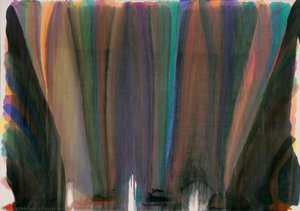
A Symphony of Color and Flow
In the vast landscape of mid-century modernism, few works capture the ethereal essence of movement quite like "Where" by Morris Louis. Created in 1960, this monumental masterpiece serves as a profound testament to the era of Abstract Expressionism, specifically the evolution into Color Field painting. At first glance, the viewer is met with a breathtaking vertical composition where elongated, rectangular forms of varying hues dance across the canvas. There is no traditional subject matter here—no figures to anchor the eye or landscapes to provide a sense of place. Instead, the artwork invites us into a purely sensory experience, where the interplay of light, pigment, and shape creates a rhythmic progression that feels both spontaneous and meticulously balanced.
The technique employed by Louis is nothing short of revolutionary. Utilizing acrylic resin on canvas, he achieved a unique texture and finish that allows colors to bleed and merge with a dreamlike fluidity. The painting features a striking arrangement of horizontal stripes in a vibrant palette—reds, blues, greens, yellows, oranges, and purples—that occasionally coalesce into a mesmerizing checkerboard pattern. This method creates a sense of depth and luminosity, as if the light is emanating from within the layers of paint itself. The soft edges and blended hues suggest a watercolor-like delicacy, yet the scale of the piece—a commanding 252 x 362 cm—imparts a powerful, physical presence that demands attention in any space.
The Legacy of Innovation
To understand "Where," one must look back to the transformative period of the 1940s and 1950s when Morris Louis emerged as a pivotal figure in the American art scene. Moving away from the heavy, gestural brushwork of early Abstract Expressionism, Louis pioneered a style that emphasized the inherent properties of paint and the flatness of the canvas. His discovery of Magna paint—an oil-based acrylic—allowed him to manipulate pigment with unprecedented freedom, leading to his famous "veil" paintings. In "Where," we see the culmination of this experimentation, where the artist rejects representational forms in favor of exploring the emotional resonance of pure color and geometric abstraction.
For the discerning collector or interior designer, this piece offers more than just visual splendor; it provides a focal point of profound serenity and contemplation. The harmonious color scheme and the rhythmic, linear progression of the forms evoke a sense of peace, making it an ideal centerpiece for sophisticated, contemporary environments. Whether placed in a grand gallery setting or a curated residential lounge, a high-quality reproduction of "Where" brings with it the historical weight of the Smithsonian American Art Museum's collection and the timeless allure of a movement that redefined the boundaries of modern art.



 معاينة الحجم الحقيقي
 اشترِ لوحة مرسومة يدويًا
 مشاركة
 مشاركة
 التفاصيل

 تحميل الملف
 قطع مشابهة
 الأشعة السينية
 عرض شرائح


 عرض المزيد






































 خيار الزجاج متاح فقط للمقاسات التي تقل عن 110 سم