Fernand Léger’s “The Baluster”: A Mechanical Dance of Form and Color
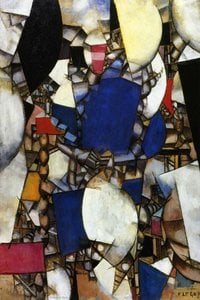
Fernand Léger's "The Baluster," painted in 1925, isn’t merely a depiction of an architectural element; it’s a vibrant manifesto of Cubism’s embrace of the modern world. This oil on canvas, currently residing within the esteemed collection of the Museum of Modern Art (MoMA) in New York City, pulsates with a dynamic energy born from the artist's unique synthesis of geometric abstraction and a fascination with industrial forms. Léger, a pivotal figure in the early 20th century’s artistic revolution, sought to translate the rhythms of the machine age – its angularity, its repetitive patterns, its sense of relentless motion – into a visual language that was both intellectually stimulating and emotionally resonant.
The painting immediately commands attention with its bold palette. A dominant blue background provides a striking contrast to the fiery reds, yellows, and oranges that dominate the central composition. This interplay of cool and warm tones isn’t simply decorative; it establishes a visual tension, mirroring the inherent dynamism within the artwork itself. Léger masterfully employs simplified geometric shapes – interlocking circles, rectangles, and stylized cylinders – to construct the balustrade, the very subject of the piece. These forms aren't rendered with meticulous detail but rather are presented in a deliberately abstracted manner, emphasizing their essential qualities over realistic representation.
The Roots of Cubism: Fragmentation and Multiple Perspectives
“The Baluster” firmly situates itself within the broader context of Cubism, a movement pioneered by Pablo Picasso and Georges Braque. Unlike earlier representational art that prioritized illusionistic depth and perspective, Cubism sought to dismantle traditional notions of space and representation. Léger’s approach, often referred to as “Tubism,” further developed this concept by reducing objects to their fundamental geometric components – cylinders, cones, and spheres – and presenting them from multiple viewpoints simultaneously. This fragmentation creates a sense of disorientation and invites the viewer to actively engage with the artwork, piecing together its meaning through observation.
The influence of Futurism is also palpable in Léger’s work. Like the Italian Futurist movement, which celebrated speed, technology, and dynamism, Léger sought to capture the essence of modern life – particularly the impact of industrialization on human experience. The painting's angular forms and sense of movement evoke the imagery of factories, trains, and other symbols of the machine age. However, unlike the often-aggressive aesthetic of Futurism, Léger’s approach is more restrained and contemplative, suggesting a nuanced understanding of both the promise and the potential anxieties associated with modernity.
Decoding the Symbolism: The Balustrade as Focal Point
The title itself – “The Baluster” – immediately draws our attention to the central element of the composition. Léger doesn’t simply depict a balustrade; he elevates it to a symbolic representation of stability, structure, and order within an increasingly chaotic world. The balustrade, traditionally associated with safety and protection, becomes a visual anchor amidst the swirling forms and vibrant colors. It represents a point of reference, a grounding element that provides a sense of equilibrium in the midst of dynamic energy.
Interestingly, Léger’s choice to depict a balustrade – a relatively mundane architectural feature – is itself significant. By focusing on an everyday object, he invites us to reconsider our perceptions of beauty and value. The painting suggests that even the most ordinary elements of our environment can be transformed into works of art through careful observation and creative interpretation.
A Legacy of Modernism: Léger’s Enduring Influence
“The Baluster” stands as a testament to Fernand Léger's innovative spirit and his profound impact on the development of modern art. His bold use of color, simplified forms, and exploration of industrial themes paved the way for subsequent generations of artists, including Pop Art pioneers like Andy Warhol. The painting’s enduring appeal lies in its ability to capture the energy and dynamism of the 20th century while simultaneously inviting viewers to contemplate the fundamental questions about perception, representation, and the relationship between art and life.
Reproductions of “The Baluster” continue to be highly sought after by collectors and interior designers alike. Its vibrant colors and dynamic composition make it a striking addition to any space, while its historical significance offers a glimpse into the artistic currents that shaped the modern world. A piece like this speaks volumes about the artist's vision and his place in art history.
الأسئلة والأجوبة
من هو الفنان الذي أبدع "The Baluster"؟
الفنان الذي أبدع عمل "The Baluster" هو فرناند ليجر. العمل مُدرج تحت اسم فرناند ليجر.
ما هي تقنية وتاريخ إنشاء "The Baluster" للفنان فرناند ليجر؟
تعتمد تقنية "The Baluster" للفنان فرناند ليجر على Acrylic On Canvas، ويعود تاريخ العمل إلى 1925.
ما هو حجم النسخة المطبوعة المقترح لـ "The Baluster" للفنان فرناند ليجر؟
يُقترح طباعة نسخة بحجم Medium لعمل "The Baluster" للفنان فرناند ليجر. ويمكن تعديل الحجم مع الحفاظ على التناسب.
ما هو تاريخ إبداع "The Baluster" للفنان فرناند ليجر؟
يعود تاريخ "The Baluster" إلى عام 1925، وهو تاريخ يضع العمل ضمن المسيرة المهنية لـ فرناند ليجر وفي سياق حقبته الزمنية.
ما مدى تناغم ألوان "The Baluster" للفنان فرناند ليجر؟
تُظهر ألوان "The Baluster" للفنان فرناند ليجر تناغماً Balanced Harmony. ويصف التناغم كيفية ترابط الألوان مع بعضها البعض.
ما هي المواد المستخدمة في صنع "The Baluster"؟
تعتمد التقنية المستخدمة في "The Baluster" للفنان فرناند ليجر على Acrylic On Canvas. وتهدف النسخ المطبوعة إلى محاكاة مظهر هذه التقنية.
في أي عمر أبدع فرناند ليجر لوحة "The Baluster"؟
أبدع فرناند ليجر لوحة "The Baluster" وهو في سن 44. وُلد الفنان في 1881 ويعود تاريخ هذا العمل إلى 1925.



 معاينة الحجم الواقعي
 اطلب نسخة مرسومة يدويًا
 إرسال
إرسال مشاركة
 عرض التفاصيل
 دليل الأعمال الفنية للطلاب

 تحميل
تحميل
 قطع مشابهة
 الأشعة السينية
 عرض شرائح متتابع
 الإحصائيات

 اقرأ المزيد






































 خيار الزجاج متاح فقط للمقاسات التي تقل عن 110 سم