The Fragrance of the Golden Age
In the heart of the Danish Golden Age, where light and shadow danced across the canvases of a nation finding its artistic voice, Johan Laurentz Jensen emerged as a master of the ephemeral. Born in Gentofte in 1800, Jensen did not merely paint flowers; he captured the very breath of nature. His journey began within the hallowed halls of the Danish Academy, where he studied under the legendary Christoffer Wilhelm Eckersberg. This foundational training, paired with the guidance of Cladius Detlev Fritzsch, instilled in him a precision that would later allow him to render the delicate textures of a petal with breathtaking realism. Yet, it was his pilgrimage to Paris that truly bloomed his talent. Immersed in the exquisite world of miniature flower painting at the Sèvres porcelain factory and mentored by the Flemish masters Gérard and Cornelis van Spaendonck, Jensen absorbed a sophisticated European elegance that he would eventually transplant back into Danish soil.
A Revival of Dutch Splendor
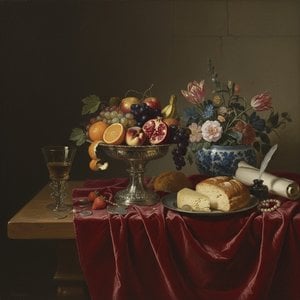
Jensen’s artistic soul was deeply rooted in the traditions of the seventeenth-century Dutch masters, yet his vision was entirely his own. He sought to revive the grandeur of floral still life in Denmark, creating works that were both decorative and profoundly symbolic. His technique relied on a masterful use of contrast; by placing vibrant, light-filled bouquets against dark, neutral backgrounds, he forced the viewer to confront the luminous intensity of each bloom. Whether it was a cluster of roses or a delicate arrangement of lilies, his compositions often featured a captivating tension between the familiar and the exotic. He would weave together local Danish flora with rare, imported species, sometimes even introducing the subtle presence of birds to complete the narrative of life and decay. In his hands, a simple vase on a marble ledge became a stage for a silent, beautiful drama of color and light.
A Lasting Impression in Porcelain and Paint
The influence of Jensen extended far beyond the canvas, permeating the very fabric of Danish decorative arts. As the head artist at the Royal Copenhagen porcelain factory, he brought his botanical precision to the world of ceramics, ensuring that his floral legacy was etched into the nation's most precious crafts. His studio was a place of both instruction and inspiration, attracting a wide circle of patrons and students, including notable figures such as Louise of Hesse-Kassel. Though his life was relatively brief, ending in 1856, the impact of his work remains undiminished. Today, his paintings serve as luminous windows into a bygone era, reminding us of a time when the meticulous study of a single blossom could capture the infinite complexity of the natural world.