Artist Biography
A Life Defined by the Frontier and the Brush
Elizabeth Simcoe stands as a luminous figure in the annals of colonial history, an artist whose delicate watercolors captured the raw, burgeoning spirit of Upper Canada. Born Elizabeth Posthuma Gwillim in 1762 in Aldwincle, Northamptonshire, her very name whispered a story of resilience; she was a posthumous child, arriving in the world on the same day her mother passed away. Orphaned at birth, her path was guided by the steady hands of her aunt and uncle, Margaret and Admiral Samuel Graves. It was within the refined atmosphere of the Graves’ Devon estate that Elizabeth received an education typical of a gentlewoman of her era, honing skills in music and drawing that would later serve as her primary lens for documenting a new world.
The trajectory of her life changed irrevocably when she met the Admiral’s godson, John Graves Simcoe. Their marriage in 1782 was not merely a union of hearts but a partnership of profound historical consequence. When John was appointed the first Lieutenant Governor of Upper Canada in 1791, Elizabeth did not remain behind the comforts of England; instead, she embarked on an odyssey across the Atlantic to witness the birth of a colony. This transition from the established landscapes of the United Kingdom to the untamed wilderness of North America provided the essential catalyst for her artistic evolution, transforming her from a skilled amateur into a vital chronicler of the Canadian frontier.
The Art of Observation and the Watercolor Legacy
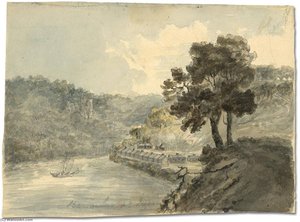
As she traversed the rugged terrains of York, later known as Toronto, Elizabeth Simcoe developed a visual language that was both topographical and deeply emotive. Her body of work, which includes over 595 watercolor paintings, serves as a breathtaking archive of a landscape in flux. Unlike the rigid, purely scientific illustrations often commissioned for colonial records, Simcoe’s approach possessed an almost Impressionistic quality. She possessed a rare ability to capture the fleeting nuances of light filtering through dense forests, the atmospheric haze over untamed coastlines, and the subtle shifts in weather that defined the Canadian wilderness.
Her technique was characterized by a meticulous attention to detail, likely influenced by her husband’s own expertise as a cartographer. While she documented the physical geography with precision, her brushstrokes often conveyed the profound sense of wonder and the daunting scale of the landscape. Her work went beyond mere scenery; she captured the pulse of daily life, sketching the early settlements, the interactions of diverse peoples, and the quiet dignity of the colonial struggle. Through her eyes, we see the transition of a wild territory into a structured society, rendered with a softness that belies the harshness of the environment she depicted.
A Lasting Historical and Artistic Significance
The true magnitude of Elizabeth Simcoe’s contribution lies in the intersection of her art and her intellect. Alongside her paintings, her meticulously kept diaries provide an unparalleled window into the social and cultural milieu of Upper Canada. These writings, paired with her visual records, offer a multidimensional perspective on the colonial experience, blending personal reflection with keen sociological observation. She was not merely a passive observer but an active participant in the narrative of a developing nation, using her art to interpret the complexities of settlement, diplomacy, and nature.
Today, Simcoe is celebrated as a pioneer of Canadian art. Her ability to transcend the boundaries of traditional female artistry of the nineteenth century—moving from the domestic sphere into the much more perilous and expansive realm of exploration—marks her as a trailblazer. Her legacy resides not only in the galleries that house her delicate watercolors but in the very historical identity of Canada itself. Through her enduring vision, the ephemeral moments of the late eighteenth century are preserved, allowing us to witness the dawn of a civilization through the eyes of a woman who saw beauty in the midst of the unknown.



 Preview
 Switch to Print
 Send
Send Share
Share
 Details

 Download
 Similars
 X-Ray
X-Ray Diaporama

 Read More






































 Glass option is only available in size under 110 CM