


x


Hand-painted oil on canvas in your size and frame, made to order by our artists.





























Pick from our preset sizes that match the artwork's original proportions.

You may enter your own dimensions to fit a specific frame or space. If your selected size does not match the original image's proportions, we will either crop the artwork or extend the painting with additional hand-painted elements. A digital mockup will be sent for your approval before production begins.
Please note that the on-screen preview does not reflect the actual cropping or extension. Only the mockup will accurately show the final composition.
While custom sizes are available, we recommend selecting a dimension from the predefined list to preserve the original proportions.
Worldwide Delivery () in 3/4 weeks instead of standard 5 weeks. (7 July). No compromise on quality.


Polyptic with Saints -\n\nSaints Sebastian and Paul the Apostle
Reproduction Size
In the quiet sanctity of the late 15th century, Francesco Morone captured a moment of profound spiritual intersection in his masterpiece, Polyptych with Saints Sebastian and Paul the Apostle. This evocative work serves as a window into the Renaissance soul, where the earthly and the divine collide through the figures of two iconic saints. The composition is anchored by a striking visual tension; on one side, we encounter the stoic presence of Saint Paul, often identified by his scholarly attributes, while the other features the martyred Saint Sebastian. The interplay of light and shadow across their forms creates a sense of living breath, pulling the viewer into a sacred dialogue that transcends the boundaries of time and canvas.
The artistry of Morone is displayed through a masterful command of color and contrast. A vibrant, crimson robe drapes over one figure, acting as a visual heartbeat against the pristine, ethereal white of the other. This deliberate use of primary tones does more than please the eye; it symbolizes the dual nature of Christian martyrdom—the passion and blood of sacrifice contrasted with the purity and light of spiritual triumph. As the figures gaze upward, their eyes fixed on an unseen celestial glory, the viewer is invited to share in their devotion, making the painting not merely a subject for observation, but an experience of transcendence.
Born into the rich artistic lineage of Verona, Francesco Morone brought a sophisticated technical precision to this polyptych that reflects his deep engagement with both Venetian colorism and humanist detail. The painting is characterized by its intricate layering, where the artist meticulously builds depth through fine brushwork. Notice the delicate rendering of the books—symbols of wisdom and the Word—which ground the spiritual figures in the intellectual tradition of the Renaissance. The background, far from being a mere backdrop, is a rich tapestry of detail that provides a sense of atmospheric perspective, enveloping the saints in a world that feels both physically tangible and spiritually vast.
For the discerning collector or interior designer, this piece offers an unparalleled opportunity to introduce a sense of historical gravity and classical elegance into a space. The composition’s balance and the rhythmic movement of the figures make it a versatile centerpiece, capable of anchoring a room with its profound emotional weight. Whether placed in a sunlit gallery or a more intimate study, the Polyptych with Saints Sebastian and Paul the Apostle radiates a timeless prestige. Owning a high-quality reproduction of this work is an invitation to surround oneself with the enduring beauty of the Italian Renaissance, fostering an environment of contemplation, sophistication, and awe.


Francesco Morone (c. 1471 – May 16, 1529) stands as a pivotal figure within the artistic landscape of 15th-century Verona, a city renowned for its rich cultural heritage and burgeoning Renaissance spirit. His life’s work, largely centered around his native city, reveals a trajectory marked by apprenticeship, independent development, and a profound engagement with both traditional Venetian styles and emerging humanist ideals. Born into a family deeply rooted in the Veronese art world – his father, Domenico Morone, was himself a respected painter – Francesco inherited not only artistic talent but also a legacy of craftsmanship and a connection to established artistic networks. His story is one of gradual emancipation from his father’s shadow, culminating in a distinctive style that secured him a place among the most significant artists of his time.
Early life details surrounding Morone are somewhat fragmented, relying heavily on accounts from contemporaries like Vasari and other art historians. He was born into a family of painters, with his father Domenico Morone being a prominent figure in Verona’s artistic scene. Domenico's workshop served as Francesco’s initial training ground, where he likely absorbed fundamental techniques and developed an understanding of the prevailing artistic trends of the era. Crucially, he also formed a lasting friendship and collaborative relationship with Girolamo dai Libri, a fellow artist who profoundly influenced his development. This partnership fostered a dynamic exchange of ideas and styles, contributing to Morone’s evolving artistic vision.
Francesco's early career was largely defined by his apprenticeship under his father, Domenico Morone. This period involved assisting in the completion of various commissions, gaining invaluable experience in fresco painting, panel painting, and altarpiece decoration. While Domenico’s style leaned towards a more conservative, Mantegna-influenced approach, Francesco gradually began to assert his own artistic voice. A significant milestone in this process was his 1496 collaboration with his father on the altarpiece for the Sanctuary of the Madonna delle Grazie in Arco – a work that marked his first independent signature and signaled a departure from purely familial influence. This piece, though initially viewed as largely shaped by Domenico’s hand, demonstrated Francesco's nascent ability to create compelling compositions and imbue them with emotional depth.
Further evidence of this burgeoning independence emerges in 1498, when he signed his own independent work: a Crucifixion for the Avanzi Chapel of the Church of San Bernardino in Verona. This painting is considered a pivotal moment, representing Francesco’s transition from assistant to recognized artist. The work showcases a more dynamic and expressive approach compared to his father's style, hinting at the influences he was absorbing from Venetian artists like Giovanni Bellini and the emerging humanist ideals that were shaping Renaissance art across Italy.
Morone’s most celebrated works are undoubtedly his frescoes decorating the sacristy of Santa Maria in Organo, Verona. Completed between 1505 and 1507, these panels represent a culmination of his artistic development and a testament to his skill as a fresco painter. The cycle depicts scenes from the lives of Christ and the Virgin Mary, rendered with remarkable detail, vibrant colors, and a profound sense of spirituality. Vasari famously lauded these frescoes as “the most beautiful… that there was in all Italy,” recognizing their technical mastery and emotional resonance. The figures are imbued with a palpable humanity, reflecting Morone’s growing ability to capture psychological nuance and convey complex emotions.
Beyond the sacristy frescoes, Morone produced several significant works throughout his career, including the decoration of the Sagramoso Library in the San Bernardino convent (1502-1504), a testament to his versatility. His later works, such as the 1517 depiction of Saint Francis, demonstrate a shift towards a more contemplative and melancholic style, possibly influenced by his personal circumstances and the prevailing religious climate of the time. His final paintings are characterized by a quiet dignity and a profound sense of spirituality.
Morone’s artistic development was shaped by a complex interplay of influences. His early training under Domenico Morone exposed him to the Mantegna-influenced style prevalent in Verona, while his collaboration with Girolamo dai Libri broadened his horizons and introduced him to new techniques and perspectives. The Venetian school of painting – particularly the works of Giovanni Bellini – exerted a significant impact on his color palette and compositional approach. Furthermore, Morone’s work reflects the broader humanist ideals that were transforming Renaissance art, emphasizing human emotion, narrative clarity, and a renewed interest in classical antiquity.
Francesco Morone's legacy is firmly rooted in Verona. His frescoes continue to captivate viewers with their beauty and emotional depth, while his paintings serve as invaluable examples of 15th-century Veronese art. He remains an essential figure in the history of Italian Renaissance painting, a testament to the enduring power of artistic skill, innovation, and personal expression.

1471 - 1529

Journey through Paul Klee's 25 most iconic paintings & prints. Explore his abstract style, Bauhaus influence, and vibrant color palettes. Find museum-quality art reproductions & decor ideas at WahooArt.com. Discover all masterpieces online.

Journey through 25 iconic artworks by Paul Cézanne – a master of Impressionism and Post-Impressionism. Explore his landscapes, still lifes, and the stories behind these timeless masterpieces. Discover museum-quality reproductions & curated decor at WahooArt.com.
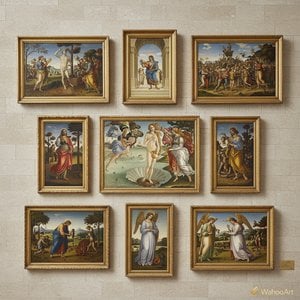
Journey through the Early Renaissance! Explore 10 iconic paintings by Botticelli, Leonardo da Vinci & Michelangelo. Discover their stories, techniques & lasting impact. Find museum-quality art reproductions and elevate your home decor with .

Journey through the Italian Renaissance with 10 iconic masterpieces by Leonardo da Vinci, Michelangelo & Raphael. Explore art history, techniques & timeless beauty. Find museum-quality reproductions and elevate your home decor on .
Journey through Alte Pinakothek's 25 most iconic paintings! Explore masterpieces by Dürer, Rembrandt & Rubens. Discover art history, techniques & find museum-quality reproductions for your home at WahooArt.com.


Stay updated with the latest art news, exclusive offers, and decoration ideas.
Tell us about your project and our art experts will provide you with 3 personalized art suggestions.
Let Us Curate 3 Options Just for You - Free!
 Buy print
 Send
Send Share
Share
 Details

 Download
 Similars
 X-Ray
X-Ray Diaporama


 Read More







 Glass option is only available in size under 110 CM


