

 Acrylic On CanvasWallArtNorthern Renaissance
 1521
1521 399.0 x 287.0 cm
 British Museum
Hand-painted oil on canvas in your size and frame, made to order by our artists. ( Switch to Print Switch to Digital Image)





























Pick from our preset sizes that match the artwork's original proportions.

Type the width and the height you need, to fit your frame or your wall. This is hand-painted, so for a size with a different shape the artist can paint a bit more around the picture, or cut a bit — you choose. We send you a digital mockup to approve before the painting starts. The picture shown on this page does not show the real result — only the mockup does.
Worldwide Delivery () in 3/4 weeks instead of standard 5 weeks. (17 October). No compromise on quality.
Christian II of Denmark
Reproduction Size
Albrecht Dürer's “Christian II of Denmark,” painted in 1521, is more than simply a likeness; it’s a carefully constructed tableau of power, piety, and the anxieties of a turbulent era. This monumental portrait, measuring an impressive 399 x 287 cm, immediately commands attention with its arresting realism and the subtly complex expression etched onto the face of the Danish king. Dürer, already establishing himself as a leading figure in the German Renaissance, masterfully utilizes oil on panel to capture not just the physical appearance of Christian II but also, arguably, his inner state – a man grappling with political instability and the looming shadow of impending defeat.
The subject himself, Christian II, was a formidable yet ultimately tragic figure. He ascended to the Danish throne in 1489, inheriting a kingdom riddled with debt and internal strife. His reign was marked by ambitious military campaigns, particularly against Norway, which ultimately proved disastrous. Dürer’s portrait reflects this duality – the regal bearing, the carefully chosen attire, all speak of authority and leadership, yet the subtle downturn of the mouth and the intensity in his gaze hint at a man burdened by responsibility and facing an uncertain future. The meticulous detail of his beard and mustache, hallmarks of Dürer's skill, draws the viewer’s eye to these expressive features, amplifying the sense of psychological depth.
Dürer’s technical prowess is immediately evident in every brushstroke. The painting showcases his mastery of sfumato – a subtle blurring of lines and colors that creates an atmospheric effect, softening the edges and lending a sense of depth to the portrait. Notice how he renders the texture of the velvet robes, the sheen on the gold embellishments, and the delicate folds of the fabric with astonishing accuracy. This level of detail wasn’t merely decorative; it served to elevate Christian II's status, suggesting wealth, power, and refinement. The composition itself is carefully balanced, drawing the eye from the king’s face – the focal point – across his elaborate attire and into the subtly rendered background.
Beyond the portrait’s immediate visual appeal, “Christian II of Denmark” is laden with symbolic meaning rooted in the political and religious climate of 16th-century Europe. The king's attire – particularly his elaborate fur trim and the prominent display of jewels – speaks to his wealth and status, but also subtly alludes to the extravagance that contributed to Denmark’s financial woes. The background, though somewhat indistinct, likely represents a stylized depiction of Christiania (now Copenhagen), the capital city, further anchoring the portrait within its historical context. The inclusion of elements suggestive of royal authority – perhaps subtle references to heraldry or state symbols – would have been carefully considered by Dürer and his patron.
Furthermore, the painting reflects the broader anxieties surrounding the Reformation, which was gaining momentum across Europe at this time. Christian II’s reign coincided with a period of religious upheaval, and the portrait can be interpreted as a subtle commentary on the challenges faced by rulers attempting to maintain control in an era of shifting loyalties and growing dissent.
WahooArt is proud to offer meticulously crafted hand-painted reproductions of Albrecht Dürer’s “Christian II of Denmark.” Our artists, trained in the finest traditions of art decoration and historical painting, painstakingly recreate every detail of this iconic portrait, ensuring that you receive a faithful representation of Dürer's original masterpiece. Whether displayed as a statement piece in a grand hall or incorporated into a sophisticated interior design scheme, this reproduction captures not only the visual beauty but also the profound emotional resonance of this remarkable work. Invest in a piece of art history – order your hand-painted reproduction today.**
The creation of "Christian II of Denmark" by Albrecht Dürer is dated 1521.
"Christian II of Denmark" belongs to the Mature Period of Albrecht Dürer's career. This classification relates the work to the artist's development.
In terms of perceived brightness, "Christian II of Denmark" by Albrecht Dürer is bright.

Albrecht Dürer, a name synonymous with the German Renaissance, emerged from the bustling artisan city of Nuremberg in 1471. His father, Albrecht Dürer the Elder, was a successful goldsmith who had immigrated from Hungary, bringing with him a lineage steeped in craftsmanship. It was within this environment—the scent of metal and the meticulous precision of handiwork—that young Albrecht’s artistic inclinations first took root. Though his father envisioned a similar path for him, apprenticing him initially in the family trade, it soon became undeniable that Albrecht possessed an exceptional gift for drawing. At thirteen, he transitioned to the workshop of Michael Wolgemut, Nuremberg's leading artist at the time. This was no mere technical training; it was immersion into a world of illuminated manuscripts, painted panels, and—crucially—the burgeoning art of woodcut illustration. The sheer volume of work produced by Wolgemut’s workshop, including the extensive illustrations for the *Nuremberg Chronicle*, provided Dürer with an unparalleled foundation in design, composition, and the mechanics of image-making. A remarkable silverpoint self-portrait from 1484, created when he was barely a teenager, stands as astonishing evidence of his precocious talent—a testament to a burgeoning artistic identity already taking shape.
Dürer’s ambition extended far beyond the confines of Nuremberg. Driven by an insatiable curiosity and a desire to master the art of painting, he embarked on his first journey to Italy in 1494. This was not simply a sightseeing trip; it was a pilgrimage to the heart of the Renaissance. He encountered the works of masters like Raphael, Giovanni Bellini, and Leonardo da Vinci—artists who were redefining the possibilities of form, perspective, and human expression. The impact of this exposure was profound. Dürer absorbed the classical motifs, harmonious compositions, and subtle sfumato techniques that characterized Italian art, yet he never abandoned his Northern European sensibility for meticulous detail and symbolic depth. A second sojourn to Italy between 1505 and 1507 further solidified these influences, allowing him to study ancient Roman ruins and refine his understanding of anatomy and proportion. This synthesis of Northern precision and Italian grace became the hallmark of Dürer’s unique artistic style.
Dürer was a master of multiple mediums, each offering him distinct avenues for creative expression. His paintings, though fewer in number than his prints, demonstrate a remarkable command of oil paint and an ability to capture both physical likeness and psychological depth. Works like the *Feast of the Rose Garlands* reveal a vibrant palette influenced by Venetian colorism. However, it was in the realm of printmaking—particularly engraving and woodcut—that Dürer truly revolutionized artistic practice. He elevated these techniques from mere reproductive methods to independent art forms, capable of conveying complex narratives and profound emotions. The *Apocalypse* series (1498), a collection of fourteen woodcuts illustrating the Book of Revelation, showcased his mastery of this medium despite its inherent limitations. Later engravings like *Melencolia I* (1514) and *Saint Jerome in His Study* (1514) are testaments to his unparalleled skill—intricate compositions filled with symbolic meaning and executed with breathtaking precision. He didn’t just depict reality; he imbued it with layers of intellectual and spiritual significance.
Dürer was not merely an artist; he was a scholar, a theorist, and an innovator who sought to understand the underlying principles governing artistic creation. He believed in the mathematical foundations of art and dedicated himself to establishing a scientific approach to representation. His treatises on geometry, proportion, and human anatomy—most notably *Four Books of Human Proportion* (1528)—were groundbreaking for their time, demonstrating his commitment to rigorous observation and rational analysis. These writings were not simply academic exercises; they were intended to elevate the status of artists from mere craftsmen to intellectual practitioners. Dürer’s legacy extends far beyond his individual artworks. He bridged the gap between Northern European traditions and Italian Renaissance ideals, introducing classical motifs into Northern art while maintaining its distinctive character. His theoretical contributions helped establish a new framework for artistic practice, inspiring generations of artists with his technical skill, innovative spirit, and profound vision. He remains, to this day, one of the most important figures in the history of Western art.
Dürer’s influence reverberates through centuries of art history. His meticulous realism, his innovative use of printmaking, and his theoretical writings continue to inspire artists and scholars alike. He demonstrated that art could be both technically masterful and intellectually rigorous—a legacy that continues to shape the artistic landscape today. His work stands as a testament to the power of observation, the pursuit of knowledge, and the enduring human desire to create beauty and meaning.

1471 - 1528 , Italy

Explore the life & art of Albrecht Dürer, a pivotal German Renaissance master. Discover his groundbreaking printmaking techniques, iconic self-portraits, and lasting influence on Western art history. A deep dive into innovation & symbolism.

Explore the captivating world of Francis Sartorius II (1734-1804), a leading British painter renowned for his exquisite equestrian portraits and hunting scenes. Discover his life, techniques & enduring legacy.

Journey through 25 iconic artworks at the British Museum, London! Explore masterpieces from Egyptian sculptures to Renaissance paintings & uncover their stories. Find museum-quality art reproductions and curated decor ideas on WahooArt.com.
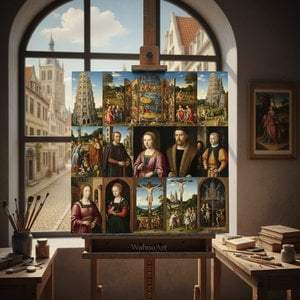
Journey through the Northern Renaissance! Explore 10 iconic paintings by Jan van Eyck, Dürer & Bosch. Discover their stories, techniques & lasting impact. Find museum-quality art reproductions & elevate your home decor on .
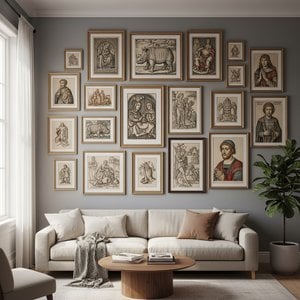
Explore 25 iconic artworks by Albrecht Dürer, a master of the German Renaissance. Discover the stories behind Melencolia I, Knight Death and Devil & more. Find museum-quality art reproductions for your home at WahooArt.com.

 Preview
 Send
Send Share
Share
 Details
 Guide
Guide

 Download
 Similars
 X-Ray
X-Ray Diaporama
 Stats
Stats Read More









 Glass option is only available in size under 110 CM


