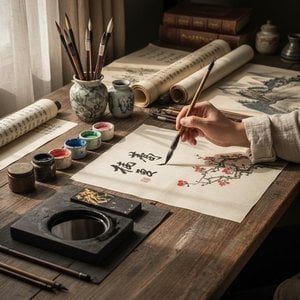
Artist Biography
A Legacy Etched in Ink: The Life and Art of Wang Hui
Wang Hui, born in 1632 in Changshu, China, emerged during a period of immense transition—the waning years of the Ming dynasty and the rise of the Qing. He wasn’t merely an artist; he was a cultural custodian, a master calligrapher wielding brush and ink to preserve and reinterpret centuries of Chinese landscape tradition. His family's deep roots in artistic practice laid the foundation for his exceptional talent. From a young age, Wang Hui absorbed the techniques passed down through generations, but it was his formal tutelage under Wang Jian and later, Wang Shimin, that truly shaped his trajectory. These mentors instilled within him not just technical proficiency, but an unwavering dedication to the study of ancient masters—a practice that would define his career and, for a time, invite both admiration and criticism.
The Four Wangs and the Orthodox Tradition
Wang Hui is most prominently known as one of the “Four Wangs”—a quartet of artists who dominated orthodox art during the late Ming and early Qing periods. This group—comprising Wang Hui, Wang Jian, Wang Shimin, and Wang Yuanqi—championed a conservative aesthetic rooted in the styles of earlier dynasties, particularly the Song and Yuan. While some viewed this as an adherence to tradition stifling innovation, it was, in reality, a deliberate attempt to maintain cultural continuity amidst political upheaval. Wang Hui’s mastery lay in his ability to synthesize these disparate historical influences into works that felt both deeply familiar and uniquely his own. He didn't simply copy; he *reimagined*, breathing new life into the landscapes of Li Cheng, Huang Gongwang, and others. This dedication to copying wasn’t seen as a lack of originality at the time but rather as an act of reverence and scholarly pursuit—a way to understand the very essence of Chinese landscape painting.
Technique and Style: A Dialogue with the Past
Wang Hui's paintings are characterized by their meticulous detail, atmospheric depth, and serene compositions. He excelled in *shan shui* (mountain-water) painting, a genre that sought not merely to depict scenery but to capture the spiritual essence of nature. His brushwork is remarkably varied—from bold, expressive strokes defining rocky cliffs to delicate washes creating mist-shrouded valleys. He was a master of layering textures and employing subtle tonal variations to evoke a sense of distance and depth. However, what truly sets his work apart is its intellectual complexity. Each painting is a conversation with the past, subtly referencing earlier masters while simultaneously forging a distinct artistic voice. Critics noted a “nostalgic attachment to classical Chinese aesthetics” in his work—a quality that stemmed from his deep immersion in historical styles. He wasn’t interested in portraying nature as he *saw* it, but rather as it had been *imagined* and represented by the great artists who came before him.
Major Achievements and Lasting Influence
Throughout his career, Wang Hui produced a vast body of work—handscrolls, album leaves, and individual paintings that showcased his unparalleled skill. In 1698, he received the imperial encomium “Landscapes Clear and Radiant,” solidifying his reputation as the foremost landscape painter of his time. Works like "A Thousand Peaks and Myriad Ravines" (1693) exemplify his ability to create monumental landscapes filled with intricate detail and atmospheric perspective. His paintings were highly sought after by collectors, and he played a crucial role in shaping the aesthetic preferences of the Qing court. The 2008 exhibition “Landscapes Clear and Radiant: The Art of Wang Hui (1632-1717)” at the Metropolitan Museum of Art—featuring loans from major museums in Beijing, Shanghai, and Taipei—testified to his enduring legacy.
A Complex Legacy
Wang Hui’s historical significance lies not just in his technical brilliance but also in his role as a cultural bridge between eras. He helped preserve the traditions of Chinese landscape painting during a period of profound change, establishing stylistic foundations that would influence generations of artists. While later critics sometimes dismissed his work as conservative or derivative, modern scholarship recognizes him as a master innovator—an artist who synthesized historical influences with remarkable skill and created paintings that are both deeply rooted in tradition and uniquely expressive. His landscapes continue to captivate viewers today, offering a glimpse into the spiritual heart of Chinese art and a testament to the enduring power of artistic dialogue with the past.


 Preview
 Send
Send Share
Share
 Details
 Guide
Guide

 Download
 Similars
 X-Ray
X-Ray Diaporama
 Q&A
Q&A Stats
Stats


 Read More
 Switch to Print





































 Glass option is only available in size under 110 CM