Paris. Private event (1906) by Mariano Fortuny, hand-painted oil painting reproduction by a master artist
Preview AR preview Switch to Print Switch to Digital Image Send
Details Guide Add to favorites Download Similars X-Ray Diaporama Q&A Presentation Stats

Paris. Private event Hand-painted oil painting reproduction

Dimensions
9.0 x 12.0 cm

A captivating black & white photograph by Mariano Fortuny of "Paris. Private event," depicting a stage scene with figures and a draped sheet, capturing the elegance of a historic theatrical gathering.

A visionary of textile and stage design, Mariano Fortuny created the iconic Delphos gown. Discover his exquisite patterns and designs today.

Hand Made Oil Reproduction

Hand-painted oil on canvas in your size and frame, made to order by our artists. ( Switch to Print Switch to Digital Image)


Corner sample of the P118B picture frame: moulded polystyrene, 5 cm wide and 3 cm thick
P118B $10
Corner sample of the P118H picture frame: moulded polystyrene, 5 cm wide and 3 cm thick
P118H $10
Corner sample of the P118W picture frame: moulded polystyrene, 5 cm wide and 3 cm thick
P118W $10
Corner sample of the P438Z picture frame: moulded polystyrene, 5.5 cm wide and 3.5 cm thick
P438Z $10
Corner sample of the P508JH picture frame: moulded polystyrene, 7 cm wide and 3.5 cm thick
P508JH $12
Corner sample of the P508YH picture frame: moulded polystyrene, 7 cm wide and 3.5 cm thick
P508YH $12
Corner sample of the P805H picture frame: moulded polystyrene, 5 cm wide and 3.5 cm thick
P805H $10
Corner sample of the P805Z picture frame: moulded polystyrene, 5 cm wide and 3.5 cm thick
P805Z $10
Corner sample of the P919BZ picture frame: moulded polystyrene, 7 cm wide and 3.5 cm thick
P919BZ $10
Corner sample of the P919G picture frame: moulded polystyrene, 7 cm wide and 3.5 cm thick
P919G $10
Corner sample of the P919XJ picture frame: moulded polystyrene, 7 cm wide and 3.5 cm thick
P919XJ $10
Corner sample of the P959ZH picture frame: moulded polystyrene, 5 cm wide and 3 cm thick
P959ZH $10
Corner sample of the P968JZ picture frame: moulded polystyrene, 6 cm wide and 4 cm thick
P968JZ $12
Corner sample of the W106C picture frame: solid wood, 5 cm wide and 3 cm thick
W106C $8
Corner sample of the W218G picture frame: solid wood, 5 cm wide and 3 cm thick
W218G $10
Corner sample of the W218JH picture frame: solid wood, 5 cm wide and 3 cm thick
W218JH $8
Corner sample of the W218Y picture frame: solid wood, 5 cm wide and 3 cm thick
W218Y $10
Corner sample of the W307PJ picture frame: solid wood, 6 cm wide and 3 cm thick
W307PJ $10
Corner sample of the W316G picture frame: solid wood, 6 cm wide and 3 cm thick
W316G $10
Corner sample of the W316PJ picture frame: solid wood, 6 cm wide and 3 cm thick
W316PJ $8
Corner sample of the W316Y picture frame: solid wood, 6 cm wide and 3 cm thick
W316Y $10
Corner sample of the W398PJ picture frame: solid wood, 5 cm wide and 3 cm thick
W398PJ $8
Corner sample of the W4111J picture frame: solid wood, 6.5 cm wide and 3.5 cm thick
W4111J $10
Corner sample of the W500HY picture frame: solid wood, 7 cm wide and 5 cm thick
W500HY $15
Corner sample of the W500JH picture frame: solid wood, 7 cm wide and 5 cm thick
W500JH $15
Corner sample of the W692G picture frame: solid wood, 8 cm wide and 4 cm thick
W692G $12
Corner sample of the W849H picture frame: solid wood, 5 cm wide and 3 cm thick
W849H $8
Corner sample of the W940BG picture frame: solid wood, 7.5 cm wide and 4.5 cm thick
W940BG $15
Corner sample of the W953PJ picture frame: solid wood, 6 cm wide and 3.5 cm thick
W953PJ $8

Standard
custom
CM
INCH

Pick from our preset sizes that match the artwork's original proportions.

width
height

Type the width and the height you need, to fit your frame or your wall. This is hand-painted, so for a size with a different shape the artist can paint a bit more around the picture, or cut a bit — you choose. We send you a digital mockup to approve before the painting starts. The picture shown on this page does not show the real result — only the mockup does.

Examples of what can be changed: Replace face with customer photo; Add pet (e.g., replace cat with dog); Include hidden message in background; Change background landscape or elements.
After order, WahooArt.com team will email client for instructions and provide a mockup preview

Worldwide Delivery () in 3/4 weeks instead of standard 5 weeks. (21 November). No compromise on quality.

Free Worldwide Express Shipping
High-Quality Linen Canvas
Full Shipping Insurance
Customs Tax Refund Guarantee
True Color Matching Guarantee
100-Day Return Policy (Defects Only)
100% Money-Back Guarantee
Bulk Discount Offer

Total Price

$ 272

Paris. Private event

Reproduction Medium

Reproduction Size

-

Total Price

$ 272

Quick Facts

  • Year: 1906
  • Medium: Photograph
  • Artist: Mariano Fortuny
  • Influences: Fortuny
  • Location: Museum Database

Art Quiz

There is only one correct answer for each question.

Question 1:
What is the primary subject depicted in Mariano Fortuny’s ‘Paris. Private event’?
Question 2:
In what year was ‘Paris. Private event’ painted?
Question 3:
The painting 'Paris. Private event' is based on a performance at which location?
Question 4:
Mariano Fortuny was primarily known for his work in which field?
Question 5:
What technique is most prominently used to create the illusion of depth and space in ‘Paris. Private event’?

The Stage of Dreams: Mariano Fortuny’s “Paris. Private Event”

Mariano Fortuny’s “Paris. Private Event,” a captivating black and white photograph measuring a modest 9 x 12 centimeters, isn't merely a snapshot; it’s a meticulously constructed tableau vivant – a staged scene brimming with theatricality and an undercurrent of quiet elegance. Painted in 1906, this work transports us to a private soirée within the opulent setting of the Comtesse de Béarn’s newly inaugurated theatre in Paris. The image captures a fleeting moment of social grace, a carefully orchestrated illusion designed to impress and delight.

Fortuny, a Spanish designer and artist renowned for his innovative textiles and groundbreaking stage lighting, possessed an extraordinary ability to synthesize disparate artistic disciplines. He wasn’t simply a painter; he was a master of illusion, a creator of immersive environments. “Paris. Private Event” exemplifies this skill perfectly. The sheet draped across the stage isn't just a backdrop; it becomes a portal, hinting at a hidden world beyond its folds – perhaps a fantastical landscape or an elaborate set design. The figures within the scene are rendered with a subtle softness, their faces partially obscured, lending them an air of mystery and inviting the viewer to project their own interpretations onto the tableau.

A Fusion of Art and Theatre: Fortuny’s Vision

Fortuny's work was deeply rooted in the burgeoning theatrical movement of the early 20th century. He recognized that theatre wasn’t just about words and music; it demanded a complete sensory experience – lighting, set design, even the very atmosphere of the space. His innovations in cyclorama domes, those quarter-dome structures designed to bathe the stage in indirect light, revolutionized how scenes were presented, creating seamless transitions between acts and enhancing the drama. “Paris. Private Event” demonstrates this perfectly; the carefully controlled lighting suggests a deliberate attempt to manipulate perception and evoke specific emotions.

The photograph itself is a testament to Fortuny’s mastery of photography. He wasn't content with simply documenting an event; he actively shaped the image, manipulating light and shadow to create a particular mood. The monochrome palette intensifies the drama, stripping away distractions and focusing attention on the composition and the figures within it. It’s a deliberate choice that echoes the style of early photography, lending the scene a timeless quality.

Symbolism and Social Commentary

Beyond its aesthetic beauty, “Paris. Private Event” offers subtle glimpses into the social dynamics of the time. The figures on stage represent a carefully curated elite – members of Parisian society indulging in an evening of entertainment. The sheet acts as a visual barrier, separating them from the audience and creating a sense of exclusivity. Fortuny’s choice to depict this private event speaks to his fascination with the constructed nature of social appearances and the artifice inherent in high society. The scene is not just about a party; it's about performance, presentation, and the carefully managed image one projects to the world.

Furthermore, the photograph’s small size—a mere 9 x 12 centimeters—adds another layer of intrigue. It suggests a treasured keepsake, perhaps a miniature reproduction intended for private viewing or a fragment of a larger collection documenting Fortuny's theatrical designs. It invites us to consider the artist’s personal motivations and his desire to preserve these fleeting moments of beauty and social interaction.

Collecting a Legacy: A Fortuny Reproduction

Reproductions of Mariano Fortuny’s works, like “Paris. Private Event,” offer a remarkable opportunity to bring this extraordinary artistic vision into your home or office. Each reproduction is meticulously crafted by skilled artisans, ensuring that the details and nuances of the original are faithfully preserved. Whether you're an art collector, an interior designer seeking to add a touch of elegance and sophistication, or simply someone who appreciates exceptional artistry, a Fortuny reproduction is a timeless investment – a window into a world of theatrical illusion and artistic innovation.

Questions & Answers

Is "Paris. Private event" typical of what Mariano Fortuny usually created?

Among Mariano Fortuny's recorded themes - orientalism, theater design, venetian influence, historical drama, fortuny legacy - "Paris. Private event" brings its own focus on paris, private event, mariano fortuny, stage, theater, ballet, 1906, painting.

Can "Paris. Private event" by Mariano Fortuny, held at the Palazzo Fortuny, be legally reproduced?

"Paris. Private event" by Mariano Fortuny, held at the Palazzo Fortuny, is in the public domain - its copyright has expired. This status determines whether reproductions of the image may be made.

How do I download the image of "Paris. Private event" by Mariano Fortuny?

A download is available for "Paris. Private event": the artwork's Download page offers a high-resolution digital image download.


Artist Biography

Early Life, Family and Training

Mariano Fortuny was born in 1871 in Spain, entering a lineage defined by visual production. He was the second child of Mariano Fortuny y Marsal, a genre painter whose influence established the artist's early trajectory. This familial connection to painting meant that Mariano Fortuny was formally trained as a painter, a discipline that would underpin his later technical precision in textile and stage design. The death of his father during Mariano's childhood forced a relocation of the family to Paris, France. This move shifted his environment from the Spanish tradition toward the diverse material influences of the French capital.

The transition to Paris proved decisive. It was here that the young artist was exposed to the textures and fabrics that would eventually define his professional output. His training was not limited to the canvas; he developed a multifaceted skill set that included photography, sculpting, and architecture. This broad technical foundation allowed him to approach design from a structural rather than merely decorative perspective. His early years were less about finding a singular direction and more about acquiring the diverse tools necessary to manipulate light and material.

Life and Activity in Venice

Mariano Fortuny relocated to Venice in 1889, a move that anchored his creative output for the remainder of his life. This city provided the necessary backdrop for his transition from a formally trained painter into a multifaceted designer and inventor. By 1900, he took possession of the Pesaro palace, a significant 15th-century noble Venetian structure. This acquisition was not merely a change of residence but a strategic expansion of his professional capacity.

Working alongside his wife, Henriette, Fortuny transformed the Pesaro palace into a functional hub of production and display. They converted the building to house both a workshop and an exhibition area. This space allowed for the direct integration of his technical experiments with the physical creation of his designs. The palace functioned as a living laboratory where his theories on light and textile manipulation were put into practice. His presence in Venice turned the residence into a center for his diverse activities, ranging from garment production to the development of complex lighting systems.

Technique, Style and Inventions

Fortuny’s technical output was defined by a relentless pursuit of controlled light and material manipulation. Between 1901 and 1934, he registered more than twenty inventions, moving far beyond the traditional boundaries of a painter. His approach to stage design relied on the manipulation of physics rather than mere decoration. He developed the Fortuny cyclorama dome, a quarter dome-shaped structure made of plaster or cloth. This device utilized indirect lighting to create seamless transitions between scenes, effectively altering the perceived depth of a stage. His treatise, Eclairage Scenique, documented these discoveries regarding how light interacts with different surfaces to change color and intensity.

His textile work functioned through a similar logic of technical precision. He obtained patents for specific textile-printing processes and the construction of the Delphos gown. His aesthetic was not a product of mere whim but resulted from rigorous explorations of both traditional and innovative artisanal textile practices. He combined these methods to achieve specific textures and visual effects that were previously unattainable through standard manufacturing. This synthesis of science and craft allowed him to treat fabric as a medium for light and shadow.

  • Delphos gown (1909)
  • Fortuny cyclorama dome
  • Fortuny Moda Lamp

Key Works and Textile Designs

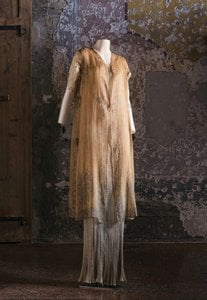
Fortuny’s impact on fashion is anchored by the Delphos gown, a design he patented in 1909. This garment utilized four to five panels of more than four-hundred hand pleats to achieve its specific silhouette. His experimentation with layering continued in 1910 when he designed the Delphos dress paired with a printed silk tunic. These pieces demonstrate a technical precision that moved beyond simple garment construction into the realm of structural textile art.

His material investigations extended into heavy textures and historical silhouettes. In 1915, he produced a model wearing a printed silk velvet dress and cape. He also developed a T-shaped outwear inspired by Coptic tunics, showing a consistent habit of translating ancient archaeological finds into wearable forms. Beyond clothing, his technical ingenuity produced the Fortuny Moda Lamp, an object designed to manipulate light within a space.

Legacy and Influence

Fortuny’s impact extends far beyond the technical patents of his lighting and textile processes. His aesthetic reached a high level of cultural relevance by attracting the attention of figures like Marcel Proust, Isadora Duncan, and Peggy Guggenheim. These connections highlight how his work functioned as a bridge between functional design and high art. He did not merely create garments; he constructed a visual language that resonated with the intellectual and creative elite of his era.

The strength of his design language relied on a specific historical synthesis. He drew heavily from the silhouettes of Classical Greece and the intricate patterns of Arabic culture. This was not a superficial imitation of the past. Instead, he adapted these historical typologies to create a distinct aesthetic that remained functional. By merging these diverse influences, he achieved a style that felt both ancient and modern, ensuring his influence persisted long after his death in 1949.

Where to See the Works Today

The most concentrated collection of his output remains in Venice, Italy. The Palazzo Fortuny houses approximately 3,000 artworks, preserving the specific aesthetic of his workshop and personal environment. This site offers the most direct look at his material experiments and the scale of his production.

Beyond Venice, his influence is distributed through major international institutions. The Museum of Fine Arts in Boston holds the Teagown, a piece that demonstrates his approach to garment construction. In Madrid, the Museo del Traje maintains a Coat from about 1940, providing a late-period example of his textile work. Berlin’s Kunstgewerbemuseum also contains a Delphos Evening Gown, an undated piece that represents his most significant contribution to fashion history.

Mariano Fortuny

Mariano Fortuny

1871 - 1949 , Spain

Quick Facts

  • Artists Or Movements Influenced By This Artist: ['Marcel Proust']
  • Artists Who Influenced This Artist: ['Mariano Fortuny y Marsal']
  • Full Name: Mariano Fortuny y Marsal
  • Nationality: Spanish
  • Notable Artworks:
    • Teagown
    • Delphos Dress
    • Print sample
    • Block for printing textiles
  • Place Of Birth: Reus, Spain
  • Date Of Birth: 1871
  • Date Of Death: 1949
Explore artworks organized by themes, styles, and characteristics.