Early Life and Artistic Training
Johan Christian Claussen Dahl emerged from a background far removed from the academic elite. Born on February 24, 1788, in Bergen, Norway, his origins were rooted in the practical realities of a fishing community; his father worked as a modest fisherman. This early environment provided a direct, unvarnished connection to the rugged Norwegian coast that would later define his visual language. He did not possess the luxury of formal, structured education in his youth, a fact he later viewed with a certain bitterness. Instead, his path was shaped by early apprenticeships and the recognition of his precocious talent by local mentors.
His formal development began in earnest between 1803 and 1809, when he studied under Johan Georg Müller. This period was less about refined theory and more about the labor of painting theatrical sets and portraits. Such practical work, while perhaps unglamorous, grounded his technique in the physical reality of light and shadow. By 1811, Dahl had moved beyond the local workshop to enter the Copenhagen Academy. Under the instruction of C. A. Lorentzen, he began to transition from a provincial talent into a disciplined practitioner of landscape. This move to Copenhagen was the essential catalyst that shifted his focus from mere depiction toward the more complex atmospheric studies that would characterize his career.
The Formative Years in Copenhagen
Dahl’s time at the Royal Danish Academy of Fine Arts in Copenhagen was the crucible for his technical development. He entered the academy as a pupil of C. A. Lorentzen, a painter whose work lacked distinction but provided the necessary institutional entry point. This period was less about the specific instruction of his mentor and more about the access it granted. The Danish royal collection provided a direct link to the past, allowing him to study established works that would inform his understanding of composition and scale.
The most decisive influence during these years was not found in the classroom, but in the sketches and paintings produced by Eckersberg. Exposure to Eckersberg’s approach was essential to Dahl's artistic formation. It shifted his focus toward the necessity of plein-air observation. This move away from purely academic, idealized scenes toward a direct engagement with the physical environment defined his trajectory. He learned to prioritize the immediacy of the landscape over the rigid conventions of the academy.
Professional Life in Dresden
Dahl’s move to Dresden in the 1820s shifted his focus from the periphery of European art to its academic center. He did not merely inhabit the city; he became a fixture of its institutional life. From 1824 until his death, he held the senior professorship at the Dresden Academy. This position gave him direct influence over a generation of German painters. His presence in the city was so established that he shared a house with Caspar David Friedrich. This proximity placed him at the heart of the Romantic movement, even as his own work remained tethered to the specificities of the Norwegian landscape.
His tenure in Dresden was marked by a commitment to the direct observation of nature. While many of his contemporaries leaned into abstraction or heavy symbolism, Dahl utilized his academic standing to promote a more grounded, topographical approach to the sublime. He relied on plein-air sketches to inform his large-scale compositions, ensuring his depictions of the North remained physically accurate rather than purely imaginative. His work from this period demonstrates a technical precision that earned him international standing during his lifetime.
Technique and Artistic Style
Dahl’s approach to the canvas was rooted in the immediate reality of the landscape rather than idealized studio constructions. His method relied heavily on the use of plein-air sketches, a practice that grounded his work in direct observation. This commitment to the physical truth of nature allowed him to move beyond mere imitation. He drew significant technical influence from the Dutch landscape masters Jacob v. Ruisdael and Albert v. Everdingen, adopting their focus on the natural world while applying a more direct, observational rigor. His style is firmly anchored in the Romantic movement, prioritizing the visceral impact of weather and light over rigid academic perfection.
The physical texture of his paintings reveals a preference for dynamism. He utilized a rich impasto, employing thick brushstrokes to build up surface texture and convey movement. This tactile quality works in tandem with his sophisticated use of tonal gradations. By carefully managing the interplay between light and shadow, he captured the shifting atmosphere of the Norwegian and German landscapes. This technical control ensured that the weather—be it a storm or a sudden clearing—remained a central, active component of the composition rather than a static backdrop.
Notable Works and Subjects
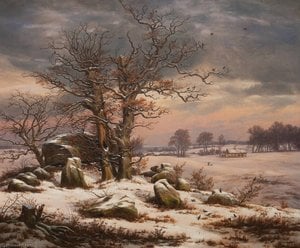
Dahl’s output centers on the tension between geological permanence and the immediate violence of weather. In 1819, he produced German Morgen nach einer Sturmnacht, a work that captures the aftermath of a storm through a turbulent seascape and crashing waves. This focus on the raw power of nature is not a mere stylistic choice but a core component of his visual language. He frequently utilized a rich impasto, employing thick brushstrokes to build texture and convey the physical dynamism of the elements. This technique allowed him to move beyond simple depiction, instead capturing the visceral impact of wind and water on the landscape.
His ability to translate the ruggedness of his homeland into a structured composition is evident in Norwegian Mountain Landscape with Waterfall (1821). Here, the subject is the sheer scale of the terrain, emphasizing the weight of stone and the movement of water. This interest in the dramatic aspects of the natural world continued into his later years. In 1849, he painted Birch Tree in a Storm, a work that uses the struggle of a single tree to mirror the broader, chaotic forces of the environment. Even his more tranquil scenes possess a certain weight; Copenhagen Harbor by Moonlight, painted about 1846, demonstrates his command over tonal gradations and the interplay between light and shadow.
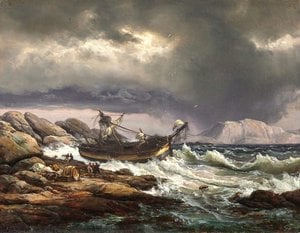
The human element in his work often serves to highlight the scale of the environment rather than to dominate it. This is most apparent in Shipwreck on the Norwegian Coast (1832), where the sea is a site of struggle and the landscape remains the primary force. His subjects are rarely static; they are defined by the immediacy of experience, from the suddenness of a thunderstorm to the slow, heavy presence of a mountain range.
Legacy and Cultural Impact
Dahl’s influence is measured by the institutional structures he helped build. He was a primary force behind the founding of the Norwegian National Gallery in Oslo and the Art Society in Oslo. These were not mere administrative efforts; they were the practical foundations for a national art scene. By establishing these institutions, he ensured that the visual identity of Norway had a permanent, physical home. His work helped shift the focus of Norwegian art away from portraiture and toward the landscape, effectively initiating the "golden age" of Norwegian painting.
He is frequently identified as the father of Norwegian landscape painting. This title is earned through his ability to move the genre from a secondary pursuit to a central pillar of national expression. His presence in the European art scene, particularly through his long tenure in Dresden, allowed him to bridge the gap between Nordic subject matter and international Romanticism. He did not merely paint scenery; he provided the visual language for a nation seeking to define itself through its rugged topography.
Where to See His Works Today
To encounter the physical reality of Dahl’s landscape vision, one must look to the major institutions of Northern Europe. His presence in the public sphere remains significant, anchored by collections in Norway, Denmark, and Germany. These holdings provide the necessary evidence of his ability to translate the ruggedness of the North into a formal visual language.
In Copenhagen, the Statens Museum For Kunst maintains Fredericksborg Castle, a work that highlights his command over architectural integration within a landscape. Nearby, the Thorvaldsen Museum houses Norwegian Mountain Landscape with Waterfall, a piece that captures the specific geological character of his homeland. These Danish collections offer a direct link to the era when his reputation began to solidify across borders.
The weight of his legacy is also felt in the National Gallery of Norway, which holds Shipwreck on the Norwegian Coast. This work remains a central part of the Norwegian collection, representing the dramatic intersection of sea and storm. In Germany, the Hamburger Kunsthalle preserves Norwegian Tordenvær i nærheten av Dresden, a piece that reflects his long-standing connection to the Dresden art scene. These locations ensure his technical approach to light and atmosphere remains accessible to those studying the development of 19th-century landscape painting.


 Preview
 Send
Send Share
Share
 Details
 Guide
Guide

 Download
 Similars
 X-Ray
X-Ray Diaporama
 Q&A
Q&A
 Stats
Stats


 Read More
 Switch to Print





































 Glass option is only available in size under 110 CM