Early Life, Family and Training
Camille Pissarro enters the world on July 10, 1830, in Charlotte Amalie, Saint Thomas. His origins are a convergence of identities. His father, Frederick Abraham Gabriel Pissarro, is a man of Portuguese Jewish descent holding French nationality. His mother, Rachel Manzano-Pomié, brings a French-Jewish lineage with Provençal roots to the household. This diverse background shapes a childhood far from the French mainland, set against the backdrop of the Danish West Indies.
The pull toward Paris eventually dictates his path. After early training at the Savary Academy in Passy, near Paris, the focus shifts toward formal academic rigor. He moves through the halls of the École des Beaux-Arts and the Académie Suisse. The training is not merely theoretical; it is a direct encounter with the giants of the era. He studies under Gustave Courbet and Jean-Baptiste-Camille Corot, absorbing the foundations of realism and the burgeoning interest in the natural world. By 1861, he is a registered copyist in the Musée du Louvre, working among the shadows of the masters he seeks to emulate.
Artistic Development and Style
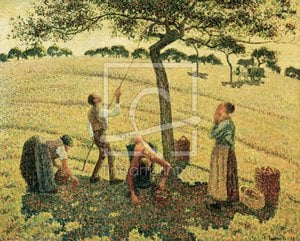
The transition from academic tradition to the open air marks a fundamental shift in his approach. He moves away from the stifling constraints of formal training to embrace plein air painting, working directly from nature to capture the immediate sensations of the landscape. This commitment to the outdoors necessitates a new technical language. He begins applying oil on canvas with visible, textured strokes, abandoning the smooth finish of the academies. His palette brightens, utilizing separate patches of unmixed pigments to build up color. By the first half of the 1870s, his compositions appear firmly controlled, maintaining a structural integrity even as his brushwork becomes more expressive.
The search for new ways to render light leads to radical experimentation. He moves beyond the traditional application of paint to explore the delicate possibilities of pastel, layering thin washes of pigment onto paper to achieve subtle gradations of tone. This curiosity extends into his later years when he engages with Neo-Impressionism. Influenced by the methods of Georges Seurat and Paul Signac, he adopts pointillist techniques, utilizing regulated, comma-like brushstrokes to build his surfaces. This period demonstrates a willingness to abandon his established methods in favor of scientific precision and new optical effects.
The Impressionist Circle and Mentorship
The Impressionist movement is often viewed as a collection of fractured, competing egos, but Pissarro provides the glue. Between 1874 and 1886, he exhibits at all eight Paris Impressionist exhibitions, maintaining a steady presence while others drifted or clashed. He is the stabilizing force in a circle defined by internal disagreements. While the group navigates the friction of radical new ideas, Pissarro remains a constant, providing a sense of camaraderie that keeps the movement from splintering entirely.
His influence extends into the studios of the next generation. He acts as a mentor to Paul Cézanne, Vincent van Gogh, and Paul Gauguin, offering the technical and philosophical guidance they require to find their own paths. The connection with Cézanne is particularly intense; the two artists often work side by side, sometimes painting the exact same subjects to test the limits of space and color. They experiment together, regulating their brushstrokes and restricting their palettes in a shared search for a new visual language.
Personal stability also anchors his life away from the Parisian ferment. In 1871, he marries Julie Vellay, a vine-grower's daughter from Burgundy, in London. This connection to the land and the working class informs the quiet, rhythmic pulse of his social outlook. He does not merely observe the landscape; he builds a community of artists around the act of seeing.
Key Works and Subjects
Pissarro moves between the quietude of the countryside and the shifting energy of the city. He captures the rhythm of everyday life, often focusing on the labor of peasants working in open fields. In 1867, he produced The Jallais Hills, Pontoise, a work that looks toward the landscapes of his frequent subjects. By 1872, his gaze turned to the architecture of the outskirts in The House of Monsieur Musy, Route de Marly, Louveciennes.
The artist also turns his attention to the intimate and the individual. In 1874, he painted a Portrait of Paul Cezanne. His experimentation with medium is evident in the 1876 Portrait of Eugenie Estruc, a pastel on paper measuring 31 x 21 cm. This work utilizes thin washes of pigment to achieve a soft, diffused light across the subject's features. Later, in 1882, he documented the social pulse of a local market in The Poultry Market at Pontoise.
Legacy and Influence
The revolution of modern art finds its structural core in Pissarro’s insistence on the plein air method. By moving the easel from the controlled studio to the unpredictable outdoors, he fundamentally altered how landscape art is perceived. This commitment to capturing the immediate, fleeting effects of light and atmosphere changed the trajectory of painting. He did not merely observe the landscape; he sought to record the very sensations of the natural world through a textured, rhythmic application of pigment.
His influence operates through a direct lineage of mentorship. He provided the philosophical and technical framework that allowed younger, more volatile talents to find their footing. Without his stabilizing presence and willingness to experiment—even venturing into the pointillist techniques of Neo-Impressionism—the development of Post-Impressionism might have taken a different shape. He bridged the gap between the structured realism of the past and the radical, subjective expressions of the future.
Today, his presence is felt in the permanent collections of major museums across the globe. His canvases remain essential for understanding the shift toward modernism. His works are held in:
Where to See the Works Today
The weight of Pissarro's influence is felt most heavily in Paris. The Musée d'Orsay holds the largest concentration of his output, with 23 works preserved within its walls. Here, the evolution of his brushwork remains visible, from the structured compositions of his early years to the more liberated, textured surfaces of his later period. Visitors can find his depictions of the French countryside and the shifting light of the Seine, including works like Red Roofs, Corner of a Village, Winter from about 1877.
Across the Atlantic, the Metropolitan Museum of Art in New York maintains a significant presence of his vision, housing 14 works. This collection allows for a direct comparison of his stylistic shifts, such as the transition from his more traditional landscapes to the experimental textures of his Neo-Impressionist phase. In the United States, the National Gallery of Art in Washington holds 6 works, while the Art Institute of Chicago preserves 5. These pieces often focus on the quiet dignity of rural labor and the atmospheric qualities of the French landscape.
The reach of his canvases extends into the United Kingdom and beyond. The Ashmolean Museum in Oxford contains 6 of his paintings, offering a window into the specific light and color he sought to capture through plein air observation. His presence in these global institutions ensures that his commitment to the ephemeral qualities of nature remains accessible to those studying the development of modern painting.


 Preview
 Send
Send Share
Share
 Details
 Guide
Guide

 Download
 Similars
 X-Ray
X-Ray Diaporama
 Q&A
Q&A
 Stats
Stats

 Read More
 Switch to Print





































 Glass option is only available in size under 110 CM