**early life and family**
paulus constantijn la fargue, a dutch painter, etcher, and draftsman, was born on january 5, 1729, in the hague, netherlands. he was part of an artistic family, with his father jean thomas being a notary, translator, and pamphleteer. his siblings, including isaac lodewijk, jacob elias, karel, and maria margaretha, were all painters.**artistic career**
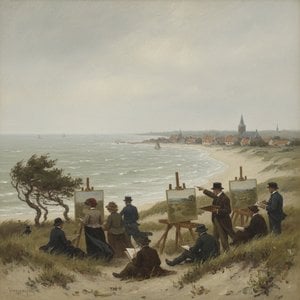
la fargue's artistic career is notable for his contributions to topographical art, specializing in painting, drawing, and etching townscapes and landscapes with topographical elements. in 1761, he and his brother jacob joined the hague painters society, known as the confrerie pictura. by 1768, he was recorded as a member of the royal academy of art in the hague.**notable works and style**
- la fargue's topographical work from the 1760s brought rotterdam into the picture, as well as the hague. - his paintings, relatively small in format, were influenced by seventeenth-century painters like jan van der heyden. - la fargue's depictions are reliable in a topographical sense, lively in color, and filled with charming little figures that create variety.**patronage and financial challenges**
despite having patrons such as the french and english ambassadors early in his career, la fargue faced financial difficulties, which were common among artists of his time. his life was not easy, and he, along with his brothers and sister, struggled financially.**legacy and significance**
la fargue belongs to the group of better topographical artists of the second half of the eighteenth century. his significance derives chiefly from the documentary value of his work, providing a glimpse into the netherlands during that period.- key points:
- born: january 5, 1729, in the hague, netherlands
- died: june 10, 1782
- notable for topographical art contributions
- member of the royal academy of art in the hague by 1768
- relevant links:
- paulus constantijn la fargue on WahooArt.com
- the museum huis ten bosch (the hague, netherlands) - a comprehensive guide
**conclusion**
paulus constantijn la fargue's artistic legacy is a testament to his family's artistic inclinations and his own contributions to the world of topographical art. his work, though often static in style, showcases originality in its spontaneous drawings and provides valuable insights into 18th-century netherlands.- further reading:
- explore more on the house of orange-nassau historic collection trust (the hague, netherlands)
Questions & Answers
Is there an overview of all the subjects Paulus Constantijn La Fargue painted?
Paulus Constantijn La Fargue's works can be explored by subject on the artist's Subject Atlas page.
Where can I see Paulus Constantijn La Fargue's artworks in chronological order?
A timeline of Paulus Constantijn La Fargue's works exists: the artist's Artwork Timeline page orders the artworks by creation date.
In which historical period did Paulus Constantijn La Fargue work?
Paulus Constantijn La Fargue worked in the Early-Modern period. The period situates the artist's activity in history.