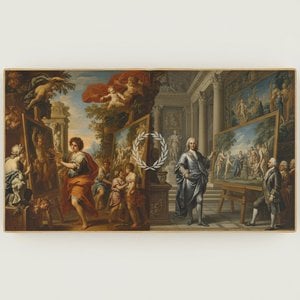
daniël marot, a french-born dutch architect, furniture designer, and engraver, was born in paris in 1661. he was a pupil of jean le pautre and the son of jean marot, who was also an architect and engraver. this lineage played a significant role in shaping daniël's future as a master of the classicizing late baroque louis xiv style.
career highlights
daniël marot worked for a long time in england and the dutch republic, where he was naturalized in 1709. his work brought the fully developed court style of louis xiv to holland and later to london, influencing what is loosely called the 'william and mary' style. * **employment by the stadthouder**: marot was employed by the stadthouder, who later became william iii of england. he designed interiors in the palace of het loo, from 1684 on. * **designing the great hall of audience**: despite not having an entry in howard colvin's dictionary of british architects, marot designed the great hall of audience for the states-general at the hague. * **decorating dutch country-houses**: he decorated many dutch country-houses, introducing the 'salon' and popularizing ornamented ceilings in the united provinces/netherlands.
notable works and legacy
* hampton court palace: marot's activities in england were concentrated at hampton court palace, where he designed the garden parterres. although these were swept away in the following generation, they have been restored at the end of the 20th century. * **furniture designs**: much of the furniture in the new state rooms at hampton court bears unmistakable traces of his authorship.
later life and death
after william's death, marot returned to holland, where he lived at noordeinde 164 in the hague from 1720 until his death in 1752. a folio volume of his furniture designs published at amsterdam in 1712 showcases strong french and dutch influences.
daniël marot's legacy as a master of the classicizing late baroque louis xiv style continues to inspire architects, furniture designers, and engravers around the world.
By the WahooArt.com Editorial Team
Test your eye
There is only one correct answer for each question.
Question 1:
Rembrandt van Rijn was primarily known for his contributions to which art movement?
Question 2:
Which of the following best describes Rembrandt's signature style?
Question 3:
Rembrandt is particularly famous for his self-portraits. How many self-portraits are generally attributed to him?
Question 4:
Johannes Vermeer is renowned for his paintings of:
Question 5:
Cornelius Johnson was an English-born painter who worked primarily in which country?
Explore the life & art of Simon Vouet, a pivotal French Baroque painter who introduced Italian styles to France. Discover his masterpieces and lasting influence on 17th-century art.
Explore the opulent world of Rococo art! Discover its origins, key artists like Watteau & Boucher, and lasting influence on design. Expert insights for collectors & enthusiasts.
Elevate hotel interiors with fine art reproductions that resonate architecturally. Discover how custom artwork & expert curation create unforgettable guest experiences. Explore Renaissance-inspired design solutions.
early life and training daniël marot, a french-born dutch architect, furniture designer, and engraver, was born in paris in 1661. he was a pupil of jean le pautre and the son of jean marot, who was also an architect and engraver. this lineage played a significant role in shaping daniël's future as a master of the classicizing late baroque louis xiv style. career highlights daniël marot worked for a long time in england and the dutch republic, where he was naturalized in 1709. his work brought th
Is Daniël Marot's work still under copyright?
No, works by this artist are in the public domain.
What is the top-ranked painting by Daniël Marot on ArtsDot.com?
Gilded Table
Rembrandt van Rijn was primarily known for his contributions to which art movement?
Baroque
When did Daniël Marot die?
1752
When and where was Daniël Marot born?
1661, Paris, France
How long did Daniël Marot live?
91 years (1661–1752)
Cornelius Johnson was an English-born painter who worked primarily in which country?