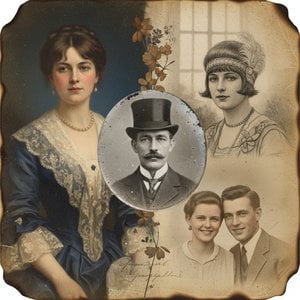
Alexander Petrovich Sokolov: A Legacy of Watercolor Portraits
Alexander Petrovich Sokolov (1829 – 1913) stands as a significant figure in late 19th-century Russian art, primarily celebrated for his masterful watercolor portraits that captured the elegance and dignity of aristocratic subjects—particularly women—and the grandeur of imperial ceremonies. Born into an artistic lineage steeped in tradition, Sokolov’s artistic journey was profoundly shaped by his father, Pyotr Sokolov, a celebrated portrait painter himself, establishing him within a family renowned for its artistic prowess. His brothers, Pyotr and Pavel Sokolov, were equally accomplished artists, fostering a creative environment that nurtured Alexander's talent from an early age.- Early Life & Education: Sokolov’s formative years were spent at the gymnasium in Moscow, where he demonstrated an aptitude for scholarly pursuits alongside his burgeoning artistic inclinations. Recognizing his potential, he abandoned formal schooling to enroll in the Moscow School of Painting, Sculpture and Architecture, immersing himself in the rigorous training demanded by academic art instruction.
- Imperial Academy & Artistic Style: Following two years at the school, Sokolov pursued advanced studies at the Imperial Academy of Arts, honing his skills under luminaries like Ilya Repin and Vasily Verkhoff. This exposure solidified his commitment to the Academic style—characterized by meticulous detail, idealized forms, and a restrained palette—a stylistic choice that would define his artistic output for decades.
The Peredvizhniki Movement & Expanding Horizons
- Joining the Wanderers: In 1881, Sokolov embraced membership in the Peredvizhniki (Wanderers), a collective of artists who championed realism and social commentary. This affiliation marked a pivotal moment in his artistic career, propelling him beyond the confines of aristocratic commissions and introducing him to broader artistic dialogues.
- Notable Commissions & Artistic Technique: Sokolov gained considerable renown for his portraits of prominent women—including Maria Feodorovna, Empress Alexandra II’s wife—and members of the imperial family. His technique involved layering translucent washes of watercolor pigment onto toned paper, achieving remarkable luminosity and capturing subtle nuances of expression. He meticulously studied anatomy and drapery, striving to convey both physical likeness and psychological depth.
Curatorship & Legacy
- Director of the Imperial Academy Museum: From 1892 to 1907, Sokolov served as curator of the Russian Academy of Arts Museum—a position that afforded him unparalleled access to artistic treasures and provided invaluable insight into the evolving landscape of Russian art history.
- Recognition & Artistic Influence: Sokolov’s dedication to his craft earned him full membership in the Imperial Academy of Arts in 1896, cementing his place among Russia's most respected artists. His meticulous attention to detail and unwavering commitment to the Academic style continue to inspire contemporary watercolorists, ensuring that Sokolov’s legacy persists as a testament to artistic excellence and enduring beauty.
Concluding Thoughts
Alexander Petrovich Sokolov's contribution to Russian art lies not merely in his prolific output of portraits but also in his embodiment of the ideals of the Academic tradition—precision, elegance, and a profound understanding of human psychology. His watercolors remain treasured examples of artistic craftsmanship, offering glimpses into the lives and personalities of Russia’s elite during a transformative era.