
1
城市 (Chéngshì)
1919年,费尔南·莱热创作了这幅具有里程碑意义的画作,它不仅仅是对城市景观的描绘,更是对新兴工业时代充满力量的宣言。这幅作品充分展现了莱热成熟风格的魅力,以其动态的形式、大胆的色彩和对现代生活本质的深刻探索而著称。它并非简单地复制现实,而是揭示了隐藏在现代世界背后的结构与节奏。

The painting that made 费尔南·莱热 famous is 城市 (Chéngshì) (1919). 机械师 (1920) and 三位女性 (1921) follow it in the hearts of collectors and museum visitors. Of the 834 works by 费尔南·莱热 in our catalogue, these 100 are the most admired, each presented with its date, its museum and what sets it apart.
Ranked by our popularity score, which combines the searches, visits and orders for each work. Updated October 2026. Every masterpiece on this page can be ordered as a museum-quality, hand-painted oil reproduction or a fine art print, at the size you choose.

1919年,费尔南·莱热创作了这幅具有里程碑意义的画作,它不仅仅是对城市景观的描绘,更是对新兴工业时代充满力量的宣言。这幅作品充分展现了莱热成熟风格的魅力,以其动态的形式、大胆的色彩和对现代生活本质的深刻探索而著称。它并非简单地复制现实,而是揭示了隐藏在现代世界背后的结构与节奏。

费尔南·勒热 (Fernand Léger) 的《机械人》(Le Mécanicien),创作于1920年,不仅仅是一幅画作,更是一曲对工业时代精神的赞歌。这幅作品以其大胆的构图和鲜明的色彩,完美地融合了立体主义的解构手法与新时代的机械美学,成为了早期二十世纪先锋艺术的杰出代表。它并非是对传统绘画技法的简单延续,而是勒热对现代社会变革的一次深刻反思与视觉诠释。

引言 费南德·勒让的《三位女性》(1921年)是现代艺术史上的传世杰作,它将立体主义与装饰艺术的影响天衣无缝地融合在一起。这幅充满活力且极具动态感的构图,精准地捕捉了20世纪初现代性的精髓,无论是对于当代艺术收藏家,还是对于追求精致格调的室内空间而言,都堪称一件令人心醉神迷的艺术珍品。 主题与构图 作品描绘了三位正沉浸在闲暇时光中的女性形象,她们以三角形的阵列分布,营造出一种平衡而和谐的视觉美感。其中一位身影斜倚在椅子上,另一位端坐着手持物件,第三位则侧卧在一旁,流露出一种放松与沉思的神态。画中融入了桌子、椅子和书籍等日常器物,暗示了一个温馨的居家环境,仿佛在无声地邀请观者步入一段现代生活的缩影之中。 风格与技法 在《三位女性》中,勒让展现了他标志性的艺术风格——一种立体主义与装饰艺术的深度交融。作品的特征在于其抽象的形态、几何化的图案以及高度风格化的形体。勒让运用了精准且干净的线条,配合大面积的平涂色彩,这正是现代主义艺术运动的典型手法。这种大胆的轮廓勾勒与简化的形式处理,既让人联想到立体主义的碎片化重构,又体现了装饰艺术对优雅与对称性的极致追求。 色彩运用 画面的色彩方案大胆且富有对比度,以红、蓝、黄等原色为主导,并辅以棕色和黑色等大地色系。绿色与白色的点缀进一步提升了整体的鲜艳度,增强了构图的动态张力。画面中均匀的光影分布维持了形体的平面感,从而突显了几何图案的节奏,创造出一个在视觉上极具冲击力的场景。 历史背景 创作于1921年的《三位女性》深刻反映了第一次世界大战后的时代精神,那是一个文化与艺术发生剧烈变革的时期。勒让这一时期的创作深受工业时代及社会机械化进程的影响,这种影响在作品的几何纹样和风格化的形体中清晰可见。这幅杰作正是当时宏大艺术运动的一部分,旨在通过抽象且充满动感的构图来捕捉现代文明的精神内核。 象征意义 这件作品传达了关于现代性、精致感与闲暇生活的深刻主题。人物放松的姿态暗示着一种舒适与自得,而几何化的图案则象征着那个时代的当代生活方式。有机形态与几何形状之间的并置,创造出一种引人入胜的视觉张力,邀请每一位观者用自己的视角去解读这幅画面背后的深意。 情感冲击 通过大胆的色彩运用和充满动感的构图,《三位女性》唤起了一种蓬勃的能量与生命力。人物与器物的高度风格化处理为作品增添了一抹神秘感,使其在视觉丰富之余,更具情感上的感染力。对于那些渴望为自己的空间注入一丝现代主义优雅与高贵气息的人来说,这件作品无疑是完美的艺术选择。 为何选择此幅复制品 对于艺术爱好者、收藏家以及室内设计师而言,拥有这样一幅高质量的《三位女性》复制品,意味着获得了一个拥抱现代艺术史的机会。其鲜艳的色彩、动态的构图以及风格化的形象,使其能够成为任何当代或现代主义风格室内装饰中的点睛之笔。无论是在客厅、办公室还是画廊空间展示,这件作品都定能激发灵感并深深吸引每一位观者的目光。 结语 费南德·勒让的《三位女性》是艺术家对现代艺术创新探索的有力见证。它融合了立体主义与装饰艺术的精髓,凭借大胆的色调和动态的构图,成为了一件跨越时空、至今仍能引起观众共鸣的永恒之作。通过选择这件杰作的高品质复制品,您可以将现代主义的优雅带入您的居家或办公空间,用20世纪初那份充满创新精神的灵魂,升华您的生活艺术。

费尔南·勒让的《森林中的裸体》(1909-1910)是一部具有里程碑意义的作品,标志着立体主义发展史上的一个关键阶段。它不仅仅是对树林中人物形象的描绘,更是一次对形式与透视的大胆解构,即便在一个多世纪后的今天,依然能深深吸引着观众的心灵。这幅画作的核心不在于表现了“什么”,而在于如何去表现——这种激进的处理方式重新定义了现代艺术。

费尔南·勒热的《大游行》(Le Grand Défilé)并非仅仅是一幅画作,它更像是一场视觉盛宴,一场对现代生活的欢快颂歌。1954年创作的作品中,人影熙攘,机械元素穿插其中,构成了一幅充满活力与动感的画面。这幅作品捕捉了都市的喧嚣、节日的狂欢,以及工业时代蓬勃发展的力量。勒热巧妙地将有机形态与工业意象融合在一起,既展现了和谐之美,也暗示着一种微妙的冲突——那是现代社会快速变革带来的复杂感。

主题与构图 这件迷人的艺术作品呈现了一个破碎且抽象的人物形象,极可能是一位女性,她沉浸在几何形状与抽象形式错综复杂的交织之中。这种构图引导观众同时从多个视角进行探索,这正是立体主义影响下的显著特征。画面中的人物似乎正处于一个亲密或沉思的瞬间,被一群既混乱又和谐的棱角形状所包围,这些形状唤起了一种内在的反思感与情感深度。形式的层叠排列暗示了一个富有心理细微差别的叙事,捕捉到了人类身份与经验的多面性。 风格与技法 植根于立体主义的原则,这件作品采用了对传统形式的有意识解构,强调几何抽象与多维视角。艺术家巧妙地将锐利的线条与柔和、融合的边缘相结合,在构图中营造出一种动态的张力。富有质感的表面展现了对层叠笔触以及光影微妙渐变的精湛运用,增添了触觉上的丰富感与深度。沉稳的大地色调——包括棕色、米色、暗绿色和深蓝色——增强了作品内省的情绪,而粉色与灰色的点缀则提供了细腻的装饰,柔化了整体基调。 历史背景与艺术意义 这件创作于 20 世纪初的艺术品,体现了立体主义的创新精神,这是一场挑战艺术传统视角的革命性运动。受毕加索和布拉克等先驱艺术家的影响,此作品反映了一个艺术实验时期,以及一种试图同时描绘现实多重维度的渴望。破碎的构图与抽象的形式象征着对古典表现主义的突破,拥抱了现代性以及人类感知的复杂性。这部作品见证了现代艺术的演变,捕捉到了艺术解放与概念探索的关键时刻。 象征意义与情感冲击 人物层叠且破碎的呈现方式,邀请观众从个人层面去解读作品,唤起内省、忧郁或沉思的情绪。低调的色调与复杂的纹理激发了一种情感深度,鼓励观众去思考记忆、身份与内在冲突等主题。抽象的形式充当了人类经验多面性的视觉隐喻,强调了理解与感知往往是具有层次感且复杂的。这件作品沉静的氛围使其成为任何寻求启发思想与情感共鸣的收藏或室内空间的有力补充。 收藏家与装饰者的独特之选 对于艺术爱好者、收藏家和室内设计师而言,这件高品质的复制品提供了一件永恒的作品,以其精致的抽象感和丰富的情感提升任何环境的格调。其多变的风格能够完美契合现代与古典的室内设计,作为一个激发对话与反思的视觉焦点。无论是在画廊、客厅还是办公室展示,这件艺术品都将凭借其深邃的艺术表达力和持久的生命力,升华您的空间品质。

在20世纪早期现代主义那充满活力的图景中,很少有作品能像费尔南·莱热的“早餐”那样,如此震撼地捕捉到变革时代的律动。这幅创作于1921年的杰作,宛如一扇窗户,让我们窥见一个家庭生活与工业文明开始融合为单一、动态愿景的世界。画面呈现了聚集在餐桌旁的三位女性,但她们绝非传统静物肖像中那种安详的人物。相反,通过莱热革命性的视角,分享早餐的行为被转化为一场由破碎平面与交错形状组成的复杂舞蹈。画布中散发出一种不可忽视的能量,仿佛餐桌周围的空气正随着现代时代的机械精准感而震颤。

一位女性从沉重的黑色线条网格中浮现,她的形体由圆柱体和球体构建而成。她手捧一束花,然而这些花朵并非柔软的花瓣,而是红、黄、蓝的色块碎片。每一个形状都显得沉重有力,仿佛是由钢铁雕刻而成,又如由生铁铸就。粗壮的轮廓勾勒出一个身体,其律动带着机器般的精准。这里没有任何阴影来柔化边缘,只有平面的色彩在锐利的建筑式交汇点上交织。

Fernand Léger’s "Composition in Blue" is a quintessential example of modernist art, showcasing his unique blend of Cubism and Futurism. The painting features a striking composition dominated by shades of blue, with a central figure – seemingly a woman or humanoid form – rendered in various hues of the color. This figure is partially obscured by a large blue headpiece, creating an enigmatic and somewhat mechanical appearance. The artwork incorporates…

请走近一些,仔细观察空间是如何被分割的。在创作于1923年的《桥》中,并没有一个单一的透视点供人驻足。相反,我们看到的是一个被划分为清晰水平与垂直区域的构图,暗示着一种破碎的建筑现实。两根厚实的翡翠绿柱子锚定了中景的上部,在整体布局中充当着结构支柱。在它们身后,背景通过红、黑、白色的平坦色块展开,并点缀着几何形状的圆圈与矩形。中间部分引入了奶油色、棕褐色和深褐色交织的波动状波浪带,暗示着某种景观,或是结构下方流动的河水。而在前景中,一种鲜明的黑白棋盘格图案横跨画布,通过其棱角分明的线条创造出一种富有节奏感的深度感。

Fernand Léger's "Smokers," painted in 1912, isn’t merely a depiction of men enjoying a cigarette; it’s a vibrant manifesto of early Cubism and a bold assertion of modernity.…
Bring it home →
Fernand Léger’s "Mural," completed in 1951, stands as an arresting embodiment of Cubist principles interwoven with a palpable fascination for the burgeoning machine age. This masterpiece does not…
Commission a hand-painted copy →
一盏台灯、一个果碗和几个杯子静静地摆放在桌面之上。在1914年的艺术语境中,这些日常器物褪去了原本柔和的边缘,幻化为圆柱体与圆锥体。费尔南·莱热将这一场景拆解为蓝、红、绿交织的重叠平面。光线不再在木质表面投下深长的阴影,而是以一种平整、均匀的清晰度,打在金属与玻璃的切面上。粗重而深沉的线条勾勒出每一个形状的边界,万物皆由沉稳的结构化部件构建而成。
Bring it home →
A Pulse of Steel and Primary Color The canvas vibrates with the rhythmic, metallic hum of an urban landscape in motion. Geometric forms—cylinders, rectangles, and sharp arcs—overlap in…
Commission a hand-painted copy →
In the quietude of an ambiguous interior, two figures sit side-by-side, lost in the profound intimacy of shared silence and individual discovery. Fernand Léger’s 1924 masterpiece, Reading, is…
Order a reproduction →
A Rhythmic Celebration of Form and Color Fernand Léger’s Dance is far more than a mere depiction of movement; it is a vibrant, pulsating symphony of color and…
Commission a hand-painted copy →
一系列重叠的圆圈如同沉重且带有色彩的信号,在画布上缓缓漂移。这些圆盘以厚重的油彩层层堆叠,与锐利的矩形和对角线色带交织在一起。深邃的蓝色与明亮的黄、橙色激烈碰撞,创造出一种律动的脉搏,仿佛在模拟一座处于运动状态的城市的喧嚣。画面中并没有单一的视觉焦点,取而代之的是一种层次分明的排列,红与白的平面在其中交叠。线条始终清晰可辨,为这种动态感提供了坚实的结构骨架。
Commission a hand-painted copy →
In the quiet intersection of Surrealist dreamscapes and the rigid precision of Cubism lies Fernand Léger’s 1932 masterpiece, The Bather. This is not merely a painting of a…
Bring it home →
In the pantheon of twentieth-century modernism, few works capture the pulse of the machine age with as much vibrant vitality as Fernand Léger’s "Three Musicians." Completed in 1930,…
Commission a hand-painted copy →
The man sits within a grid of sharp edges and heavy lines. His body is not composed of soft skin, but of cylinders and metallic volumes that suggest…
Bring it home →
The canvas breathes with an energy that transcends mere pigment; it pulsates with the rhythm of industrial progress, captured in the bold strokes and vibrant hues of Fernand…
Order a reproduction →
Two nude female figures move through a landscape of interlocking shapes, their bodies caught in a moment of dynamic instability. The scene unfolds with a flattened perspective, where…
Order a reproduction →
在这幅创作于1924年的布面油画中,我们邂逅了一个结构异常坚实、甚至带有雕塑感的形象。画中的女性正面伫立,其轮廓由厚重且连续的线条勾勒,赋予了她一种纪念碑式的沉稳重量感。她手中托着一只巨大的花瓶,这个器物呈现出的圆柱形精准度,与其自身的解剖结构交相辉映。画面中流淌着一种静谧,这种宁静源于形状之间的重叠——它们无需依赖传统的透视法,便巧妙地暗示出了体积感。构图始终保持着中心对称,将我们的视线聚焦在这些圆润且具有机械感的形态交汇之处。
Commission a hand-painted copy →
Fernand Léger’s “The Builders,” completed in 1920, stands as a cornerstone of Cubist aesthetics and embodies the fervent optimism surrounding technological advancement during the tumultuous years of World…
Commission a hand-painted copy →
Fernand Léger’s “Walking Flower”: A Symphony of Color and Form Against Industrial Backdrop The ceramic sculpture "Walking Flower (La fleur qui marche)" by Fernand Léger, completed in 1952,…

A Symphony of Form and Fragmented Identity In the heart of 1942, amidst the profound shadows cast by the Second World War, Fernand Léger unveiled Plungers II, a…
Commission a hand-painted copy →
The painting Woman with Mirror, created in 1920, presents a configuration of geometric shapes that deconstruct the human figure and its surroundings. The composition relies on an arrangement…
Order a reproduction →
In the quietude of the Kröller-Müller Museum, Fernand Léger’s “Nudes in the Forest” stands as a monumental testament to the dawn of a new era. Painted in 1910,…
Commission a hand-painted copy →
In the transformative landscape of early twentieth-century modernism, few works capture the rhythmic pulse of a changing world as vibrantly as Fernand Léger’s “The Man with the Pipe.”…
Order a reproduction →
In the vast landscape of twentieth-century modernism, few works capture the rhythmic pulse of the machine age as vibrantly as Fernand Léger’s "Project for a mural." Completed in…
Order a reproduction →
Fernand Léger’s “Mechanical Elements,” painted in 1924, stands as a striking testament to the burgeoning fascination with technology during the interwar period. More than just a depiction of…
Commission a hand-painted copy →
Step closer and observe how the canvas seems to move even when you remain still. In 1919, Fernand Léger captured something far more visceral than a mere urban…
Bring it home →
In the 1919 painting Le Petit Djeuner, Fernand Léger presents a breakfast scene through a fragmented, Cubist lens. Two stylized human figures occupy a space that merges with…
Bring it home →
The oil painting titled The Dance - 1st Stage presents two stylized female figures positioned in an intertwined pose. These figures are rendered with thick, continuous lines that…
Bring it home →
Step closer to observe how the canvas begins to pulse with a rhythmic, mechanical energy. In Contrast of Forms, we find ourselves looking at a fragmented landscape where…
Commission a hand-painted copy →
A heavy red rectangle anchors the center, pressed against thick black lines that slice through white and yellow planes. Circles overlap like the interlocking teeth of a gear,…
Commission a hand-painted copy →
This striking black and white drawing of sunflowers by Fernand Léger, created in 1953, offers a compelling glimpse into the artist's unique vision – a synthesis of observed…
Commission a hand-painted copy →
In the painting The Big Breakfast, created in 1921, a woman sits at a table with a bowl positioned in front of her. She appears to be engaged…
Bring it home →
The painting is a Cubist artwork by Fernand Léger featuring a woman lying on her side with a yellow snake wrapped around her body. The snake appears to…
Bring it home →
A Portrait of Quiet Contemplation Amidst Mechanical Forms Fernand Léger’s “The Man in the Blue Hat,” painted in 1937, stands as a striking embodiment of Purism – an…
Commission a hand-painted copy →
Created in 1948, Reading is a portrait that captures a moment within an interior space. The painting features a woman sitting on the floor with her legs crossed,…
Commission a hand-painted copy →
请走近一些,仔细观察这些人物是如何从留白中浮现出来的。在《跳水者》中,我们邂逅了一群被定格在半空中的个体,他们正进行着杂技般的动作,仿佛置身于一个风格化的水下环境。在这里,传统的透视深度并不存在;相反,构图依赖于重叠的平面和高对比度的色彩,创造出一个扁平且具有层次感的空间。肢体与躯干被厚重且连续的黑色轮廓所界定,赋予了它们一种结构性的重量感。你可以观察到艺术家如何运用粗犷且富有节奏感的线条来暗示运动,仿佛这些人物正在液体介质中扭转穿行。这是一种由碎片化形状组成的构图,代表人体解剖学的有机形态与僵硬的矩形色块在这里交汇碰撞。
Commission a hand-painted copy →
Two profiles occupy the center of this 1928 composition. These two faces are rendered in stark black and white shapes, positioned so they face one another across the…
Order a reproduction →
Step closer and observe how the canvas seems to hum with a quiet, industrial energy. In Mechanical Element, created in 1920, there is no attempt to depict a…
Commission a hand-painted copy →
To encounter Fernand Léger's "Dancer Blue" is to step directly into the rhythmic, metallic heartbeat of the twentieth century. Created in 1930, this masterpiece serves as a crystallized…
Commission a hand-painted copy →
To stand before this work is to witness a moment of profound, unformed energy. Completed in 1939, Adam and Eve presents a landscape that feels less like a…
Commission a hand-painted copy →
In the vibrant landscape of early twentieth-century modernism, few works capture the electric pulse of a changing world quite like Fernand Léger’s “The Creation of the World, The…
Bring it home →
一位女性静静地坐着,她的身形由球体与管状物构建而成。她怀中抱着一只黑猫,这抹深沉的重量与她身体上明亮的黄色及深蓝色平面形成了鲜明对比。整个场景由圆柱体和圆锥体交织而成,这种结构性的安排用机械的精准取代了柔软的肌肤。在她身后,黑白相间的垂直条纹穿透了空间,宛如工业百叶窗投下的阴影。
Bring it home →
一个金属圆柱体切入了一片平坦的色块之中。1919年的巴黎正处于重建时期,克利希广场(Place de Clichy)笼罩在工业时代的骨架结构之中。这幅画作精准地捕捉到了城市转型的那个瞬间。闪闪发光的脚手架圆柱体与建筑那厚重、静止的立面相互交错。一段装饰着圆形花纹的楼梯扶手,沿着锐利的对角线牵引着观者的视线。在这里,不存在柔和的阴影,只有玫瑰色的波纹表面与更为冷峻的形状交汇时所形成的硬朗边缘。
Commission a hand-painted copy →
A deconstructed arrangement of everyday objects defines this 1926 composition. An open umbrella and parts of a chair are integrated into a complex grid of shapes, utilizing strong…
Commission a hand-painted copy →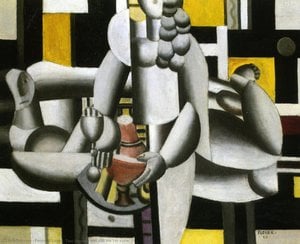
Fernand Léger's “Two Women & Still Life” stands as a cornerstone of Cubist aesthetics and a testament to the artist’s unwavering commitment to capturing the dynamism of the…
Order a reproduction →
A large, dark reddish-brown oval anchors the center of the canvas, acting as a heavy weight amidst a sea of shifting planes. Around this central anchor, thick black…

画面中心的一个白色多边形包裹着一抹深蓝色的流体形状,宛如一池静谧的油滴。在这片蓝色空间内,纤细的白线勾勒出如骨骼般的轮状结构,仿佛机器正在飞速旋转的辐条。在画面的右侧,一个边缘起伏波动的拉长红色形状,以垂直的姿态切入构图。背景是一片淡黄色的奶油色调,其间点缀着厚重的黑色有机形态,这些形态如同画框一般,将中心元素环绕其中。这些形状相互重叠,摒弃了传统的透视深度,创造出一个扁平且富有层次的空间,让机械的精准感与有机的曲线美在此交汇。
Order a reproduction →
请走近一些,仔细观察这些原本熟悉的桌面陈设,是如何在结构精准性的视角下发生蜕变的。在这件创作于1928年的作品中,艺术家背离了传统的写实表现,转而拥抱一种由圆柱体、球体和立方体构成的视觉语言。一张木质桌面为整个构图提供了稳固的基底,使得整体布局在保持井然有序的同时,又散发出蓬勃的生命力。你可以看到深红、亮黄与钴蓝交织在一起,在厚重的黑色轮廓线勾勒下,每一个形状都显得如此鲜明。构图不再依赖单一的光源,而是通过相互重叠的平面来构建空间,创造出一个物体以惊人的清晰度相互交错的浅层空间。这里蕴含着一种机械性的律动,通过粗线条与起伏曲线的精心布局,赋予了画面一种流动的动感。
Order a reproduction →
In the heart of the roaring twenties, as the gears of industry began to reshape the very fabric of human existence, Fernand Léger captured a moment of profound…
Commission a hand-painted copy →
In the vibrant tapestry of early twentieth-century modernism, few works resonate with as much structural vitality as Fernand Léger’s "The Three Musicians." This masterpiece is far more than…
Commission a hand-painted copy →
创作于1923年的费尔南·莱热作品《红底上的两个裸体人物》,绝非仅仅是对两个女性形象的简单描绘;它是机械主义立体主义(Mechanistic Cubism)运动的强力浓缩,更是对20th世纪初欧洲日益增长的焦虑与痴迷的深刻反思。莱热出生于诺曼底的阿让唐,原名约瑟夫·费尔南·亨利·莱热,他最初接受的是建筑学训练,但最终在绘画中找到了自己的真谛——这种驱动力源于他渴望将机器时代的动感转化为画布上的生命力。这件作品正是这一雄心的典范:它大胆地背离了传统的表现手法,将几何形式与一种超然的观察感置于情感写实主义之上。
Order a reproduction →
Fernand Léger's "Ballet Mécanique," painted in 1924, isn’t merely a depiction of a scene; it’s a vibrant, pulsating embodiment of the machine age and its impact on human…
Commission a hand-painted copy →
Step closer to observe how the familiar objects on this table have been transformed. In this 1927 composition, we find a quiet arrangement that rejects the soft edges…
Order a reproduction →
A rhythmic energy surges through the canvas as geometric shapes collide and overlap in a dense, industrial dance. Cylinders, cones, and flat planes interlock, creating a landscape where…
Commission a hand-painted copy →
Fernand Léger's "Nude Model in the Studio," painted in 1912-13, stands as a cornerstone of Cubist art and embodies the movement’s radical departure from traditional artistic conventions. More…
Commission a hand-painted copy →
Fernand Léger’s “Head Constructor,” painted in 1950, isn't merely a portrait; it’s a distilled essence of the burgeoning modernity that gripped Europe after World War I. This striking…
Commission a hand-painted copy →
A Symphony of Steel and Geometry The year 1920 marked a profound shift in the visual language of modernity, and few works capture this seismic transition as vibrantly…
Order a reproduction →
A Symphony of Form and Feeling: Exploring Fernand Léger’s “Three Characters” Fernand Léger's 1924 painting, *“Three Characters,”* is a pivotal work exemplifying his distinctive contribution to Cubism –…
Bring it home →
A Symphony of Steel and Soul: Exploring Fernand Léger’s “The Great Stop” Fernand Léger's "The Great Stop," painted in 1931, isn’t merely a depiction of horses and musicians;…
Bring it home →
The Rhythms of an Urban Symphony Fernand Léger’s 1919 masterpiece, Characters in the City, is far more than a mere depiction of metropolitan life; it is a vibrant…
Commission a hand-painted copy →
A fragmented landscape emerges through a complex vocabulary of cones, cylinders, cubes, and planes. The composition deconstructs reality into overlapping geometric shapes that intersect across a shallow, flattened…
Bring it home →
A Symphony of Form and Industrial Grace The year 1922 marked a transformative era in the Parisian avant-garde, and Fernand Léger’s Still Life with Candlestick stands as a…
Order a reproduction →
To stand before this 1924 canvas is to encounter the very pulse of a changing era. There is a certain structural honesty in how the composition unfolds, utilizing…
Bring it home →
Created in 1912 by Fernand Léger, Smoke is an oil on canvas painting that belongs to the Cubism style. This cityscape features various buildings and structures characterized by…
Order a reproduction →
A Dynamic Synthesis: Fernand Léger’s “The Rider Acrobat Juggler” (1921) Subject & Composition: This captivating work presents a stylized figure – a synthesis of rider, acrobat, and juggler…
Commission a hand-painted copy →
A Vision of Creation: Fernand Léger’s “The Creation of the World Bird drawing of Costume” This striking artwork by Fernand Léger, created in 1923, is a powerful example…
Bring it home →
The composition deconstructs an urban landscape into a rhythmic arrangement of overlapping planes and intersecting lines. Through a Cubist lens, the city is stripped of its traditional perspective,…
Bring it home →
In the heart of the early twentieth century, as the gears of industry began to turn with an unstoppable rhythm, Fernand Léger captured the very pulse of modernity…
Order a reproduction →
A Life Forged in Form: The World of Fernand Léger Fernand Léger, born Joseph Fernand Henri Léger in 1881 amidst the rural landscapes of Argentan, Normandy, stands as…
Commission a hand-painted copy →
To step into the world of Fernand Léger is to witness the heartbeat of the modern age captured in pigment and form. His 1928 masterpiece, "Keys (Composition)", serves…
Order a reproduction →
Fernand Léger: A Pioneer of Mechanistic Cubism Fernand Léger stands as one of the most distinctive figures in twentieth-century art, a painter who relentlessly pursued his own vision…
Bring it home →
In the quiet, hallowed atmosphere of the Saint-Joseph Chapel in Audincourt, France, lies a masterpiece that defies the traditional boundaries between the sacred and the industrial. Fernand Léger’s…

Fernand Léger's "Transport Forces," completed in 1937, stands as a cornerstone of Purism – an artistic movement that vehemently rejected Impressionism’s fleeting effects and embraced instead the bold…
Order a reproduction →
A Glimpse into Modernity’s Rhythm: Deconstructing Léger's “The King of Cards” Fernand Léger’s 1927 painting, “The King of Cards,” is not merely a depiction of an interior scene;…
Order a reproduction →
In the landscape of twentieth-century modernism, few works capture the rhythmic pulse of life with as much structural integrity and vibrant energy as Fernand Léger's 1950 masterpiece, 'The…
Bring it home →
Geometric Fragments and Industrial Logic A vase brimming with apples occupies the center of this 1916 composition, though the fruit has been stripped of its organic softness. In…
Bring it home →
A Symphony of Form and Feeling: Exploring Fernand Léger’s “Study for Breakfast” Fernand Léger's "Study for Breakfast," completed in 1954, transcends mere representation; it embodies the very spirit…
Commission a hand-painted copy →
Fernand Léger: Capturing the Rhythm of Industry Through Geometric Abstraction Fernand Léger’s artistic legacy rests upon a singular achievement – transforming the anxieties and exhilarations of the burgeoning…
Commission a hand-painted copy →
A Geometric Echo of Modernity: Delving into Léger’s “The Three Companions” Fernand Léger's 1920 painting, *The Three Companions*, isn’t merely a depiction of figures; it is a bold…
Order a reproduction →
In the quiet, hallowed spaces of Audincourt, France, there exists a window that does not merely permit light to pass through, but rather transforms it into a rhythmic…

In the quiet, hallowed atmosphere of Audincourt, France, light does not merely illuminate; it transforms. Fernand Léger’s The Sacred Heart of Audincourt, completed around 1950-1951, stands as a…

In the quiet, hallowed atmosphere of post-war Europe, Fernand Léger’s "Sacred Heart of Audincourt" emerged not merely as a religious ornament, but as a profound philosophical manifesto. Completed…

The painting is a colorful depiction of people in various positions. There are three main figures in the scene, with one person standing on top of another figure…
Bring it home →
In the wake of the First World War, as Europe grappled with the profound tremors of a changing era, Fernand Léger captured something far more enduring than mere…
Order a reproduction →
In the vast landscape of twentieth-century modernism, few artists captured the rhythmic heartbeat of the industrial age as vibrantly as Fernand Léger. His 1952 masterpiece, Composition, serves as…
Order a reproduction →
The Geometry of Sustenance A monochrome human face occupies the center of this composition, captured in the act of consuming an apple, a banana, and grapes. These organic…
Bring it home →
Fernand Léger's “The Bathers (The Dancers)” stands as a cornerstone of Cubism and a poignant reflection on the burgeoning dynamism of the early 20th century. Completed in 1912,…
Order a reproduction →
The canvas breathes with an energy that defies stillness—a palpable pulse emanating from Fernand Léger’s 1918 masterpiece, "Contrast of Forms." More than just a depiction of a man…
Commission a hand-painted copy →
In the quiet aftermath of a world reshaped by conflict, Fernand Léger’s "The Sacred Heart of Audincourt" emerges as a luminous testament to resilience and renewal. Completed around…

In the pantheon of modernist masterpieces, few works capture the rhythmic pulse of the machine age as vibrantly as Fernand Léger’s “Three Musicians.” Created in 1930, this iconic…
Bring it home →
Fernand Léger's "The Wedding," painted in 1911, isn’t merely a depiction of a social event; it’s a vibrant manifesto of the burgeoning modern age. Born amidst the rural…
Order a reproduction →
In the vibrant landscape of early twentieth-century modernism, few works capture the pulse of a changing world as electrifyingly as Fernand Léger’s “The Staircase.” Painted in 1913, this…
Bring it home →
In the vibrant landscape of early twentieth-century modernism, few works capture the rhythmic pulse of the machine age as elegantly as Fernand Léger’s Red Pot. Created in 1926,…
Bring it home →
In the quiet tension of Fernand Léger’s 1948 masterpiece, Mechanical Elements on a blue background, we encounter a visual dialogue that transcends the mere arrangement of shapes. This…
Bring it home →The four subjects that return most often among these masterpieces, with the finest example of each.
The 8 museums that hold the most of the paintings on this page.
| Museum | City | Works by 费尔南·莱热 | Paintings from this list |
|---|---|---|---|
 纽约现代艺术博物馆 |
纽约 | 14 | 三位女性, 早餐, The City |
 费城艺术博物馆 |
费城 | 8 | 城市(碎片,第三状态), Contrast of Forms, 脚手架(初稿) |
 芝加哥艺术学院 |
芝加哥 | 6 | Composition in Blue, Reclining Woman, 静物 |
 大都会艺术博物馆 |
纽约 | 6 | The Builders, Mechanical Elements |
 巴黎市立现代艺术博物馆 |
巴黎 | 5 | The Man with the Pipe, Woman with Mirror |
 克羅勒爾·穆勒博物館 |
奧特洛 | 4 | 森林中的裸体, Mechanical Element |
 古根海姆博物馆 |
纽约 | 4 | Characters in the City, Mural Painting |
 提森·博爾涅米薩博物館 |
馬德里 | 3 | 桥 |

1919年,费尔南·莱热创作了这幅具有里程碑意义的画作,它不仅仅是对城市景观的描绘,更是对新兴工业时代充满力量的宣言。这幅作品充分展现了莱热成熟风格的魅力,以其动态的形式、大胆的色彩和对现代生活本质的深刻探索而著称。它并非简单地复制现实,而是揭示了隐藏在现代世界背后的结构与节奏。

费尔南·勒热 (Fernand Léger) 的《机械人》(Le Mécanicien),创作于1920年,不仅仅是一幅画作,更是一曲对工业时代精神的赞歌。这幅作品以其大胆的构图和鲜明的色彩,完美地融合了立体主义的解构手法与新时代的机械美学,成为了早期二十世纪先锋艺术的杰出代表。它并非是对传统绘画技法的简单延续,而是勒热对现代社会变革的一次深刻反思与视觉诠释。
In the quiet intersection of Surrealist dreamscapes and the rigid precision of Cubism lies Fernand Léger’s 1932 masterpiece, The Bather. This is not merely a painting of a…
A Rhythmic Celebration of Form and Color Fernand Léger’s Dance is far more than a mere depiction of movement; it is a vibrant, pulsating symphony of color and…

费尔南·勒热的《大游行》(Le Grand Défilé)并非仅仅是一幅画作,它更像是一场视觉盛宴,一场对现代生活的欢快颂歌。1954年创作的作品中,人影熙攘,机械元素穿插其中,构成了一幅充满活力与动感的画面。这幅作品捕捉了都市的喧嚣、节日的狂欢,以及工业时代蓬勃发展的力量。勒热巧妙地将有机形态与工业意象融合在一起,既展现了和谐之美,也暗示着一种微妙的冲突——那是现代社会快速变革带来的复杂感。
城市 (Chéngshì) (1919). Next come 机械师 (1920) and 三位女性 (1921).
38 years old: 城市 (Chéngshì) dates from 1919 and 费尔南·莱热 was born in 1881.
城市 (Chéngshì), 机械师, 三位女性, 森林中的裸体, 大游行, 婚礼, 早餐, 手持花束的女人, Composition in Blue and 桥. The ranking above gives the year and the museum of each.
Our catalogue lists 834 works by 费尔南·莱热, dated from 1910 to 1954.
Most of them are in 纽约现代艺术博物馆 (纽约), 费城艺术博物馆 (费城) and 芝加哥艺术学院 (芝加哥). The table above lists the museums one by one.
In 1920s: 36 of the 100 works on this page date from then, among them 机械师.
The earliest on this page is 森林中的裸体 (1910), the latest 大游行 (1954).
Geometric shapes (29), Geometric forms (17) and Modernity (11), among the 100 works on this page.
Oil On Canvas: 45 of the 100 works on this page.
立体主义, as the paintings on this page show.
三位女性, 早餐 and The City are among the 5 works on this page held by the 纽约现代艺术博物馆, 纽约.
Yes. Every painting on this page can be ordered as a museum-quality, hand-painted oil reproduction or a fine art print, in the size you choose, from the painting's own page.
费尔南·莱热的故事始于诺曼底下诺尔省的阿根坦村。1881年2月4日,他作为独生子降生于这个世界。他的早年生活被法国乡村的宁静以及母亲玛丽-阿德尔·道努(Marie-Adèle Daunou)的陪伴所塑造。他的父亲是一名靠贩卖牲畜为生的商人,在费尔南还很年幼时便撒手人寰,留下这个孩子在母亲的抚育下长大,那是一个充满了虔诚与谦逊气息的家庭。
这种在诺曼底乡村景观中的成长经历,与他日后在法国文化繁华中心所过着的生活形成了鲜明的对比。虽然他的根基扎于土地和农业生活的体力劳动之中,但他的精神却被现代社会的复杂性所吸引。最终,他的影响力远远超出了阿根坦的边界,成为一位跨越多种艺术领域的探索者。他并未将自己局限于画布之上,而是试图通过雕塑和电影的动态影像来表达他的视觉愿景。
他的生命轨迹是在童年时期那种有机的质感与城市中结构化的机械节奏之间不断穿梭。这种二元性定义了他的存在,随着他穿行于这个变革世纪的更迭之中。他的道路从未平坦,始终伴随着童年传统世界与未来快速工业脉动之间的张力,而他最终通过艺术,成为了定义这种未来节奏的关键人物。
费尔南·莱热的艺术愿景,其根基深植于法国下诺曼底奥恩省阿根坦的田园风光之中。出生于一个以畜牧业为生的家庭,他的早年岁月被土地的质感与农业生活的律动所塑造。这种对真实、劳作世界的深刻感知,如同一种无声的力量,潜伏在他日后更为复杂的艺术探索之下。作为独生子,他在一位虔诚且谦逊的母亲抚育下成长,最初的生命轨迹被引向了严谨的建筑学领域。从1897年到1899年,他全身心地投入到这项技术性手艺中,学习空间的逻辑以及精确绘图的必要性。
到了1900年,城市的召唤变得愈发强烈,令他无法抗拒,于是他移居巴黎。在当时,他通过担任建筑绘图员来维持生计,这份工作要求对线条与比例有着极其敏锐的洞察力。虽然建筑学的正式训练为他奠定了结构理解的基础,但他的心早已开始向画布偏移。他曾试图考入享有盛誉的巴黎美术学院,尽管未能获得正式学生的身份,但他并未因此气馁,而是以旁听生的身份在学校学习,在学术体制的边缘汲取大师们的教诲。这段求学时光,虽然有时被视为一段迷茫的探索期,但对于磨炼他的技术功底至关重要——正是这些技艺,让他最终能够以自己的方式,去拆解并重构这个世界。
1907年,当这位艺术家在秋季沙龙(Salon d'Automne)邂逅塞尚的回顾展时,一场深刻的艺术变革在他内心悄然发生。这次邂逅犹如一颗催化剂,将他从少年时代那种柔和的印象主义风格中剥离出来,引向一种更具结构性的视觉感知方式。他开始穿透事物的表象,转而探寻定义世界的底层几何逻辑。到了1909年,随着他与亚历山大·阿基潘科、雅克·利普希茨、马克·夏加尔以及罗伯特·德劳内等艺术巨匠的交汇,他在巴黎创意圈的影响力日益增强。这些邂逅绝非简单的社交往来,而是新思想的激烈碰撞,共同塑造了他不断演进的艺术愿景。
随着岁月的流转,费尔南·莱热逐渐进入了“皮托小组”(Puteaux Group)的视野,这个被称为“黄金分割”(Section d'Or)的艺术家圈子成为了他的精神栖息地。他与让·梅津格和亨利·勒弗科尼埃并肩作战,共同探索这种全新艺术语言在数学与结构上的无限可能。他并不满足于仅仅追随前人的足迹,而是试图在那个时代标志性的破碎平面与重叠形态中,开辟出属于自己的路径。这段充满张力的实验时期,最终促成了他在1911年独立沙龙展(Salon des indépendants)上的首次重大亮相,并在那里展示了他的杰作——《森林中的裸体》。
第一次世界大战的动荡将这位艺术家从巴黎的画室中生生拽出,推向了前线残酷的现实。从1914年到1917年,他在法国军队中服役,在阿贡森林度过了两年艰苦卓绝的岁月。这场冲突不仅仅是他生命中的一段背景,更是一种彻底改变了他对形式认知的变革力量。1916年,一场毒气袭击险些夺走他的生命,在他休养期间,周围的世界正被工业毁灭的巨大力量重新塑造。即便是在那年短暂的休假中,他也无法抑制创作的冲动,创作出了《抽烟斗的士兵》。这件作品捕捉到了一种全新的现实感——在那个战场被机器统治的时代,人类的躯体也开始呈现出机器般的特质。
到了1917年,他的创作精神发生了显著的转向,这标志着他所谓的“机械时期”的开端。他在现代战争与工业的工具与技术中,发现了一种奇特而富有节奏感的律动之美。那些圆滑的管状形态与机械零件的精准感,成为了他全新的视觉语言。在他眼中,这些物体并非冰冷或缺乏情感的,相反,他拥抱了它们的力度,以及它们在组织现代生存之混沌中所展现出的秩序感。战争剥离了他早期作品中那些柔和的边缘,取而代之的是一种棱角分明、结构清晰的质感,如同一个正在剧烈变革的时代中,那些钢铁与活塞所散发出的力量。
他的画笔带着一种律动感,甚至拥有一种近乎工业化的精准,试图捕捉那个剧变时代的脉搏。他背离了过去那种柔和、晕染的阴影处理方式,转而选择通过一种充满力量感的几何语言来构建画面。这种探索催生了一种独特的个人化立体主义,被评论界戏称为“管状主义”。在这种风格中,世界通过圆柱形、圆锥形和立方体的形态被重新构想,创造出一种既厚实稳重又充满动感的体积感。他不仅仅是在描绘物体,更是在探寻物体内在的、本质的结构逻辑。
他所选用的色彩与其填充的形状一样,都充满了张力。他偏爱以原色为主的色调,并常以鲜明的黑白进行点缀,这有助于勾勒出主体清晰的边界。他并不依赖传统的错觉主义手法,而是以大胆、扁平的色块来涂抹色彩。他经常使用厚涂法(impasto),这种技法强调了颜料在画布上的物质存在感。这种质感化的处理方式确保了他的作品具有一种扎实、写实的物质感,恰好映射出他所崇尚的机器与城市建筑。他的形象往往呈现出光滑、机械化的轮廓,模糊了有机的人体形态与现代工业精密工程之间的界限。
全球冲突的动荡浪潮最终将这位艺术家从巴黎的艺术圈中抽离,带到了大西洋的另一端。在1940年至1945年间,他生活在美国,这段经历为他长期以来试图在画布上转译的现代世界提供了全新的视角。这段海外时光为他漫长的艺术演变提供了一个停顿,成为他最终回归法国故土之前的过渡时刻。
回到祖国后,他的个人生活发生了重大变化。1952年2月,他与纳迪亚·霍达塞维奇(Nadia Khodasevich)结为连理。这段婚姻开启了他生命的最终篇章,在此期间,他持续创作出风格多样的作品,从宏伟的壁画到细腻的彩色玻璃窗,不一而足。即便步入晚年,他在国际舞台上的声望依然稳固。1955年,他荣获圣保罗双年展大奖,这一至高无上的荣誉与他逝世的年份重合。1955年8月17日,费尔南·莱热在法国伊维特河畔吉夫逝世。
费尔南·莱热留下的印记,早已超越了他所处时代的先锋艺术圈。通过在抽象艺术与具象表现之间架起桥梁,他为艺术家提供了一种与现代世界对话的新方式,而无需完全抛弃人类主体。他的创作手法让几何结构的逻辑与人物及物体的可识别存在之间展开了一场深刻的对话。这种在纯粹概念与触手可及的实体之间寻找平衡的能力,深刻地塑造了此后许多艺术流派的发展方向。
他对形式的大胆简化以及对大规模生产美学的痴迷,无异于波普艺术运动的先驱。他在机器时代重复且功能性的本质中发现了一种独特的美感,这种视角在后来引起了新一代创作者的强烈共鸣。诸如 罗伊·利希滕斯坦 和 安迪·沃霍尔 等艺术家,从他对大胆轮廓和机械意象的实验中,清晰地汲取灵感,并将其延伸至对大众文化的探索之中。他为那个最终歌颂工业与商业元素的时代,提前准备好了视觉语言——而那些元素,正是他曾试图将其转化为画布生命的灵魂。
若想亲身感受他艺术愿景的实体存在,你或许需要踏上一段前往法国南部的旅程,前往滨海阿尔卑斯省的比奥(Biot)。在这里,坐落着专门用于研究与保护其创作成果的国家费尔南·莱热博物馆(Musée national Fernand Léger)。这座博物馆就安置在马斯圣安德烈别墅(Mas Saint-André)内,这里曾是艺术家本人的居所。在这些墙垣与环绕的庭院之间,他那些色彩斑斓的陶瓷雕塑找到了最契合的归宿,让观者得以直观地观察他的艺术形态是如何与地中海景观的光影与空间交织共鸣的。
除了这处专门的艺术圣地,他的画布与雕塑作品还被珍藏在多家重要的艺术机构之中。法国的艺术与历史博物馆(Musée d'Art et d'Histoire)也保存有他的作品系列,确保他在更宏大的法国艺术叙事中占据一席之地。通过这些馆藏,人们得以持续探究他是如何将机器时代的能量转化为静止却又充满律动的视觉形式。对于那些追寻其独特美学的旅行者来说,可以在以下几家主要收藏机构中寻得他的踪迹:
虽然他的影响力也潜移默化地流淌在后世艺术家的作品中,但亲眼见证他笔触最直接的方式,仍是走进这些历史悠久的艺术殿堂。无论是在博物馆的静谧中凝视那些大胆的圆柱形构图,还是在花园的幽静中观赏他的雕塑,观者所面对的始终是那份定义了他艺术生涯的、极具结构感的清晰美学。他的遗产被稳固地锚定在这些特定的地点,那些画作中沉重而机械的律动,正静静地等待着每一位试图探寻其几何真谛的寻觅者。


