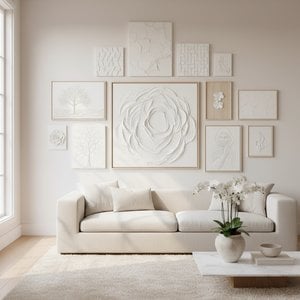
A Life Dedicated to the Essence of Painting
Robert Ryman, born in Nashville, Tennessee, in 1930 and passing away in 2019, wasn’t interested in depicting the world; he was captivated by painting itself. His journey began not with a formal artistic education geared towards representation, but with studies at the Tennessee Polytechnic Institute and George Peabody College for Teachers – foundations that would later inform his disciplined approach. A stint in the United States Army from 1950 to 1952 instilled a sense of structure, perhaps subtly influencing the rigorous self-examination that characterized his artistic practice. However, it was his relocation to New York City in 1952 that proved pivotal. Securing a position as a security guard at the Museum of Modern Art wasn’t merely a job; it was an immersion into the heart of modern and contemporary art. Surrounded by masterpieces from Abstract Expressionists like Mark Rothko, Willem de Kooning, Clyfford Still, and Jackson Pollock, Ryman began to question not *what* could be painted, but *how*.From Jazz Aspirations to Monochromatic Visions
Interestingly, Ryman’s initial artistic ambitions lay elsewhere. He harbored dreams of becoming a jazz saxophonist, even taking lessons with the renowned pianist Lennie Tristano. This musical pursuit wasn't abandoned in vain; it profoundly shaped his understanding of composition and rhythm – elements that would later manifest in the subtle variations within his seemingly austere canvases. The discipline required for mastering an instrument translated into a meticulous approach to painting, where every brushstroke, every layer of paint, held significance. Around 1955, he began experimenting with painting, gradually moving towards what would become his signature style: white-on-white abstractions. This wasn’t simply about reducing art to its most basic elements; it was a radical exploration of materiality, light, and space. He deliberately limited his palette, often employing square canvases or metal surfaces, focusing on the very act of painting and the inherent qualities of the materials themselves.A Materialist Approach: Beyond Minimalism
Ryman’s work is frequently associated with minimalism, but he resisted that categorization, preferring to identify as a “realist.” This distinction is crucial. He wasn't striving for reductive forms or impersonal surfaces; rather, he aimed to present his materials – canvas, linen, steel, aluminum, plexiglas, vinyl, fiberglass, and countless others – at their most honest and direct. His experimentation extended beyond the support itself, encompassing a diverse range of media including oil, acrylic, encaustic, Lascaux acrylic, casein, enamel, pastel, graphite, guache, and enamelac. The *Classico* series, begun in the late 1960s, exemplifies this approach. These works involved attaching heavy white paper to walls with masking tape, painting them with shiny acrylic, then removing the tape to reveal traces of the process – a testament to the act of creation itself. The *Surface Veil* works, starting in the 1970s, further explored transparency and opacity, creating membrane-like effects on fiberglass or cotton/linen supports. He wasn’t interested in illusion; he wanted viewers to experience the painting as an object in space, a tangible entity with its own unique presence.Legacy and Lasting Influence
Robert Ryman's impact on contemporary art is undeniable. He challenged conventional notions of representation, expanded the possibilities of abstraction, and redefined our understanding of what a painting could be. His work wasn’t about depicting something *else*; it was about being itself – a self-referential exploration of the medium. While often categorized alongside minimalists, Ryman transcended such labels, forging his own path and influencing generations of artists who followed. Throughout his career, he exhibited extensively in major museums and galleries worldwide, receiving numerous accolades including election to the American Academy of Arts and Letters in 1994. His legacy isn’t simply a body of work; it's a profound questioning of artistic conventions and an unwavering commitment to the essential qualities of painting. He leaves behind not just canvases covered in white paint, but a lasting invitation to see – truly *see* – the world around us with fresh eyes.问答详情
在哪里可以按艺术流派浏览 Robert Ryman 的作品?
您可以在Robert Ryman的所有艺术流派页面上,按艺术流派浏览其作品。
在哪里可以按主题查看Robert Ryman的作品分布?
Robert Ryman 的 主题图谱 是一个按主题对艺术家作品进行索引的页面。
在哪里可以查看 Robert Ryman 作品的色彩风格?
Robert Ryman 作品的色彩特征展示在艺术家的 色彩基因 页面上。
Robert Ryman 出生于哪个城市和国家?
Robert Ryman 出生于 United States of America 的 Nashville。
我可以在虚拟博物馆中参观Robert Ryman的作品吗?
您可以在Robert Ryman的3D 博物馆页面中,通过3D展厅欣赏其艺术作品。
Robert Ryman 的创作时期属于哪个历史阶段?
Robert Ryman 的创作时期处于 Modern 时期。这一时期确立了艺术家在历史中的地位。
如何查看 Robert Ryman 的所有作品?
您可以在 Robert Ryman 的 全部作品 页面上浏览其在 本网站 上的所有作品。
如何按特定色调查找 Robert Ryman 的作品?
若要按特定色调查找 Robert Ryman 的作品,请访问艺术家的 按色调分类 页面。