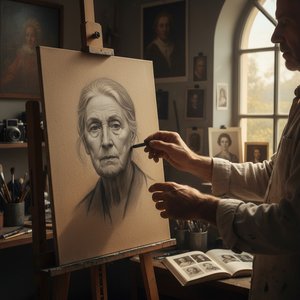
The Quiet Elegance of Marcin Jabłoński
In the tapestry of nineteenth-century Polish art, few names evoke the intimate grace of the Biedermeier era quite like Marcin Jabłoński. Born in 1801, this master of the brush navigated a period of profound cultural identity for Poland, capturing the essence of his era through a lens of delicate realism and soulful portraiture. His life and work serve as a window into a world where the quiet dignity of the individual was celebrated through meticulous detail and an unwavering commitment to the truth of the human countenance.
Jabłoński’s artistic journey is deeply rooted in the traditions of his homeland, emerging from a landscape where art served as both a mirror to society and a vessel for national sentiment. His technique, often characterized by a masterful command of oil on canvas, allowed him to breathe life into his subjects, imbuing them with a sense of presence that transcends the mere application of pigment. Whether rendering the soft folds of a garment or the subtle glint of light in an eye, his hand moved with a precision that spoke of deep technical discipline and an empathetic connection to his sitters.
A Legacy Captured in Portraiture
The true heart of Jabłoński’s oeuvre lies in his ability to capture character. His portraits are not merely anatomical studies but psychological landscapes, where every brushstroke contributes to a narrative of the soul. One can observe this particularly in works such as his Portraits of brothers from 1832, where the familial bond is rendered with a tender, almost tactile intimacy. Through these compositions, he achieved a level of storytelling that made his subjects feel eternally present, bridging the gap between the historical moment and the contemporary viewer.
His repertoire extended beyond the formal studio portrait to include evocative genre scenes that captured the spirit of Polish life. A notable example is his 1845 work, Krakowianka, which showcases his ability to blend cultural iconography with a naturalistic charm. In such pieces, Jabłoński does more than document a costume or a tradition; he captures the very pulse of the Kraków streets, immortalizing the folk elegance and the vibrant social fabric of the nineteenth century.
Historical Significance and Enduring Presence
Though the specific details of his later years remain shrouded in the soft shadows of history—with records suggesting his passing around 1870 or 1876—the impact of his work remains undeniably luminous. His paintings have found prestigious homes, with significant pieces residing in collections such as the National Museum in Kraków, ensuring that his contribution to Polish heritage is preserved for future generations.
The enduring allure of Marcin Jabłoński’s art lies in its ability to evoke nostalgia and reverence simultaneously. To look upon a Jabłoński painting is to engage in a silent dialogue with the past, experiencing a period of history through the refined, emotive language of his brush. His legacy continues to resonate within the halls of museums and private collections alike, standing as a testament to the power of portraiture to preserve the dignity of the human spirit against the relentless passage of time.
问答详情
Marcin Jabłoński 的艺术生涯是如何划分为不同时期的?
您可以在艺术家的 艺术历程 页面上查阅 Marcin Jabłoński 作品的编年史,其作品按创作顺序分章节依次呈现。
在哪里可以按氛围浏览 Marcin Jabłoński 的作品?
Marcin Jabłoński 的 情境空间 汇集了该艺术家的多件作品,并按心情分类呈现。
如何按特定色调查找 Marcin Jabłoński 的作品?
若要按特定色调查找 Marcin Jabłoński 的作品,请访问艺术家的 按色调浏览 页面。
哪里可以浏览Marcin Jabłoński的所有作品?
您可以在 Marcin Jabłoński 的 全部作品 页面上浏览其在 本站 上的所有作品。