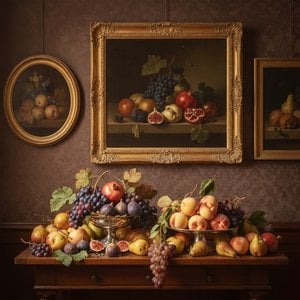
The Quiet Elegance of Johan Johnsen
In the twilight of the seventeenth century, a period defined by the opulent flourishes of the Baroque, the works of Johan Johnsen offered a window into the meticulous beauty of the natural world. A German painter active during the years 1653 to 1708, Johnsen occupied a space in art history where precision met poetry. While much of the era's grander art focused on sweeping historical narratives and dramatic religious fervor, Johnsen’s legacy resides in the intimate, the tactile, and the exquisitely detailed. His ability to capture the fleeting essence of life—the dew on a petal or the luster of a shell—remains a testament to his mastery of the still life genre.
Though historical records regarding his early training remain sparse, Johnsen’s stylistic fingerprints suggest a deep immersion in the traditions of Northern European realism. His work reflects a profound fascination with the textures of existence, moving beyond mere representation to evoke a sensory experience for the viewer. Whether depicting a bountiful arrangement of flora or the decadent spread of a feast, his compositions possess an inherent rhythm that guides the eye through a landscape of light and shadow.
A Mastery of Light and Texture
The true brilliance of Johnsen’s oeuvre lies in his technical command over the interplay of light and organic matter. To observe one of his compositions is to witness a silent dialogue between the artist's brush and the physical world. He possessed an uncanny ability to render the translucency of flower petals and the heavy, succulent weight of ripening fruit, creating a sense of depth that feels almost tangible.
His approach to the still life was characterized by several key elements:
- Luminous Detail: The use of light to define form, often highlighting the delicate edges of botanical specimens to create a lifelike glow.
- Textural Contrast: A sophisticated layering of surfaces, ranging from the smooth, reflective surface of a silver goblet to the rugged, organic exterior of a lobster or a weathered stone.
- Compositional Balance: An arrangement of objects that feels both spontaneous and carefully orchestrated, leading the viewer through a narrative of abundance and decay.
In works such as Still Life with a Bouquet of Flowers, one can sense the artist's devotion to the ephemeral. There is a subtle melancholy woven into his beauty; by capturing these objects in their peak moment of perfection, he simultaneously acknowledges the inevitable passage of time—a hallmark of the vanitas tradition that permeated much of the art produced during his lifetime.
Legacy and Historical Significance
While Johan Johnsen may not have sought the monumental fame of his contemporaries who painted massive altarpieces or royal portraits, his contribution to the evolution of the still life remains significant. He helped refine a visual language that celebrated the quiet wonders of the domestic and natural spheres. His influence can be traced through the continued fascination with botanical accuracy and the celebration of material abundance in European painting.
Today, his works serve as vital historical documents, reflecting the aesthetic values and the burgeoning scientific curiosity of the late seventeenth century. Through his eyes, we are invited to slow down and appreciate the intricate complexities of the small, often overlooked details of our world. His paintings are not merely depictions of objects, but meditations on presence, beauty, and the enduring grace of the natural order.
问答详情
Johan Johnsen 的创作时期属于哪个历史阶段?
Johan Johnsen 的创作活跃于 Early Modern 时期,这一时期确立了艺术家在艺术史上的地位。
是否有关于Johan Johnsen所创作的所有主题的概览?
主题索引 页面按主题对 Johan Johnsen 的作品进行了分类索引。
是否有Johan Johnsen作品的时间线?
您可以在Johan Johnsen的作品时间轴页面上按时间顺序查看其作品。
目前目录中共有多少件 Johan Johnsen 的作品可供浏览?
您可以在 全部作品 页面浏览由 Johan Johnsen 创作的 4 件作品 件作品。