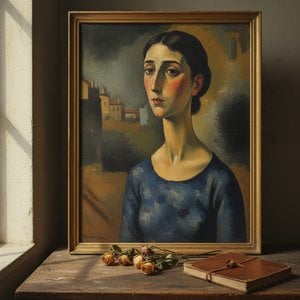
The Quiet Search for Form
Igor Hudcovič lived a life shaped by the subtle shifts of light and the weight of thought. Born in Bratislava, his early years were spent under the guidance of Rudolf Fila at the SŠUP in Bratislava. This period was not merely about learning technique, but about a developing way of seeing. His early work often found its way into the realm of applied graphics and the artistic poster, where the clarity of a line meets the necessity of a message. He did not look toward the loud or the chaotic; instead, his gaze turned inward, seeking a more meditative way to interpret the world around him.
His work often feels like a quiet conversation with existence. There is a specific tension in his compositions, a sense of looking at the space between things rather than the things themselves. He moved through the decades with a focus on the philosophical, turning his hand to drawing, graphic design, and painting. His presence in the art scene was marked by this steady, contemplative rhythm, avoiding the frantic energy of the era to focus on the essence of being.
A Language of Lines and Layers
The evolution of his practice shows a man deeply interested in the boundaries of perception. His sketches and paintings often grapple with the concept of time and the human condition. In the mid-1980s, his output became a way to map out these internal territories. He explored themes that felt both personal and universal, often using the medium of graphics to strip a subject down to its most honest form.
- The exploration of space and dimension in his mid-eighties works.
- A focus on the relationship between the individual and the concept of time.
- The use of graphic design as a foundation for more abstract, meditative painting.
- A recurring interest in the interplay between light and shadow in his drawings.
His technical approach was grounded in the discipline of the draftsman. Whether he was working on a poster or a large-scale painting, there was a sense of intentionality in every mark. He was a man of many tools—a draftsman, a graphic artist, and a painter—each role feeding into the next. His work from the late 1980s, particularly his series of reflections on man and time, suggests a mind constantly trying to reconcile the physical presence of a person with the abstract nature of their existence.
The Final Marks
By the early 1990s, his work continued to refine itself, moving through various stages of drawing and composition. His later years were spent in Banská Bystrica, where he continued to develop his visual language until his death in 1995. Even in his final years, the focus remained on the core elements of his craft. He left behind a body of work that does not demand attention through volume, but through the quiet strength of its inquiry. His legacy is found in the way he approached the canvas—not as a space for spectacle, but as a place for thought.
问答详情
在哪里可以按艺术流派浏览 Igor Hudcovič 的作品?
您可以在艺术家的 全部流派 页面中查看 Igor Hudcovič 所属的艺术流派,该页面按流派对作品进行了分类。
我可以通过色调来浏览 Igor Hudcovič 的作品吗?
按色调浏览 页面按色调将 Igor Hudcovič 的艺术作品进行了分类。
在哪里可以按时间顺序欣赏 Igor Hudcovič 的作品?
您可以在Igor Hudcovič的作品时间轴页面上按时间顺序查看其作品。
我可以通过主题来探索 Igor Hudcovič 的作品吗?
Igor Hudcovič 的 主题索引 旨在通过主题对艺术家的作品进行分类索引。