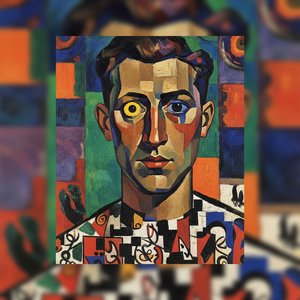
The Alchemist of Light and Logic
In the vibrant intellectual landscape of late nineteenth-century Philadelphia, Henry Lyman Saÿen emerged as a figure of profound and rare duality. He was a man who inhabited two seemingly disparate worlds: the precise, empirical realm of the scientific laboratory and the emotive, fluid sanctuary of the artist’s studio. Born in 1875, Saÿen’s early education at the Central Manual Training School instilled in him a rigorous understanding of engineering and mechanics—a foundation that would later become the silent architect of his visual language. While many of his contemporaries sought only to capture the surface of the world, Saÿen possessed a unique obsession with what lay beneath. As a pioneer in the design of X-ray tubes, he mastered the technology required to peer through flesh and bone, an experience that fundamentally altered his artistic perception. To Saÿen, the ability to visualize internal structures was not merely a scientific triumph but a spiritual metaphor for art itself; he sought to use his brush to uncover the hidden geometries and essential truths residing within the natural world.
From Impressionist Radiance to Geometric Essence
The evolution of Saÿen’s style serves as a captivating chronicle of the shifting tides of American Modernism. His early works were deeply rooted in the luminous, atmospheric traditions of Impressionism, characterized by a delicate play of light and a soft, evocative palette. In masterpieces such as The Thundershower, one can witness his ability to capture the ephemeral energy of nature through fluid brushwork and a sense of movement that mirrors the fleeting qualities of light. However, as his fascination with scientific structure deepened, so too did the structural integrity of his compositions. Saÿen began to move away from the hazy boundaries of Impressionism, gravitating instead toward a more disciplined exploration of form and color. This transition saw him embracing the bold, simplified shapes of early Abstraction and Expressionism. His later works, such as Fugue and Newman’s House, demonstrate a masterful command of geometric arrangement, where color is used not just for decoration but to define space and rhythm. Through this progression, he bridged the gap between the sensory experience of the landscape and the intellectual rigor of abstract design.
A Legacy Written in Light and Form
Though his life was tragically cut short in 1918 at the age of forty-three, the impact of Henry Lyman Saÿen remains a significant chapter in the history of American art. He stood as a precursor to the modern era, anticipating the stylistic shifts that would soon define the twentieth century by proving that science and art are not opposing forces, but rather two different lenses through which we might view the same reality. His ability to synthesize the mechanical precision of an engineer with the soulful intuition of a painter allowed him to create works that were both structurally sound and emotionally resonant. Today, his legacy is preserved in the collections of institutions like the Smithsonian American Art Museum, where his contributions continue to inspire those who seek beauty in the intersection of discovery and expression. His life’s work remains a testament to the idea that true vision requires both the eye that sees the surface and the mind that understands the structure.
- Notable Artistic Achievements:
- Pioneering the integration of scientific observation into abstract composition.
- Developing a unique stylistic bridge between Impressionism and early American Modernism.
- Mastery of both landscape painting and intimate, structural portraiture.
问答详情
在哪里可以参观Henry Lyman Saÿen作品的3D虚拟展厅?
Henry Lyman Saÿen 的 3D 博物馆 是一个在虚拟三维展厅中展示艺术家作品的页面。
是否有关于 Henry Lyman Saÿen 的生平年表?
Henry Lyman Saÿen 的 艺术编年史 是一个随滚动条变化的艺术时间轴,按创作时期进行章节划分,并按时间顺序呈现艺术家的作品。
Henry Lyman Saÿen 的创作时期属于哪个历史阶段?
Henry Lyman Saÿen 的创作时期处于 Modern 时期。这一时期确立了艺术家在历史中的地位。