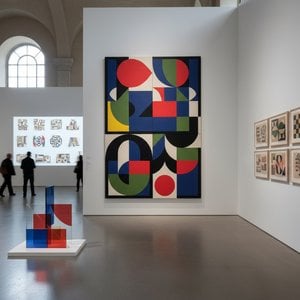
Gordon Walters: Pioneer of Māori Abstraction
Gordon Frederick Walters (1919-1995) stands as a pivotal figure in New Zealand art history, recognized for his groundbreaking fusion of Māori symbolism—particularly the koru spiral—with the principles of geometric abstraction. Born in Wellington on September 24, 1919, Walters’s artistic journey began amidst the burgeoning modernist movement and was profoundly shaped by collaborations with fellow artist Theo Schoon, fostering a unique visual language that continues to resonate today.- Early Influences & Training: Walters' formative years were marked by exposure to influential thinkers like Roger Fry and Herbert Read, whose writings championed artistic experimentation and broadened his understanding of global art traditions. He honed his skills at Wellington Technical College under esteemed instructors Ellis, Hipkins, and McCormack, absorbing techniques that would underpin his later stylistic innovations.
- The Impact of Theo Schoon: Walters’s relationship with Theo Schoon proved transformative. Their shared fascination for Māori rock art near Ōpihi River ignited a dialogue about incorporating indigenous motifs into Western abstraction. Schoon encouraged Walters to explore the work of European artists like Klee, Mondrian, and Miró—figures who championed reductive forms and visual counterpoint—inspiring him to push beyond representational constraints.
Exploring Geometric Abstraction & Māori Symbolism
Walters’s artistic evolution witnessed a decisive shift toward geometric abstraction in the mid-1950s. Influenced by artists like Victor Vasarely and Auguste Herbin, he embraced hard-edged forms and repetitive patterns—techniques honed during his studies in London and Paris—creating canvases characterized by precise lines and balanced compositions. Simultaneously, Walters drew inspiration from Māori art traditions, specifically the koru spiral, which embodies regeneration and interconnectedness. He skillfully translated these symbolic elements into abstract visual language, generating a series of distinctive images that explored fundamental artistic concepts.- Notable Works: Among his most celebrated pieces are “The Poet” (1953), showcasing the influence of Schoon’s explorations of Māori rock art and demonstrating Walters' commitment to conveying complex ideas through simplified geometric forms. His gouaches on paper, executed with meticulous attention to detail, captured a contemplative mood while simultaneously reflecting the broader aesthetic currents of European abstraction.
- Recognition & Legacy: Despite limited public engagement during his lifetime, Walters’s contribution to New Zealand art is undeniable. His pioneering approach to blending Māori symbolism and geometric abstraction established him as a cornerstone of NZ Modernism and cemented his place in the canon of 20th-century art.
The Walters Art Museum & Continued Influence
Today, Gordon Walters’s legacy lives on through exhibitions at institutions like The Walters Art Museum in Baltimore and Marshall M. Fredericks Sculpture Museum in Michigan—testaments to the enduring appeal of his distinctive artistic vision. His work continues to inspire artists and scholars alike, prompting ongoing discussions about the intersection of cultural heritage and abstract expressionism.Further Resources
For more information on Gordon Walters’s life and art, please refer to:问答详情
在哪里可以按关键词浏览 Gordon Walters 的作品?
若要按特定主题查找 Gordon Walters 的作品,请访问艺术家的 关键词分类 页面,该页面通过关键词对作品进行了分类整理。
Gordon Walters 的哪些作品浏览量最高?
有关 Gordon Walters 作品的统计数据,请参阅艺术家的 统计数据 页面。
Gordon Walters 属于哪些艺术流派?
全部流派 页面按艺术流派对 Gordon Walters 的作品进行了分类。
是否有关于 Gordon Walters 的生平年表?
Gordon Walters 的 艺术历程 是一个随滚动条变化的艺术时间轴,按创作时期进行章节划分,并按时间顺序呈现艺术家的作品。