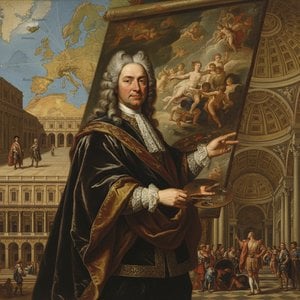
The Shadow of a Master
In the bustling studios of Naples, the air was often thick with the scent of oil and the quiet intensity of a workshop in motion. It was here, around 1650, that Giuseppe Simonelli began his life, eventually becoming a central figure in the circle of Luca Giordano. His early years were spent absorbing the rhythms of the late-Baroque style, learning to capture light and movement with a precision that mirrored his mentor. The connection between the two was so profound that, for a time, the distinction between their hands was difficult to discern. Giordano’s influence was not merely a teaching; it was a shared language of brushstrokes and color that Simonelli would carry throughout his career.
The true weight of Simonelli's skill became clear when the tides of patronage shifted. In 1692, when Giordano departed Naples for the Spanish court, he left behind a trail of unfinished commissions. The responsibility of completing these works fell to Simonelli. He was tasked with ensuring that the vision of the master was realized for the clients waiting in Naples, a duty that required both technical mastery and a deep understanding of another man's intent. This period of intense collaboration solidified his reputation as a painter capable of maintaining the high standards of the Neapolitan school.
A Life of Devotion and Collaboration
Simonelli’s work was deeply woven into the religious fabric of his city. His hands were busy with large-scale commissions that defined the sacred spaces of the era. He did not work in isolation, often finding strength in family ties to meet the demands of his patrons. His output was steady and prolific, marked by a commitment to the spiritual narratives required by the churches of Southern Italy.
- A series of 28 paintings created for the Church of the Annunziata in Aversa between 1702 and 1703, produced alongside his brother Gennaro.
- An altarpiece commissioned for Santa Maria di Montesanto in Naples.
- A significant work of Holy Martyrs for the Jesuit college in Trapani, for which he received final payment in 1686.
His ability to navigate the complexities of large-scale religious cycles allowed him to leave a lasting mark on the Neapolitan landscape. Whether working on a single altarpiece or a massive series of canvases, his approach remained consistent, focused on the clarity of the narrative and the grace of the figures.
The Final Years in Naples
As the years progressed, Simonelli’s identity as an artist became more distinct from the shadow of his teacher. While he remained a practitioner of the late-Baroque style, his hand possessed its own specific qualities in the way it handled form and composition. He continued to paint steadily, maintaining his presence in the Neapolitan art scene through the turn of the century and into the first decade of the 1700s.
He remained active in his craft until the very end, working without pause until his death in 1710. His legacy is found in the quiet corners of churches and the collections of those who value the continuity of the Neapolitan tradition. He was a painter who understood that art was often a matter of duty, a service to both the church and the masters who paved the way before him.
问答详情
在哪里可以浏览 Giuseppe Simonelli 的全部作品?
您可以在 Giuseppe Simonelli 的 全部作品 页面上浏览其在 本站 上的所有作品。
如何按年份顺序浏览 Giuseppe Simonelli 的作品?
您可以在Giuseppe Simonelli的作品时间轴页面上按时间顺序查看其作品。
Giuseppe Simonelli 是否还有其他别名或曾用名?
Giuseppe Simonelli 也被称为 Gioseppe Simonelli, Giuseppe Simanelli, Simanelli, Simonelli, G. Simonelli。
可以按颜色对Giuseppe Simonelli的作品进行排序吗?
Giuseppe Simonelli 的 色彩索引 页面按色彩对艺术家的作品进行了分类整理。