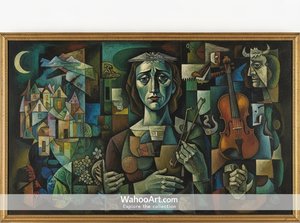
A Life of Dual Pursuits
Born in Oldenburg, Germany, Gerd Meyer led a life defined by both professional administration and artistic exploration. After completing his schooling, he initially trained with the railway administration in Osnabrück before transitioning to the financial administration. His career in the civil service saw him rise to the position of senior tax auditor, serving in Bremen, Cuxhaven, and Delmenhorst, where he also held the role of deputy office manager. Following his retirement as a tax official in 1952, he continued his professional life as a tax consultant.
Parallel to his administrative career, Meyer pursued formal artistic training, beginning with drawing lessons under Richard tom Dieck in 1914. During the First World War, he served as a soldier on the Eastern Front, where he produced fine drawings. His formal art education continued at the Bremen School of Applied Arts, where he lived from 1920.
Artistic Evolution and Style
Meyer's artistic output was characterized by a significant shift in style. In the early 1920s, he was among the few artists from Oldenburg to embrace abstraction and non-objectivity. His work during this period can be categorized into several distinct groups:
After 1930, his subject matter moved toward more realistic motifs in both his paintings and drawings. His work has been held in collections such as the Bremer Kunsthalle, the Museum Folkwang in Essen, and the Landesmuseum Oldenburg.
问答详情
在哪里可以查看 Gerd Meyer 作品的色彩风格?
Gerd Meyer 作品的色彩特征展示在艺术家的 色彩基因 页面上。
Gerd Meyer 来自哪里?
Gerd Meyer 出生于 Germany。
是否有Gerd Meyer作品的时间线?
您可以在Gerd Meyer的作品时间轴页面上按时间顺序查看其作品。
如何按特定媒介查找 Gerd Meyer 的所有作品?
您可以在Gerd Meyer的所有媒介页面上按媒介浏览其作品。