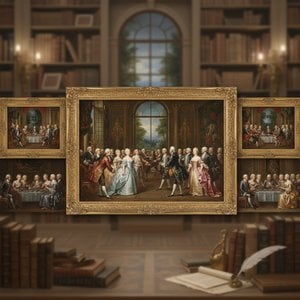
George Patten: A Victorian Portraitist of Distinction
George Patten (1801-1865) stands as a significant, yet often overlooked, figure in 19th-century British art. More than simply a portrait painter, he was a master of presentation portraits – those elaborate and theatrical commissions designed to showcase the subject’s status and wealth. His work offers a fascinating glimpse into Victorian society, capturing not just likenesses but also the aspirations and social dynamics of the era. Born in 1801, Patten's artistic journey began within his family; his father, William Patten, was a respected miniature-painter, providing an early foundation for George’s own career. This lineage instilled a dedication to detail and refinement that would become hallmarks of his style.Early Life and Artistic Training
Patten's formal training commenced at the Royal Academy Schools in 1816, where he honed his skills under various instructors. He quickly established himself as a promising young artist, gaining recognition for his early miniature portraits, notably one of his father exhibited at the Royal Academy in 1819. This initial success demonstrated an aptitude for capturing subtle nuances and conveying personality within a small format – a skill that would prove invaluable later in his career. His decision to pursue oil painting in 1830 marked a pivotal shift, allowing him to tackle larger-scale works and explore broader subject matter. A significant period of artistic development occurred during his time in Italy between 1837 and 1839, where he immersed himself in the art and culture of Rome, Venice, and Parma. This exposure profoundly influenced his style, introducing him to classical themes and techniques that would inform his later mythological and scriptural compositions.The Rise of Presentation Portraits
Patten’s career truly flourished during the mid-19th century as presentation portraits gained immense popularity among the British elite. These weren't mere likenesses; they were carefully orchestrated spectacles designed to impress. Subjects would often arrive at the studio in elaborate costumes, surrounded by attendants and props – a theatrical display intended to elevate their status and project an image of wealth and influence. Patten skillfully captured this atmosphere, imbuing his portraits with a sense of grandeur and formality. He was commissioned by prominent figures including Richard Cobden, Lord Francis Egerton, Hugh Boyd M'Neile, Baptist Wriothesley Noel, and Paganini the violinist – individuals who represented the leading voices and cultural luminaries of their time. His ability to portray these subjects with both accuracy and a subtle understanding of their personalities cemented his reputation as one of the foremost portraitists of his generation.Subject Matter and Artistic Style
Patten’s artistic repertoire extended beyond traditional portraits, encompassing mythological scenes, scriptural narratives, and fanciful compositions. His works frequently drew inspiration from classical mythology and religious iconography, demonstrating a deep appreciation for the rich traditions of Western art. Notable examples include “A Nymph and Child,” “Bacchante,” “The Passions,” and “Dante’s Descent with Virgil to the Inferno.” These pieces showcase his technical skill in rendering complex figures and dramatic settings, as well as his ability to evoke emotion through carefully chosen compositions and color palettes. His style is characterized by a refined elegance, meticulous detail, and a subtle use of light and shadow – qualities that contribute to the overall sense of realism and sophistication found in his portraits.Legacy and Historical Significance
George Patten’s contribution to 19th-century British art lies not only in his impressive body of work but also in his embodiment of a particular artistic trend: the presentation portrait. He played a crucial role in shaping this genre, elevating it to new heights of artistry and social significance. His portraits offer valuable insights into Victorian society – its values, aspirations, and social hierarchies. While he may not be as widely celebrated as some of his contemporaries, Patten’s work continues to be studied and appreciated for its technical skill, artistic merit, and historical importance. The Royal Academy's collection holds a significant number of his works, ensuring that his legacy endures for future generations of art enthusiasts. His paintings are also found in museums such as St George Church in Sopron, Hungary, and the George Daniell Museum in Miami Beach, demonstrating the breadth of his influence across Europe and America.问答详情
如何按特定主题查找 George Patten 的作品?
您可以通过艺术家关键词分类页面,按关键词探索George Patten的作品。每个关键词都汇集了相关的艺术品。
George Patten 的艺术生涯是如何划分为不同时期的?
George Patten 的艺术生涯在 艺术历程 页面上按时期逐一展开:以横向时间轴的形式呈现作品,并按创作时期划分为不同的篇章。
在哪里可以浏览 George Patten 的全部作品?
您可以在 George Patten 的 全部作品 页面上浏览其在 本站 上的所有作品。