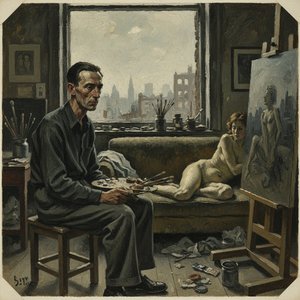
The Soul Behind the Canvas: The Life of François Schell
In the heart of Strasbourg, amidst the winding streets and historical echoes of Alsace, the life of François Joseph Schell unfolded with the quiet dignity of a master craftsman. Born on March 30, 1864, to Michel Schell and Barbe Kopp, his beginnings were rooted in the local fabric of the city. While history often remembers the grand movements of art, Schell’s story is one of intimate connection—a life dedicated to capturing the very essence of the human spirit through the medium of oil and pigment. As a painter who navigated the transition between the late nineteenth century and the mid-twentieth, his work serves as a visual bridge to a bygone era of Alsatian elegance.
Schell was not merely an observer of life but a participant in the architectural and cultural evolution of his beloved Strasbourg. His passion for art was matched by a sense of permanence; he famously took ownership of a building at 19, quai Saint-Nicolas, where he undertook a significant elevation of the structure in 1896. It was within this very space, in an atelier overlooking the historic riverbanks, that his creative vision found its sanctuary. This studio became more than just a workspace; it was a laboratory of light and shadow where the textures of reality were meticulously translated onto canvas.
A Master of the Portrait and Still Life
While many artists of his era sought to capture vast landscapes or sweeping historical dramas, Schell found his true calling in the profound intimacy of the portrait. He possessed a rare ability to look beyond the surface of his subjects, seeking the psychological depth that defines a person's character. His reputation as a premier portraitist was cemented by his ability to render the likenesses of notable figures with both precision and grace. To study a Schell portrait is to encounter the dignity of the sitter, whether they were military leaders or local luminaries.
His repertoire extended beyond the human face into the quiet, contemplative realm of still life. In these works, he demonstrated a masterful command over chiaroscuro and texture, breathing life into inanimate objects through delicate brushwork. The interplay of light on glass, the velvet weight of fabric, or the organic decay of fruit allowed him to explore themes of mortality and beauty. His technical skill ensured that even his most accessory works possessed a structural integrity and emotional resonance that commanded attention.
Legacy and Historical Significance
The breadth of Schell's influence can be glimpsed through the diverse array of individuals who sat for him, creating a visual record of the social fabric of his time. His subjects included:
- General Gouraud, representing the military prestige of the era;
- General Humbert-Berthelot, adding to the historical weight of his portraiture;
- The Prefect Borromée, capturing the administrative elegance of Strasbourg;
- The organist Munch, illustrating his connection to the musical and cultural arts.
Though he passed away in Strasbourg on April 10, 1944, leaving behind a legacy shaped by decades of dedicated practice, the impact of François Schell remains etched in the historical archives of Alsace. He was an artist who understood that greatness is often found in the details—the curve of a jawline, the glint of light on a tabletop, and the enduring spirit of a city. Through his eyes, we continue to glimpse the refined, soulful atmosphere of a world that has long since transformed, yet remains eternally preserved in his masterful strokes.
问答详情
在哪里可以找到关于François Schell作品的相关统计数据?
François Schell 拥有一个 统计数据 页面,其中展示了该艺术家在 本站 上的作品统计数据。
François Schell 的创作时期属于哪个历史阶段?
François Schell 的创作活跃于 19th Century 时期,这一时期确立了艺术家在艺术史上的地位。
我可以通过关键词来探索 François Schell 的作品吗?
François Schell 的 关键词分类 页面通过关键词对艺术家的作品进行了分类。
François Schell 出生于何时何地?
François Schell 于 1864 出生于 Strasbourg。