The Life and Artistic Journey of Ferdinand Röntgen
Ferdinand Röntgen was a German painter and graphic artist. He began his formal training in 1913 under Gustav Wiethüchter at the Kunstgewerbeschule Barmen. During his military service, he served as an airshipman, an experience he later described as providing unforgettable impressions that decisively influenced his artistic development. Following the end of the war, he resumed his studies in Barmen and lived there as a freelance artist starting in 1924. He was a co-founder of the artist group Die Wupper alongside Walter Gerber, Kurt Nantke, and Richard Paling. His travels for study included trips to Normandy, Brittany, and Italy, and he became a member of the Rheinische Sezession.
During the period of National Socialism, Röntgen was a member of the Reichskammer der bildenden Künste and exhibited until 1937. However, his work was classified as degenerate by the Nazi regime; in 1937, three of his works were confiscated and destroyed from museums as part of the "Entartete Kunst" action. From 1941 to 1945, he worked as a stage designer at the Landestheater in Piła/Schneidemühl. After 1945, he settled in Bayreuth with his family, where he lived near the Green Hill and helped form the Freie Gruppe Bayreuth.
Selected Works and Legacy
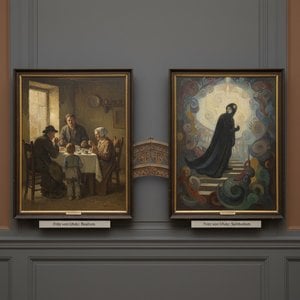
Röntgen's artistic output includes various illustrations, such as graphic works for Gustav Meyrink's Golem and E. T. A. Hoffmann's novella Der goldne Topf, which are held in the Von der Heydt-Museum. His notable paintings include:
问答详情
在哪里可以按氛围浏览 Ferdinand Röntgen 的作品?
艺术家的 情境空间 页面按氛围分类展示了 Ferdinand Röntgen 的艺术作品。
Ferdinand Röntgen 出生于何时何地?
Ferdinand Röntgen 于 1896 出生于 Barmen。
Ferdinand Röntgen 的艺术风格是如何随时间演变的?
Ferdinand Röntgen 的 艺术历程 是一个随滚动条变化的艺术时间轴,按创作时期进行章节划分,并按时间顺序呈现艺术家的作品。
Ferdinand Röntgen 的作品受欢迎程度如何?
有关 Ferdinand Röntgen 作品的统计数据,请参阅艺术家的 统计数据 页面。