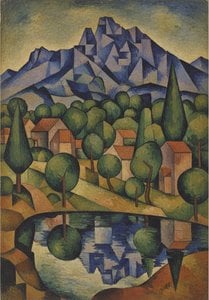
The Ethereal Legacy of Felix Esterl
In the quiet corridors of early twentieth-century art history, certain names flicker like candlelight, offering a profound glimpse into an era of transition and profound emotional depth. Felix Esterl, born in 1894, remains one such figure, a painter whose brief life and untimely passing in 1931 left behind a collection of works that resonate with the melancholic beauty of his time. Though his presence in the mainstream canon is often overshadowed by the giants of Modernism, Esterl’s contribution to the visual language of his generation provides an essential window into the shifting sensibilities of the pre-war European landscape.
The life of Esterl was shaped by the turbulent currents of a world on the brink of monumental change. Emerging from the artistic traditions of the late nineteenth century, his early development was marked by a pursuit of form and light that sought to capture more than just the surface of reality. His work often reflects a delicate balance between the tangible world and a dreamlike, almost spectral, interiority. To study Esterl is to witness a painter grappling with the weight of existence, using color and texture to articulate the subtle nuances of human experience and the fleeting nature of beauty.
Technique and Artistic Vision
Esterl’s mastery lay in his ability to manipulate medium and light to evoke a sense of profound stillness. His approach to the canvas was characterized by a deliberate, thoughtful application of pigment, where every stroke seemed to carry an emotional weight. There is a certain poetic rhythm in his compositions, often utilizing soft transitions and a muted palette that draws the viewer into a contemplative state. He did not merely depict subjects; he sought to capture their essence, imbuendo landscapes and figures alike with a sense of quiet dignity and underlying mystery.
The technical brilliance of his work can be observed through several key elements:
- Luminous Depth: A remarkable ability to layer tones to create an illusion of atmospheric depth, making the canvas feel as though it possesses its own internal light.
- Emotional Texture: The use of brushwork that fluctuates between smooth, ethereal washes and more textured, tactile applications to direct the viewer's emotional response.
- Symbolic Composition: A structural approach where the placement of elements serves to guide the eye through a narrative of solitude and reflection.
Historical Significance and Enduring Influence
The untimely death of Felix Esterl in 1931 marked the end of a promising trajectory, yet his influence persists in the way we perceive the intersection of realism and expressionism. His work serves as a bridge between the structured academic traditions of the past and the more fragmented, psychological explorations of the modern era. By focusing on the quiet, often overlooked moments of beauty and sorrow, Esterl provided a visual vocabulary for the introspective movements that would follow.
Today, collectors and historians look to Esterl not just as a painter of exquisite skill, but as a chronicler of an era's soul. His paintings remain poignant reminders of the power of art to transcend time, offering a sanctuary of peace and reflection in an increasingly chaotic world. Through his eyes, we are invited to rediscover the profound significance found within the subtle shadows and soft glows of the human condition.
问答详情
目前目录中共有多少件 Felix Esterl 的作品可供浏览?
您可以在 全部作品 页面浏览由 Felix Esterl 创作的 5 件作品 件作品。
Felix Esterl 的创作时期属于哪个历史阶段?
Felix Esterl 的创作活跃于 Modern 时期,这一时期确立了艺术家在艺术史上的地位。
可以按心情浏览 Felix Esterl 的作品吗?
艺术家的 情境空间 页面按氛围分类展示了 Felix Esterl 的艺术作品。
在哪里可以按时间顺序欣赏 Felix Esterl 的作品?
您可以在Felix Esterl的作品时间轴页面上按时间顺序查看其作品。