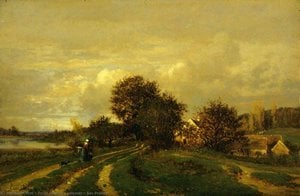
The Serene Vision of Émile Charles Lambinet
In the heart of the nineteenth century, as the rigid structures of academic art began to yield to a more profound connection with the natural world, Émile Charles Lambinet emerged as a master of quietude. Born in 1813 into a family of artists in Paris, his very existence was woven into the fabric of French creativity. While many of his contemporaries sought the dramatic and the heroic, Lambinet turned his gaze toward the subtle rhythms of the countryside. His life, which took him from the vibrant streets of Paris to the tranquil reaches of Bougival, was a continuous dialogue with the landscape, a lifelong endeavor to capture the fleeting atmospheric nuances that define the soul of rural France.
Lambinet’s artistic identity was forged through a lineage of exceptional mentors. He began his studies under Horace Vernet and Antoine-Félix Boisselier, receiving a rigorous foundation in technical precision. However, it was his encounter with the legendary Jean-Baptiste-Camille Corot that would irrevocably alter his artistic trajectory. Under Corot’s guidance, Lambinet moved away from mere topographical accuracy toward an emotive interpretation of nature. This relationship instilled in him a deep reverence for the Fontainebleau Forest and taught him to prioritize atmospheric perspective—the way light and mist soften the edges of the world—over dramatic composition. This influence placed him at the very heart of the Barbizon School, a movement dedicated to the honest, unadorned observation of the earth.
A Mastery of Atmosphere and Light
The works of Lambinet are characterized by an almost meditative stillness, inviting the viewer into a world where time seems to slow. His technique was rooted in the meticulous study of watercolors and sketches, which he translated onto canvas with a sophisticated understanding of tonal gradation. Unlike the theatrical landscapes of the previous era, Lambinet’s canvases often feature muted palettes and hazy, luminous skies that evoke the specific mood of a particular moment. Whether depicting a river scene or a coastal view, his brushwork serves to create a sense of depth and humidity, making the air itself feel tangible.
His subject matter frequently celebrated the harmonious coexistence of humanity, animals, and the environment. In masterpieces such as English Landscape (1859), one finds a delicate balance of life:
- The presence of pastoral life: Figures resting by water or tending to cattle, integrated seamlessly into the scenery.
- The interplay of light and water: Reflections on river surfaces that capture the shimmering essence of the Seine or similar waterways.
- The dignity of the mundane: A focus on bridges, farmyards, and quiet meadows that elevate everyday rural existence to the level of high art.
Legacy and Historical Significance
Though he lived a relatively private life in the Yvelines department, Lambinet’s contribution to the evolution of landscape painting remains profound. He stood as a bridge between the classical training of the academy and the modern pursuit of sensory truth. His ability to eschew grand narratives in favor of tranquil landscapes allowed him to capture a version of France that was both timeless and deeply personal. Today, his works serve as vital historical documents of a nineteenth-century landscape before the rapid onset of industrial transformation.
The enduring legacy of Émile Charles Lambinet is found in the emotional resonance of his quietest moments. He taught us that there is as much majesty in a grazing cow by a riverbank as there is in a mountain peak, and that the true essence of nature lies in its ability to inspire peace. His paintings remain a testament to the power of observation and the enduring beauty of the natural world, preserved for generations to admire the soft light of a bygone era.
问答详情
Émile Lambinet 来自哪里?
Émile Lambinet 出生于 France。
Émile Lambinet 的创作时期属于哪个历史阶段?
Émile Lambinet 的创作活跃于 19th Century 时期,这一时期确立了艺术家在艺术史上的地位。
在哪里可以找到关于Émile Lambinet作品的相关统计数据?
有关 Émile Lambinet 作品的统计数据,请参阅艺术家的 统计数据 页面。
Émile Lambinet 的艺术生涯是如何划分为不同时期的?
Émile Lambinet 的艺术生涯在 艺术历程 页面上按时期逐一展开:以横向时间轴的形式呈现作品,并按创作时期划分为不同的篇章。