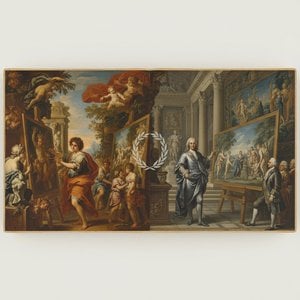
Claude Deruet: A Nancy Baroque Master
Claude Deruet (1588 – 1660) stands as a prominent figure in the artistic landscape of 17th-century France, particularly within the vibrant baroque tradition emanating from Nancy. Born into a noble family, his formative years were steeped in artistic patronage and fostered by an apprenticeship under Jacques Bellange, the court painter to Charles III, Duke of Lorraine—a connection that profoundly shaped his career trajectory. This early influence instilled in him a meticulous attention to detail and a masterful command of technique, characteristics that would define his enduring legacy.- Early Life & Training: Deruet’s artistic journey commenced with formal training under Bellange, allowing him access to the highest echelon of artistic circles and equipping him with invaluable skills in portraiture and decorative painting.
- Roman Period (c. 1612 – 1619): Seeking further refinement and inspiration, Deruet traveled to Rome around 1612, where he studied diligently alongside Antonio Tempesta—a renowned etcher and painter whose stylistic innovations resonated deeply with Deruet’s sensibilities. This period witnessed the creation of his first significant fresco in Villa Borghese, showcasing an emerging talent for dramatic composition and nuanced color palettes.
- Notable Paintings: Among Deruet's celebrated works are “Departure of the Amazons” (1620) and “Road to Calvary” (1620)—scenes imbued with dynamism and emotional intensity—testaments to his artistic prowess.
- Royal Patronage & Recognition: Recognizing Deruet’s exceptional talent, Charles III bestowed upon him nobility in 1621, followed by knighthood of the Order of St Michael in 1645 by Louis XIII—a testament to his contribution to Lorraine's cultural prestige.
Legacy & Historical Significance
Claude Deruet’s artistic legacy extends beyond his individual masterpieces—he established a tradition of dramatic storytelling and refined technique that profoundly impacted subsequent generations of painters. His work continues to inspire admiration for its expressive power and stylistic sophistication, securing his place as one of the most important artists of the baroque era in France. The enduring fascination with his depictions of samurai underscores the broader cultural exchange between Europe and Asia during this period—a testament to Deruet’s artistic vision and intellectual curiosity.问答详情
在哪里可以找到关于Claude Deruet作品的相关统计数据?
Claude Deruet 的 访问统计 页面展示了基于 本网站 上列出的艺术家作品所计算出的统计数据。
Claude Deruet 最常使用的色彩有哪些?
Claude Deruet 作品的色彩特征展示在艺术家的 色彩基因 页面上。
我可以通过艺术流派来浏览 Claude Deruet 的作品吗?
您可以在Claude Deruet的所有艺术流派页面上,按艺术流派浏览其作品。