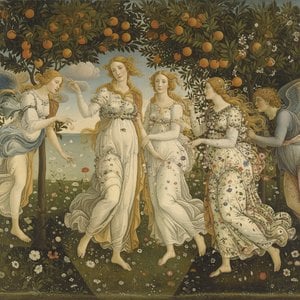
Neri di Bicci: Life and Legacy
Early Life and Family Background
- Born: 1419, Florence, Italy.
- Died: 1492, Florence, Italy.
- Neri di Bicci was the third in a lineage of Florentine painters. His grandfather, Lorenzo di Bicci, was a pupil of Spinello Aretino, and his father, Bicci di Lorenzo, continued the family tradition.
- This familial artistic heritage profoundly shaped Neri’s early training and development.
Artistic Training and Influences
- Neri studied under his father, Bicci di Lorenzo, absorbing the stylistic conventions of the time.
- Early Influences: Initially, Neri’s work closely resembled that of his father. However, he gradually developed a unique style influenced by artists such as Fra Filippo Lippi, Paolo Schiavo, Fra Angelico, and Domenico Veneziano.
- He joined the Confraternity of Saint Luke (Compagnia di San Luca) at a young age, demonstrating his commitment to the artistic community.
Artistic Style and Major Works
- Primary Medium: Neri primarily worked in tempera on panel, creating predominantly religious works.
- Notable Characteristics: His paintings are characterized by detailed execution, a refined sense of color, and often feature advanced use of foreshortening in architectural elements.
- Key Works Include:
- St. John Gualbert Enthroned with Ten Saints (Santa Trinita, Florence)
- Annunciation (Florentine Academy)
- Two altarpieces (Diocesan Museum of San Miniato)
- Madonna with Child Enthroned (Pinacoteca Nazionale of Siena)
- Coronation of the Virgin (Abbey Church at San Pietro a Ruoti, Bucine)
The ‘Ricordanze’ and Historical Significance
- The Ricordanze: Neri di Bicci meticulously kept journals from 1453 to 1475, known as the 'Ricordanze'. These records provide invaluable insights into the daily life of a 15th-century painter.
- They detail rates of remuneration, lists of pupils and their works, and offer a comprehensive view of artistic practices during the Renaissance.
- Historical Importance: The ‘Ricordanze’ are considered the most extensive surviving documentation from a 15th-century painter's workshop. They have been crucial for art historians in understanding the economic and social context of Florentine painting.
Legacy and Recognition
- While initially overshadowed by misattributions (due to confusion with his father, Bicci di Lorenzo, as noted by Vasari), Neri di Bicci’s work has gained increasing recognition in recent decades.
- Contribution: He represents a significant link between the earlier traditions of Florentine painting and the innovations of the High Renaissance. His detailed craftsmanship and insightful documentation continue to fascinate art historians and enthusiasts alike.
问答详情
我可以通过色调来浏览 Bicci Di Neri 的作品吗?
您可以在Bicci Di Neri的按色调分类页面上,按色调浏览其作品。
Bicci Di Neri 最常使用的色彩有哪些?
Bicci Di Neri 作品的色彩特征展示在艺术家的 色彩基因 页面上。
在哪里可以按时间顺序欣赏 Bicci Di Neri 的作品?
您可以在Bicci Di Neri的作品时间轴页面上按时间顺序查看其作品。