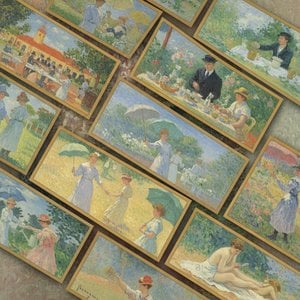
The Painter of Parisian Elegance
Auguste Toulmouche (1829-1890) stands as a luminous figure in the tapestry of 19th-century French art, a master whose brush captured the very essence of the Belle Époque. Born in Nantes to Emile Toulmouche, a prosperous broker, his early life was bathed in an atmosphere of artistic appreciation, nurtured by the steady encouragement of his father. This foundational support allowed him to pursue a rigorous classical education, beginning with the study of drawing and sculpture under Amédée Ménard. His journey eventually led him to the heart of Paris, where he sought the guidance of the esteemed Charles Gleyre. Under Gleyre’s tutelage, Toulmouche refined his command over academic realism, developing a sophisticated ability to translate the textures of high society onto canvas with unparalleled precision.
The brilliance of Toulmouche’s talent was recognized almost immediately by the art establishment. At the tender age of nineteen, he made his debut at the prestigious Paris Salon in 1848, an entrance that signaled the arrival of a formidable new voice in French genre painting. His subsequent triumphs at the Salons of 1852 and 1861, where he was honored with medals, solidified his standing among the artistic vanguard. This period of rising acclaim was further elevated by the highest form of recognition: imperial patronage. When Napoleon III commissioned ‘La Fille,’ a portrait of Eugénie de Bourbon, it served as a profound testament to the Emperor's trust in Toulmouche’s vision and cemented the artist's status as one of the era’s most fashionable and sought-after painters.
A Vision of Opulence and Introspection
Toulmouche’s oeuvre is characterized by a breathtaking devotion to the aesthetics of the upper-bourgeoisie. He did not merely document the lives of Parisian women; he crafted an idealized, almost dreamlike vision of domestic refinement. His canvases are celebrated for their meticulous rendering of opulent fabrics—the shimmering sheen of silk, the heavy weight of velvet, and the delicate intricacy of lace. Through his eyes, we witness a world of lavish furnishings and gilded interiors that epitomize the luxury of 19th-century France. Yet, beneath this surface of material splendor, there exists a profound psychological depth.
In works such as ‘La Fiancée Hesitante’ and ‘The Reluctant Bride,’ Toulmouche explores the nuanced emotions of his subjects. He possessed a singular talent for capturing moments of quiet introspection, where a gaze into an ornate mirror or a subtle tilt of the head suggests a complex inner life. His paintings often invite the viewer to contemplate themes of identity, beauty, and the fleeting nature of youth. This mastery of light and shadow—the interplay of soft pinks against deep blues and warm golds—creates an atmosphere that is simultaneously intimate and grand, pulling the observer into the private, elegant sanctuaries of his subjects.
Legacy of Academic Realism
The historical significance of Auguste Toulmouche lies in his ability to bridge the gap between strict academic tradition and the evocative storytelling of genre painting. While his technique remained rooted in the disciplined realism taught by Gleyre, his subject matter embraced the contemporary social shifts of his time. He became a chronicler of a specific social stratum, preserving the sartorial elegance and domestic rituals of a bygone era for posterity. His work remains a vital window into the cultural heartbeat of Paris during a period of immense transformation.
Today, Toulmouche’s influence persists through the enduring allure of his compositions. Collectors and art enthusiasts continue to be drawn to his ability to evoke nostalgia and wonder. His legacy is defined by:
- Technical Mastery: An unparalleled skill in rendering textures, light, and the tactile qualities of luxury goods.
- Cultural Documentation: Providing a detailed visual record of the social hierarchies and aesthetic values of the Belle Époque.
- Emotional Resonance: The ability to imbue highly stylized portraits with genuine human sentiment and psychological complexity.
问答详情
Auguste Toulmouche 的作品受欢迎程度如何?
关于 Auguste Toulmouche 作品的相关统计数据,请参阅艺术家的 访问统计 页面。
目前目录中共有多少件 Auguste Toulmouche 的作品可供浏览?
您可以在 全部作品 页面浏览由 Auguste Toulmouche 创作的 22 件作品 件作品。
我可以在其所有作品中研究 Auguste Toulmouche 对色彩的运用吗?
您可以在Auguste Toulmouche的色彩基因页面上,深入研究其在本网站所列作品中的色彩运用。