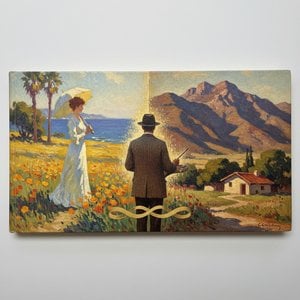
Andrew Putnam Hill: Life, Art, and Conservation
Early Life and Artistic Beginnings
- Born: 1853 in Porter County, Indiana.
- Andrew Putnam Hill began his career as both a painter and a photographer, drawn to capturing the beauty of the American West. His early work focused on realistically depicting landscapes and portraits.
- Influences during this period are not extensively documented but likely included the Hudson River School tradition of landscape painting prevalent at the time.
Artistic Development and Style
- Hill’s artistic style evolved over time, eventually aligning with the Precisionist movement, which gained prominence in the United States after World War I.
- Precisionism emphasized geometric shapes, a reduction of detail, and the use of planes of light to create a sense of crisp focus. Hill’s paintings began to reflect these characteristics, showcasing a meticulous attention to form and clarity.
- While not a strict adherent to all tenets of Precisionism, his work demonstrates a clear affinity for its aesthetic principles.
The Fight for Big Basin Redwood Forest
- Hill is perhaps most celebrated for his pivotal role in preserving the ancient redwood forests of Big Basin, California.
- From 1899 to 1902, he spearheaded a campaign to establish Big Basin as a public park – becoming the first unit within what would eventually become the California State Park System.
- His photographs and paintings of the majestic redwoods played a crucial role in raising awareness about their vulnerability and garnering support for conservation efforts.
- This dedication to preservation marked a turning point in California’s environmental history, establishing a precedent for protecting natural resources.
Notable Works and Collections
- “George W. Hoag” is among his most recognized paintings and resides in the collection of the Crocker Art Museum in Sacramento, California.
- His body of work includes landscapes, portraits, and studies of Californian scenery.
- While not prolific in terms of sheer volume, his paintings are valued for their technical skill and evocative depictions of the natural world.
Legacy and Historical Significance
- Andrew Putnam Hill’s legacy extends beyond his artistic achievements. He is remembered as a pioneer in the conservation movement, demonstrating the power of art to inspire environmental stewardship.
- His efforts laid the groundwork for the extensive network of state and national parks that protect California's natural heritage today.
- Furthermore, his artistic approach influenced subsequent generations of artists working in the fields of Precisionism and Photorealism.
- He died in Pacific Grove, California in 1922, leaving behind a lasting impact on both the art world and the environmental landscape of California.
问答详情
Andrew Putnam Hill 来自哪里?
Andrew Putnam Hill 出生于 United States of America。
如何浏览 Andrew Putnam Hill 的全部作品?
您可以在 Andrew Putnam Hill 的 全部作品 页面上浏览其在 本站 上的所有作品。
我可以通过关键词来探索 Andrew Putnam Hill 的作品吗?
您可以通过艺术家关键词分类页面,按关键词探索Andrew Putnam Hill的作品。每个关键词都汇集了相关的艺术品。