Early Life, Family and Training
Adolf Doerner entered the world on July 26, 1892, in Ilbesheim bei Landau in der Pfalz, Germany. Born the son of a vintner, his early environment was rooted in the practical realities of the wine-growing region. This upbringing provided a grounded starting point before he moved into the formal structures of German art education. His trajectory was defined by a transition from the rural landscape of his birth to the rigorous academic environments of the era.
His technical foundation was built through disciplined study under established figures. He first sought instruction from Walther Klemm in Weimar, a period that established his early professional direction. This was followed by more advanced training at the Staatliche Akademie der Bildenden Künste Karlsruhe, where he studied under Albert Haueisen. These academic settings provided the necessary technical scaffolding for his later development as a painter.
Beyond formal classroom instruction, Doerner’s professional standing was bolstered by the support of Max Slevogt. Such patronage is a concrete indicator of his early standing within the artistic community. This combination of academic rigor in Weimar and Karlsruhe, paired with the influence of Slevogt, shaped the painter's early capabilities before his work eventually moved into the more complex territories of his later career.
Artistic Style and Techniques
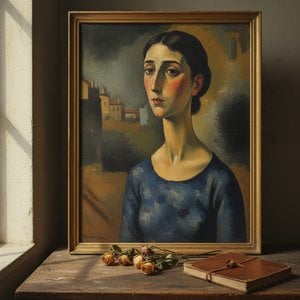
Doerner’s approach to the canvas was defined by a heavy reliance on the expressive power of color. He did not merely depict subjects; he captured the world through a painterly lens that prioritized mood and intensity. His technical range was broad, spanning from delicate drawings and watercolors to large-scale murals and high-contrast oil paintings. This versatility allowed him to manipulate light and pigment to achieve a specific, atmospheric effect that remains the core of his visual identity.
His stylistic leanings align with abstract expressionism. Rather than adhering to strict realism, he utilized color-intensive compositions to convey depth and emotion. This method is particularly evident in his treatment of the Palatinate landscape, where the physical terrain is filtered through a lens of light and intense hue. While he frequently turned to portraits and figures to explore the human form, his most striking results came from his ability to translate environmental atmosphere into tangible, high-contrast imagery.
- Bauarbeiter (about 1934)
- Die Gänseliesel (fresco)
Key Works and Commissions
Doerner’s output was defined by a tension between large-scale public utility and private expression. During his time in Maxdorf between 1931 and 1934, living there at the invitation of his friend Theobald Hauck, he secured one of his most significant public engagements. He was commissioned to execute the fresco Die Gänseliesel. This work was not a fleeting installation; it occupied the wall of the old school building in the Hauptstraße for decades, remaining a fixture of the local landscape until the building was demolished in 1980.
His technical range extended from these architectural interventions to more focused, singular subjects. In 1934, he produced Bauarbeiter, a work that reflects the era's preoccupation with labor and form. While much of his output remains in private collections, these specific pieces demonstrate his ability to move between the expansive requirements of mural painting and the concentrated intensity of oil on canvas.
- Die Gänseliesel (fresco)
- Bauarbeiter (1934)
Later Years and Death
The final decades of Doerner's life were defined by political entanglement and personal decline. He joined the NSDAP on March 1, 1932, and by 1940, he held the position of Ortsgruppenleiter in Mörzheim. This political involvement led to direct legal consequences after the war. In 1948, he was sentenced to four months in prison for crimes against humanity.
Physical and mental health struggles eventually dominated his existence. He suffered from blindness and severe depression, conditions that shadowed his later years. He died by suicide on November 13, 1964, in Ilbesheim.
问答详情
可以按心情浏览 Adolf Doerner 的作品吗?
艺术家的 情境空间 页面按氛围分类展示了 Adolf Doerner 的艺术作品。
我可以通过色谱来探索 Adolf Doerner 的作品吗?
色彩索引 页面按色彩对 Adolf Doerner 的作品进行了分类整理。
是否有关于 Adolf Doerner 的生平年表?
Adolf Doerner 的艺术生涯在 艺术历程 页面上按时期逐一展开:以横向时间轴的形式呈现作品,并按创作时期划分为不同的篇章。
可以按媒介类型浏览 Adolf Doerner 的作品吗?
若要查找Adolf Doerner在特定媒介下的所有作品,请访问艺术家的所有媒介页面。