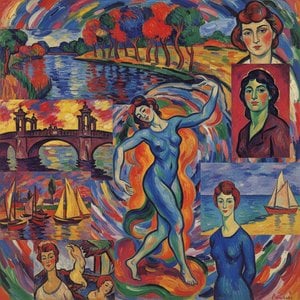
The Architect of Abstraction
Munich, 1911. The air in Anton Ažbe's art school carries the weight of new ideas. Ado Vabbe moves through these halls, absorbing the formal rigor of his training while his mind drifts toward the radical. He is not merely a student; he is a conduit. When he eventually returns to Estonia, he carries more than sketches in his luggage. He carries the seeds of abstraction, a concept that had yet to take root in his homeland. His presence acts as a catalyst, shifting the trajectory of a national aesthetic by introducing a language of form that defies simple representation.
The transition is not a slow evolution but a series of sharp, decisive movements. His early work leans into the avant-garde, fueled by the energy of the era. He finds himself in the middle of the great European shifts, living through the turbulence of World War I in Moscow and St. Petersburg. These years in the centers of Russian artistic life sharpen his vision. He becomes a figure of the moment, an illustrator for the literary group Siuru, translating the pulse of modern literature into visual form.
The Pallas Legacy
By 1918, the landscape of Estonian art is being rebuilt, and Vabbe is at the center of the construction. He becomes a founder of the Pallas Art Society, a move that anchors his influence in the very soil of the emerging Republic. His role shifts from the solitary creator to the legendary educator. In the classrooms of the Pallas Art School, he shapes the hands and eyes of the next generation. He does not merely teach technique; he imparts a way of seeing that will define Estonian modernism.
His influence is felt through the specific lineages of his students:
His own output remains varied, refusing to settle into a single mode. He moves between the playful precision of Indian ink drawings and the structured drama of commedia dell’arte characters. He captures the sun-drenched light of his travels south and the quiet, nuanced sketches of everyday life. Even his later works, such as his Paraphrases, mark a turning point, signaling a departure that forces the art world to look at itself anew.
The Final Years in Tartu
The creative life of Vabbe is a cycle of constant transformation. He explores the woman as a source of lust and dreams, often set against a landscape that feels both specific and ethereal. His work is a record of a man who lived through the birth of a nation and the shifting borders of Europe. He remains a fixture of the Estonian art scene until his death in Tartu. His name survives not just in the paintings he left behind, but in the Ado Vabbe Art Fellowship, a recognition of the profound impact he had on the artistic life of the city and the country.