The Ink and the Soul: The Life of Yang Tianji
In the shifting landscape of early 20th-century China, a period defined by profound transformation and the delicate tension between tradition and modernity, the brushstrokes of Yang Tianji emerged as a testament to enduring cultural elegance. Born in Beijing in 1882, Yang came of age during a time when the foundations of the old world were meeting the winds of change. His journey was not merely one of personal artistic growth, but a profound engagement with the very essence of Chinese identity. Through his mastery of ink on paper, he captured a sense of timelessness that resonated far beyond the borders of his homeland, establishing himself as a vital figure in the development of modern Chinese painting during the Republic period.
Yang’s early years were steeped in the rigorous discipline of classical training. He began his artistic odyssey at a young age, immersing himself in the ancient techniques of traditional Chinese painting under the guidance of the era's most esteemed masters. This foundational period was marked by an intense study of form, rhythm, and the subtle nuances of monochromatic expression. A significant influence on his burgeoning style was the Suiboku ga art movement, which taught him the profound power of black ink. By experimenting with varying concentrations of soot and water, he learned to evoke depth, atmosphere, and emotion through nothing more than the interplay of light and shadow on a paper surface.
A Synthesis of Poetry and Brushwork
As his technical prowess matured, Yang Tianji developed a signature style that transcended simple imitation of the past. He possessed a rare ability to weave together the disparate threads of calligraphy, poetry, and landscape painting into a singular, cohesive vision. His work often functioned as a visual dialogue with classical literature, where the movement of the brush mirrored the cadence of ancient verses. One of his most celebrated achievements remains his 1917 masterpiece, the pair of hanging scrolls titled Couplet Composed from Jiang Kui's Verses. In this work, Yang demonstrated an extraordinary capacity to balance the weight of historical tradition with a fresh, modern sensibility, using the ink to breathe life into the lyrical beauty of the poetry.
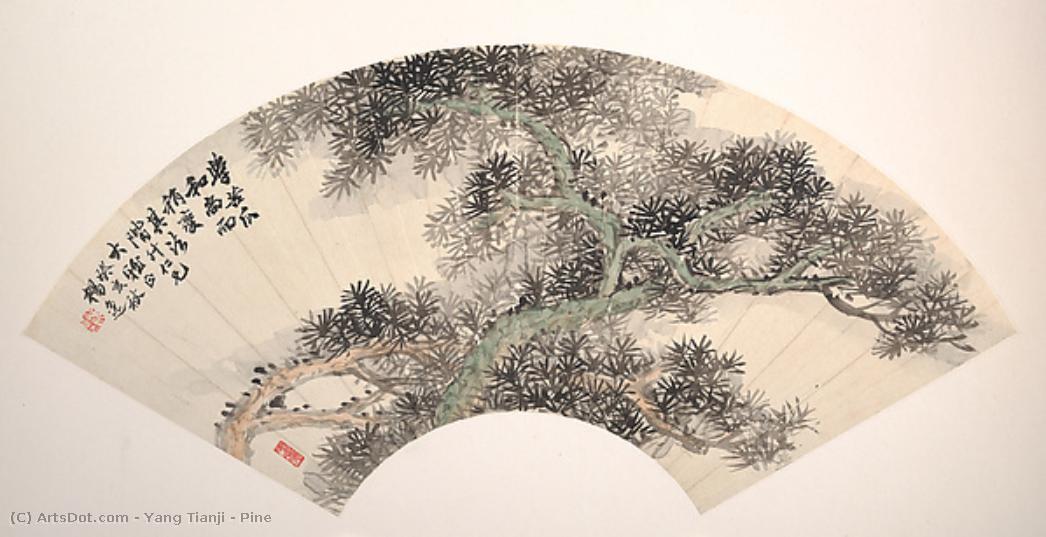
The technical brilliance of his work lies in its delicate complexity. To observe a Yang Tianji painting is to witness a controlled dance of spontaneity and precision. His use of ink on paper allowed for a transparency and fluidity that could capture the ephemeral mist of a mountain range or the sharp, decisive strength of a calligraphic stroke. This duality—the ability to be both ethereal and grounded—became the hallmark of his contribution to the art world. He did not merely paint scenes; he painted the atmosphere of thought and the rhythm of nature.
Legacy and the Shaping of Modernity
Beyond his individual canvases, Yang Tianji’s impact was felt through his role as a guardian and a pioneer. As an educator, he dedicated himself to shaping the next generation of Chinese artists, ensuring that the profound wisdom of traditional techniques would not be lost in the rush toward modernization. He taught his students that innovation did not require the abandonment of heritage, but rather a deeper, more nuanced understanding of it. This philosophy allowed him to bridge the gap between the classical era and the burgeoning modern movement, making him a pivotal figure in the artistic evolution of the Republic period.
Today, the legacy of Yang Tianji continues to inspire those who find beauty in the subtle and the profound. His works serve as vital historical documents of an era of transition, reflecting a spirit that sought harmony amidst upheaval. Through his meticulous brushwork and his deep reverence for the poetic soul of China, he left behind a body of work that remains a cornerstone of 20th-century Chinese art, reminding us that true mastery lies in the ability to make the ancient speak to the contemporary.



 效果预览
效果预览
 购买印刷品
购买印刷品 分享
分享 分享
分享
 详情
详情

 下载
下载
 相似作品
相似作品 X射线
X射线 幻灯片播放
幻灯片播放

 展开详情
展开详情





