
 Acrylic On CanvasWallArtModern Chinese painting
 1926
1926 80.0 x 39.0 cm
 中国美术学院美术馆
由我们的艺术家按需定制,为您提供您所选尺寸及画框的布面手工油画。 ( 切换至版画销售渠道 切换至数字图像销售渠道)





























您可以从与原作比例一致的预设尺寸中进行选择。

您可以输入自定义尺寸,以适配特定的画框或空间。如果所选尺寸与原图比例不符,我们将通过裁剪作品或添加手绘元素来扩展画面。数字样稿将在制作开始前发送给您确认。
请注意,屏幕预览无法准确反映实际的裁剪或扩展效果,只有样稿才能真实呈现最终的构图。
虽然我们提供定制尺寸服务,但为了保留原作比例,建议您从预设列表中选择尺寸。

Flute Music
复刻品尺寸说明
Xu Beihong’s “Flute Music,” painted in 1926 during his formative years in Paris, is more than a portrait; it’s a poignant distillation of longing, domesticity, and the burgeoning spirit of modern Chinese art. The painting captures Jiang Biwei, Xu’s first wife, seated gracefully on a chair, her hands poised over a flute – an instrument that becomes a conduit for unspoken emotions within the intimate setting. It's a work deeply rooted in both traditional Chinese aesthetics and the innovative techniques he was absorbing from Western masters, representing a pivotal moment in his artistic evolution.
The scene unfolds within a modestly furnished studio, subtly suggested by the muted tones of the background – a suggestion of trees hinting at an outdoor setting, yet firmly grounded in the domesticity of a Parisian room. Xu Beihong masterfully employs a technique that blends Chinese ink wash painting with Western oil realism. The figure of Jiang Biwei is rendered with meticulous detail, capturing her delicate features and the subtle curve of her posture. Notice how he utilizes loose brushstrokes to convey the softness of her clothing and the gentle play of light on her face – a deliberate departure from the rigid formality often associated with traditional Chinese portraiture. The background trees are painted with a slightly looser style, creating an atmospheric depth that anchors the scene while maintaining a sense of intimacy.
“Flute Music” stands as a testament to Xu Beihong’s deliberate engagement with both Eastern and Western artistic traditions. He was deeply influenced by the classical Chinese emphasis on capturing the essence of a subject – its spirit and mood – through evocative brushwork and symbolic imagery. However, he wasn't content to simply replicate these established forms; instead, he sought to synthesize them with the techniques and perspectives he encountered in Europe. The use of oil paints, for instance, allowed him to achieve a level of realism and luminosity previously unattainable with traditional Chinese inks.
The painting’s historical context is crucial to understanding its emotional resonance. 1926 was a period of significant upheaval in China, marked by political instability and social change. Xu Beihong, like many artists of his generation, was grappling with the challenge of defining a new national identity—one that embraced both its rich cultural heritage and its aspirations for modernity. “Flute Music” reflects this internal struggle, capturing a moment of quiet contemplation amidst the turbulence of the era.
The flute itself is laden with symbolic weight. It represents not just musical expression but also communication—a means of conveying emotions that cannot be articulated through words. Jiang Biwei’s downward gaze as she plays suggests a sense of introspection, perhaps even melancholy. The posture of her hands, poised over the instrument, speaks to a yearning for connection and understanding within her marriage. The muted color palette further reinforces this mood—a subtle blend of blues, greens, and browns that evokes feelings of serenity and wistfulness.
Interestingly, Xu Beihong’s autobiography reveals his own dissatisfaction with his relationship at the time, hinting at a complex dynamic beneath the surface of this seemingly idyllic scene. The inscription on the painting itself – “Beihong, winter of the Bingyin year (1926)” – serves as a poignant reminder of the personal struggles that shaped the artist’s creative vision.
“Flute Music” is more than just a beautiful painting; it's a window into the soul of a remarkable artist and a reflection on the complexities of human relationships. Its masterful blend of Eastern and Western influences, coupled with its evocative symbolism and emotional depth, ensures that it remains a timeless masterpiece—a testament to Xu Beihong’s genius and his enduring legacy in the world of art.

1895 - 1953 , 中国
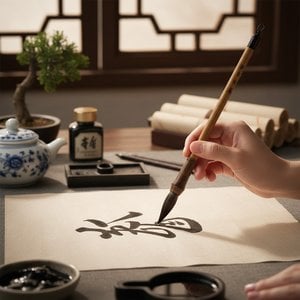
Embark on a profound journey through the soul of Chinese calligraphy. Explore the historical mastery of ink, brush, and script, from ancient Zhuanshu to elegant running script, and discover how this timeless art form reflects the enduring spirit of classical East Asian aesthetics.


 实景预览
实景预览
 发送
发送 分享
分享
 详情
详情 指南
指南

 下载图片
下载图片
 相似作品
相似作品 X射线
X射线 幻灯片播放
幻灯片播放 统计数据
统计数据 阅读全文
阅读全文









 玻璃选项仅适用于110厘米以下的尺寸。


