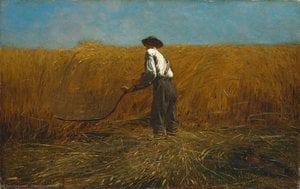
Winslow Homer’s “Waiting”: A Study in Quiet Observation
Winslow Homer (1836–1910) wasn't sculpted by the formal academies of Europe; he emerged from an American experience defined by practicality and a profound connection to the natural world. His artistic journey began not with grand historical canvases—a path favored by many contemporaries—but with commercial illustration for Harper’s Weekly at just twelve years old. This early apprenticeship instilled in him an exceptional ability to capture scenes with remarkable clarity and detail – skills that would become cornerstones of his mature oeuvre. He wasn't absorbing perspective from Parisian studios; he was learning to *see* America, its people, and the unfolding narrative of its time, a perspective that profoundly shaped his artistic vision. The bustling streets of Boston, the serene dignity of rural New England life—these were his initial subjects, rendered with a precision born of necessity for the demands of print media, establishing a foundational understanding of observation that would permeate his later paintings.
- Subject Matter: Homer’s “Waiting” depicts a woman seated on grass, her hat resting in her hand, radiating an aura of contemplative stillness. Two figures flank her—one positioned at the upper right corner and another near the lower left—adding to the scene's complexity without disrupting its central focus. A handbag rests beside her, subtly hinting at preparation or anticipation.
- Style: The painting embodies Homer’s signature Realism, prioritizing accurate representation of form and texture over idealized beauty. It eschews dramatic flourishes, favoring instead a restrained palette and meticulous attention to detail—characteristics that align perfectly with the aesthetic sensibilities of his era.
- Technique: Executed in watercolor on paper, “Waiting” exemplifies Homer’s masterful control over medium. Watercolor allows for luminous washes and subtle gradations of color, capturing the diffused light characteristic of outdoor landscapes. The artist's brushstrokes are deliberate yet understated, conveying a sense of immediacy and capturing the ephemeral qualities of the moment.
Historical Context: Impressionism’s Shadow
“Waiting” emerged during the twilight years of Impressionism, though Homer consciously resisted its stylistic conventions. While Impressionists sought to capture fleeting impressions of light and color—often prioritizing subjective experience over objective accuracy—Homer remained steadfast in his commitment to portraying reality with unflinching honesty. This distinction reflects a broader trend within American art at the time: a preference for depicting familiar subjects—such as rural life and maritime scenes—with meticulous detail, rather than attempting to emulate European artistic trends. Homer’s approach can be seen as a reaction against the perceived artificiality of Parisian salons and a celebration of America's distinctive visual culture.
Symbolism: Anticipation and Vulnerability
Despite its apparent simplicity, “Waiting” is laden with symbolic resonance. The woman’s posture—seated calmly yet poised—suggests vulnerability and anticipation; she embodies the human condition grappling with uncertainty. The presence of the two figures adds to this sense of unease, hinting at external forces shaping her experience. Furthermore, the setting—a tranquil meadow bathed in dappled sunlight—contrasts sharply with the implied tension within the scene, creating a powerful visual dialogue between stillness and movement. Homer skillfully utilizes these elements to convey not merely what is seen but also what is felt—a profound meditation on human emotion and resilience.
Emotional Impact: A Moment Frozen in Time
“Waiting” transcends mere depiction; it evokes a palpable emotional atmosphere. The painting’s muted color palette contributes to its contemplative mood, fostering a feeling of quiet introspection. Homer's meticulous rendering of texture—the grass blades swaying gently in the breeze, the folds of the woman’s dress—grounds the viewer in the physicality of the scene, enhancing its immersive quality. Ultimately, “Waiting” succeeds in capturing a fleeting moment of human experience—a pause before an unknown future—resonating with viewers long after they have gazed upon it. It stands as a testament to Homer's ability to transform observation into artful expression and to imbue his canvases with enduring emotional power.
问答详情
为什么“Waiting”的版权状态是目前的状况?
温斯洛·霍默 的《Waiting》 已进入 属于公有领域 —— 其版权已过期。版权保护期自艺术家逝世之日起计算,该艺术家于 1910 年逝世。
针对我的房间,"Waiting" 应该打印成什么尺寸?
温斯洛·霍默 的《Waiting》 的推荐搭配:在 Living Room 中悬挂尺寸为 Large 的版画。
在哪里可以找到关于温斯洛·霍默 的《Waiting》的数据统计?
关于 温斯洛·霍默 的《Waiting》 的统计数据可在该作品的 统计数据 页面查看:包括作品的每月访问量、艺术家作品的访问量,以及近期访客的国家和语言分布情况。