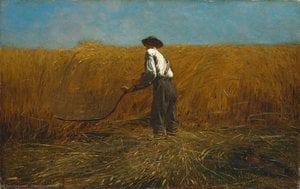
A Moment Frozen on the Waves: Winslow Homer’s *Observations on Shipboard*
Winslow Homer's *Observations on Shipboard*, painted in 1881, isn’t merely a depiction of a sailing vessel; it’s a carefully constructed tableau of solitude, resilience, and the profound connection between humanity and the vast, indifferent ocean. This watercolor masterpiece, now available as a stunning hand-painted reproduction from WahooArt.com, invites us to linger on its surface, discovering layers of meaning within its deceptively simple composition. Homer, a pivotal figure in American art, masterfully employed the fluidity of watercolor to capture not just the visual reality of a ship at sea, but also the emotional weight of human experience confronting nature’s power. The painting immediately draws us in with its muted palette—a symphony of grays, browns, and ochers that evoke the relentless churn of the waves and the somber mood of a storm-laden sky.
The focal point is a lone figure, standing on the deck of a substantial sailing ship, his back turned to the viewer. This deliberate anonymity imbues the scene with universality; we are not invited to identify with any specific individual but rather to contemplate the shared human condition – the vulnerability and quiet strength experienced when facing an overwhelming force. The man’s posture suggests readiness, perhaps anticipation or even a subtle acceptance of fate. He holds onto a rope, a tangible link between himself and the vessel, symbolizing both connection and isolation. The ship itself is rendered with remarkable detail, its rigging intricate and suggesting the complex machinery that governed life at sea. Homer's meticulous attention to these elements speaks to his deep understanding of maritime life, gleaned from years spent observing and documenting this world. The inclusion of a smaller boat in the background adds depth to the scene, hinting at rescue efforts or perhaps simply the vastness of the surrounding ocean.
The Language of Watercolor: Technique and Atmosphere
Homer’s choice of watercolor as his medium is crucial to understanding the painting's evocative power. Unlike the bolder, more assertive strokes of oil paint, watercolor allows for a remarkable degree of spontaneity and luminosity. The artist skillfully manipulates washes of color, creating a sense of atmospheric perspective—the distant ship appearing smaller and paler, while the foreground details are rendered with greater clarity. The soft, feathery brushstrokes contribute to the painting’s overall feeling of tranquility, despite the implied threat of the sea. Homer's mastery lies in balancing light and shadow, not through stark contrasts but through subtle gradations that create a sense of depth and dimensionality. As documented in “The Art Medium of Watercolour,” watercolor’s transparency allows colors to blend seamlessly, resulting in an ethereal quality that perfectly captures the mood of the scene. The way he builds up layers of color, allowing each layer to partially bleed into the next, is a testament to his intuitive understanding of the medium's unique properties.
A Pilgrim’s Soul: Echoes of Samuel Palmer
*Observations on Shipboard* resonates with another notable watercolorist, Samuel Palmer, particularly in its use of light and color. Palmer’s *Study of a Pilgrim*, also available as a reproduction on WahooArt.com, shares a similar contemplative mood and a focus on solitary figures within a vast landscape. While Homer's composition is more dynamic—the ship dominating the scene—both artists share a sensitivity to atmosphere and a willingness to explore themes of isolation and spirituality. The shared visual vocabulary – the muted palette, the emphasis on light and shadow, and the depiction of human figures dwarfed by nature – creates a subtle but powerful connection between these two masters.
A Legacy of American Realism
Winslow Homer’s work transcends mere representation; it embodies a profound understanding of the American experience—the struggles and triumphs of ordinary people in relation to their environment. His career, spanning from commercial illustration to groundbreaking paintings like *Observations on Shipboard*, reflects a constant evolution and a relentless pursuit of artistic truth. Alongside other notable artists such as Pyotr Konchalovsky and Clarence Alphonse Gagnon, Homer’s legacy continues to inspire artists today. The Yale Center for British Art holds many remarkable watercolor works by Palmer, further illuminating the rich tradition of this medium in American art. *Observations on Shipboard*, a testament to Homer's skill and artistry, remains a captivating work that invites repeated contemplation—a timeless reminder of humanity’s enduring relationship with the sea.
- Artist: Winslow Homer
- Year: 1881
- Medium: Watercolor on Paper
- Dimensions: Unknown (Available as a hand-painted reproduction)
- WahooArt.com Reproduction Quality: Museum quality, hand-painted recreation of the original artwork.


































 效果预览
效果预览
 购买手绘画作
 分享
分享 分享
分享
 详情
详情

 下载
下载
 相似作品
相似作品 X射线
X射线 幻灯片播放
幻灯片播放

 展开详情
展开详情









 玻璃选项仅适用于110厘米以下的尺寸。