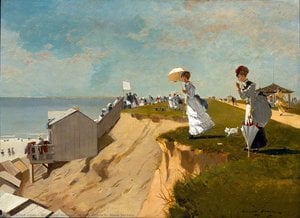
A Moment of Serenity: Unpacking the Poetic Depth of Winslow Homer’s Moonlight
Winslow Homer's 1874 watercolor, “Moonlight,” isn’t merely a depiction of a beach scene; it’s a carefully constructed meditation on solitude, connection, and the evocative power of light. Homer, already establishing his signature style—a masterful blend of realism and atmospheric sensitivity—captures an intimate moment between two figures nestled on a darkened shore. The painting immediately draws the viewer in with its soft, diffused glow, a testament to Homer’s extraordinary command of watercolor technique. He eschews sharp outlines and dramatic contrasts, instead favoring subtle washes and delicate gradations of color that mimic the ethereal quality of moonlight filtering through clouds.
The scene is deceptively simple: two individuals, positioned close enough for easy conversation yet distanced in a way that suggests quiet contemplation, sit on the sand. One figure leans slightly towards the left, perhaps drawn into a private thought, while the other occupies a more central position, suggesting an openness to connection. The placement of these figures is deliberate, creating a sense of balance and inviting the viewer to step into their shared space. Homer’s use of color—a palette dominated by blues, grays, and subtle greens—reinforces this feeling of tranquility. The muted tones are punctuated by the silvery luminescence of the moon and the gentle shimmer on the water's surface, creating a visual harmony that is both calming and profoundly beautiful.
Masterful Watercolor Technique: Homer’s Dance with Light
What truly distinguishes “Moonlight” is Homer’s unparalleled ability to render light. He doesn’t simply paint the moon; he paints its *effect*. The artist employs a technique known as ‘wet-on-wet,’ layering translucent washes of color upon each other, allowing them to bleed and blend seamlessly. This creates an atmospheric depth that is rarely achieved in oil painting. The clouds themselves are not defined shapes but rather suggestions of form, rendered with delicate strokes that capture their ephemeral nature. Notice how Homer uses varying degrees of pressure to build up the highlights on the water’s surface—a subtle indication of movement and reflection without resorting to harsh lines or details.
Furthermore, Homer's mastery extends to his understanding of shadow. The darkness isn’t oppressive; it’s a gentle embrace that softens the forms and enhances the luminosity of the moon. The shadows cast by the figures are minimal, contributing to the overall sense of peace and intimacy. This careful manipulation of light and shadow is not merely technical skill—it's an expression of Homer’s deep appreciation for the natural world and his ability to translate its beauty onto canvas.
Historical Context & The American Spirit
Created in 1874, “Moonlight” reflects a pivotal moment in American art history. Following the Civil War, artists like Homer were increasingly turning away from grand historical narratives and focusing on scenes of everyday life—the landscapes, people, and experiences that defined the nation’s identity. Homer's work embodies this shift towards realism and a celebration of the American spirit. Unlike the idealized depictions often found in European art, Homer presents a humble, unpretentious scene—a simple moment of connection between two individuals enjoying the quiet beauty of nature.
The painting’s roots are also deeply connected to Homer's early career as an illustrator for Harper's Weekly. This experience honed his observational skills and taught him how to capture scenes with remarkable clarity and detail. “Moonlight” demonstrates this legacy—a testament to Homer’s ability to transform observation into art, capturing not just the appearance of a scene but also its emotional essence.
A Timeless Resonance: Symbolism & Emotional Impact
Beyond its technical brilliance, “Moonlight” resonates with viewers on an emotional level. The painting evokes a sense of nostalgia, tranquility, and quiet contemplation. It’s a reminder of the simple pleasures in life—the beauty of nature, the comfort of companionship, and the solace found in solitude. The moon itself is a potent symbol—representing mystery, romance, and the passage of time. The figures, seemingly lost in their own thoughts, invite us to reflect on our own relationships and experiences.
Reproductions of “Moonlight” offer an exceptional opportunity to bring this timeless masterpiece into your home or office. WahooArt’s hand-painted reproductions faithfully capture the painting's delicate nuances and atmospheric depth, allowing you to experience its beauty firsthand. Whether as a statement piece in a living room or a calming addition to a study, “Moonlight” is sure to evoke a sense of serenity and wonder for years to come.



 效果预览
效果预览
 购买手绘画作
 分享
分享 分享
分享
 详情
详情

 下载
下载
 相似作品
相似作品 X射线
X射线 幻灯片播放
幻灯片播放

 展开详情
展开详情






































 玻璃选项仅适用于110厘米以下的尺寸。