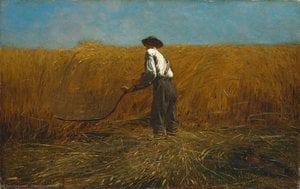
从与原作比例一致的预设尺寸中进行选择。

您可以输入自定义尺寸,以适配特定的画框或空间。如果所选尺寸与原图比例不符,我们将通过裁剪作品或添加手绘元素来扩展画面。数字样稿将在制作开始前发送给您确认。
请注意,屏幕预览无法准确反映实际的裁剪或扩展效果,只有样稿才能真实呈现最终的构图。
虽然我们提供定制尺寸服务,但为了保留原作比例,建议您从预设列表中选择尺寸。

A Voice from the Cliffs
复制品尺寸
Winslow Homer (1836-1910), a titan of American landscape painting, didn't forge his artistic path through formal academies but rather emerged from the crucible of observation and practicality—a distinctly American ethos that profoundly shaped his oeuvre. Unlike many European contemporaries preoccupied with grand narratives and idealized visions, Homer focused on capturing the palpable spirit of everyday life, particularly in rural New England and the rugged beauty of coastal America.
His early career as a commercial illustrator honed an unparalleled ability to distill complex scenes into crystalline clarity and detail—skills that would become foundational to his mature artistic endeavors. Harper’s Weekly wasn't merely a job; it was an apprenticeship in visual storytelling, teaching Homer how to translate observation into compelling imagery. This formative experience instilled within him a meticulous attention to texture and light, characteristics that permeate his paintings.
Initially experimenting with watercolor, Homer swiftly mastered the medium’s delicate responsiveness to tonal shifts and subtle color harmonies. The etching “A Voice from the Cliffs,” created shortly after 1883 (private collection), exemplifies this mastery. Homer employed a loose, expressive brushstroke—a hallmark of his style—to convey the atmosphere of the seaside cliffs. Notice how he builds up layers of pigment to create depth and luminosity, capturing the interplay of sunlight on the water’s surface and the muted tones of the rocky shoreline.
“A Voice from the Cliffs” depicts three women standing serenely beneath towering cliffs. Their presence is juxtaposed against the backdrop of two boats—one positioned on the distant horizon, adding a sense of scale and perspective, while the other closer to shore suggests practical activity. The figures are not actively engaged in dramatic action; instead, they listen intently to the birdsong emanating from above – a deliberate choice that underscores Homer’s fascination with capturing fleeting moments of beauty and contemplation.
Beyond its visual precision, “A Voice from the Cliffs” speaks volumes about Homer's artistic philosophy. The cliff itself represents resilience and permanence against the ceaseless forces of nature—a recurring motif in Homer’s work that reflects his belief in the enduring spirit of America. Simultaneously, the women embody domestic tranquility and connection to the natural world, offering a poignant counterpoint to the turbulent currents of industrialization sweeping across the nation.
You can admire this iconic piece at The Metropolitan Museum of Art (https://www.metmuseum.org/art/collection/search/349309) and Cleveland Museum of Art (https://www.clevelandart.org/art/1942.1485). Alternatively, explore similar works by Homer at the National Gallery (https://americanart.si.edu/artwork/listening-voice-cliffs-century-magazine-november-1883-37160).

1836 - 1910 , 美国

探索温斯洛·荷马25幅杰作,领略美国绘画大师的海洋风情与自然主义魅力。从经典油画到水彩风景,每一幅作品都讲述着动人故事。WahooArt.com提供高品质艺术复制品,点亮您的家居空间!立即探索完整系列。

Journey through 10 legendary watercolor masterpieces by Sargent, Turner & Homer! Explore iconic landscapes, portraits & floral art that redefined history. Find museum-quality reproductions and curated decor ideas at WahooArt.com.

Explore 10 defining American Realism masterpieces – Hopper, Homer & more. Discover the stories behind these iconic paintings and bring timeless art to your home with WahooArt's museum-quality reproductions. Explore the full collection online.

Explore the captivating world of watercolor painting! Discover its rich history, essential techniques, influential artists & collecting tips. A comprehensive guide for art enthusiasts from WahooArt.

Explore the captivating world of watercolor painting! Discover its rich history, essential techniques, influential artists & collecting tips from art experts. A comprehensive guide for enthusiasts.


 效果预览
效果预览
 购买印刷品
购买印刷品 分享
分享 分享
分享
 详情
详情

 下载
下载
 相似作品
相似作品 X射线
X射线 幻灯片播放
幻灯片播放
 展开详情
展开详情









 玻璃选项仅适用于110厘米以下的尺寸。


![Indian Tobacco Shop Sign [reverse, Indian Facing Right] — 温斯洛·霍默, Contemporary Realism](/media/artworks/images-thumb/74/22/7422432cafc295265ef3b7f7fa62d35d.jpg)