OilWallArtImpressionism
 1930Modern
 105.0 x 128.0 cm
 皇家苏格兰学院艺术与建筑展
购买高分辨率增强版数字图像,其品质远超在线预览。
每一份文件都由我们的内部专家使用先进工具与专业的后期润色技术精心打造。我们确保每一张图像都具备卓越的清晰度、精准的色彩还原度以及细腻的细节表现。
最终文件将在 72 小时内通过电子邮件交付,并针对专业、编辑及印刷用途进行了优化。其品质与顶级设计工作室、出版社和画廊所信赖的标准完全一致。
选择 WahooArt.com,您获得的不仅仅是一张图像——您收到的是经过专业级增强、精雕细琢的数字艺术作品,并享有满意保证。以下是您的订单中自动包含的所有内容:

您的高分辨率数字图像文件将在下单后 72 小时内通过电子邮件发送给您 —— 即可立即使用。

您的艺术品经过专业优化,结合先进的 AI 技术与人工修饰,确保呈现极致的细节、清晰度与色彩准确度。

不小心删除了文件或找不到了?没关系——我们将随时为您免费重发。

即刻拥有您的艺术作品,无需支付任何关税、税费或运费——数字下载始终免税。

我们通过专业工具与色彩管理技术,确保您的数字图像尽可能真实地还原原作色彩。

如果您对所购数字图像不满意,我们将在100天内为您进行修改或提供100%的全额退款——无需任何理由。

不满意?在收到数字文件后的100天内,您可以申请全额退款——无需任何理由。

购买 3 张图片可享 10% 折扣 - 购买 5 张可享 15% 折扣 - 购买 10+ 张可享 20% 折扣。非常适合创意项目、画廊和机构使用。
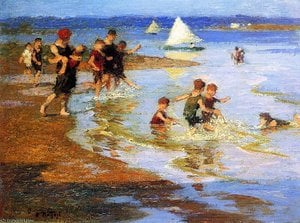
In the gentle embrace of A Breton Washing Pool, we are transported to a sun-drenched moment on the French coast, where the rhythmic pulse of the tides meets the quiet industry of daily life. Painted in 1930 by the esteemed Scottish artist William Marshall Brown, this masterpiece captures a scene of profound tranquility. At the heart of the composition stands a solitary woman, her figure anchored by the weight of tradition and the simple grace of her task. Clad in attire suited for the coastal breeze and crowned with a modest hat, she holds a broom, a symbol of the humble, repetitive labors that define the rhythm of maritime communities. Around her, the landscape breathes; figures are scattered across the shoreline like notes on a musical staff, some drawn to the water's edge while others linger in the distance, all part of a larger, harmonious tapestry of existence.
The painting serves as more than just a depiction of a landscape; it is an invitation to witness the intersection of human presence and the vast, indifferent beauty of nature. The inclusion of boats drifting upon the water—one anchored near the left periphery and another nestled toward the center—adds a sense of depth and movement to the stillness. A solitary chair sits placed in the middle ground, perhaps left behind by a passerby, acting as a silent invitation for the viewer to pause, sit, and immerse themselves in the salt-tinged air. This subtle detail enhances the painting's emotional resonance, transforming the canvas from a mere observation into an experiential journey of leisure and reflection.
William Marshall Brown, a distinguished member of the Royal Scottish Academy, brings his profound mastery of light and color to this Breton scene. His technique, deeply rooted in the Impressionist tradition, avoids rigid outlines in favor of soft, luminous brushstrokes that capture the fleeting quality of natural light. The artist’s ability to render the subtle nuances of the atmosphere is nothing short of extraordinary; one can almost feel the warmth of the sun reflecting off the damp sand and the cool mist rising from the washing pool. His palette is a sophisticated blend of earthy coastal tones and shimmering aquatic hues, meticulously layered to create a sense of three-dimensional space and atmospheric perspective.
For the discerning collector or interior designer, this work offers an unparalleled opportunity to introduce a sense of calm and historical elegance into a living space. The composition’s balance between the detailed foreground elements and the expansive, hazy horizon creates a sense of openness that can breathe life into any room. Whether placed in a sunlit gallery or a sophisticated study, A Breton Washing Pool acts as a focal point of peace, evoking the timeless allure of the European seaside. It is a piece that does not merely decorate a wall but enriches the very soul of an environment, offering a permanent escape to a world of quiet beauty and enduring grace.

In the quiet, salt-sprayed corners of the European coastline, where the rhythmic pulse of the tide meets the steady toil of humanity, lies the heart of William Marshall Brown’s artistic vision. A Scottish master of the Royal Scottish Academy, Brown (1863–1936) possessed a rare ability to transform the mundane labors of rural life into scenes of profound, luminous serenity. His work does not merely observe; it breathes with the atmosphere of the landscapes he frequented, particularly the sun-drenched shores of Holland, Belgium, and France. Through his eyes, we witness a world where the boundaries between nature and human existence are blurred by a soft, Impressionist light, creating a timeless tapestry of coastal tranquility.
Brown’s journey into the mastery of light began in the historic studios of Edinburgh. Studying at the RCA School of Art and Design, he was shaped by instructors who emphasized a rigorous dedication to realism, yet encouraged an expressive exploration of color. This foundational period instilled in him a technical discipline that would later allow him to execute complex atmospheric effects with breathtaking ease. His election into the Royal Scottish Academy in 1894 served as a definitive milestone, signaling his arrival as a significant voice within the Scottish artistic community and providing him the platform to share his evocative visions with a wider audience.
The essence of Brown’s oeuvre is found in his intimate portrayals of genre scenes—moments of everyday life captured with a sense of reverence. He was particularly drawn to the lives of fisherfolk, documenting the quiet industry of those who gathered mussels along sandy shores or hauled heavy nets onto the beach. These subjects were more than mere topical interests; they represented a deeper, symbolic connection between humanity and the natural world, echoing the Victorian ideals of pastoral harmony and moral virtue. In his hands, the act of gathering shellfish becomes a meditative dance with the sea.
Technically, Brown was a virtuoso of the Impressionist tradition. He achieved a remarkable sense of depth and luminosity by layering thin, delicate glazes of oil paint, a method that allowed light to appear as if it were emanating from within the canvas itself. This technique is nowhere more evident than in his celebrated works:
Beyond the technical brilliance of his brushwork, William Marshall Brown’s significance lies in his ability to evoke emotion through stillness. While many of his contemporaries sought the dramatic or the avant-garde, Brown found power in the quietude of a coastal meadow or the gentle movement of a boat drifting upon a calm bay. His paintings serve as historical windows into a way of life that was intimately tied to the seasons and the tides—a world of manual labor and natural rhythm that felt increasingly distant even during his own lifetime.
Today, Brown’s work remains a cherished cornerstone for collectors of 19th and early 20th-century art. His ability to capture the fleeting quality of light—the way it glints off wet sand or softens the edges of a distant horizon—ensures that his paintings continue to offer a sense of peace to the modern viewer. He remains a definitive figure of the Impressionist movement, leaving behind a legacy of beauty that celebrates the enduring, harmonious bond between the human spirit and the vast, indifferent majesty of the sea.

1863 - 1936


 效果预览
效果预览
 切换至版画销售渠道
 分享
分享 分享
分享
 详情
详情 指南
指南

 下载
下载
 相似作品
相似作品 X射线
X射线 幻灯片播放
幻灯片播放 统计数据
统计数据 展开详情
展开详情