
x


 51.0 x 77.0 cm
 Guildhall Art Gallery
从与原作比例一致的预设尺寸中进行选择。

您可以输入自定义尺寸,以适配特定的画框或空间。如果所选尺寸与原图比例不符,我们将通过裁剪作品或添加手绘元素来扩展画面。数字样稿将在制作开始前发送给您确认。
请注意,屏幕预览无法准确反映实际的裁剪或扩展效果,只有样稿才能真实呈现最终的构图。
虽然我们提供定制尺寸服务,但为了保留原作比例,建议您从预设列表中选择尺寸。

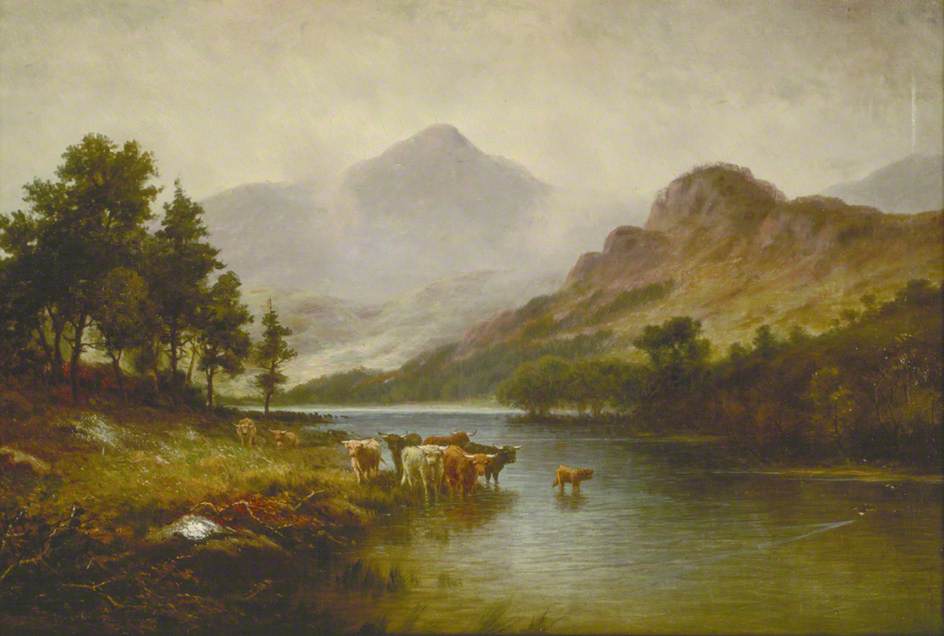
Highland Cattle in a River Landscape
复制品尺寸

The history of Victorian Scotland is often told through the lens of industrial progress, yet there exists a parallel narrative written in the luminous oils and dramatic vistas of William Glover. Born on November 4, 1836, in Croydon, South London, to a family deeply rooted in the theatrical arts, Glover’s life was an intricate tapestry woven from the threads of stagecraft and fine art. Though his beginnings were in England, his soul became inextricably linked to the Scottish landscape. As the son of the esteemed actor and theatre manager Edmund Glover, William was raised amidst the magic of the footlights, a heritage that would later inform his unique ability to transform a flat canvas into a breathing, theatrical world.
Glover’s artistic journey was marked by a profound transition from the ephemeral beauty of the stage to the enduring permanence of landscape painting. After honing his skills through rigorous self-study and formal training at the Glasgow School of Art in 1859, he emerged as a master of visual storytelling. His early years were defined by an apprenticeship to light and shadow, a skill set perfected while working as a scenic painter. In this role, he learned to manipulate scale and perspective to create immersive environments for the theatre, a technique that would eventually breathe life into his most celebrated landscape works. His professional ascent in Glasgow’s theatrical scene was nothing short of meteoric; he became a pivotal figure in the management of the Glasgow Theatre Royal, helping to establish it as a cornerstone of British entertainment.
What distinguishes Glover from his contemporaries is the unmistakable presence of the theatrical within his naturalism. To gaze upon a Glover landscape is to witness a carefully composed drama where nature itself takes center stage. His experience as a stage manager allowed him to approach the Scottish Highlands not merely as a topographical subject, but as a set designed to evoke profound emotional responses. He possessed an uncanny ability to use color and light to direct the viewer's eye, much like a spotlight illuminating a protagonist in a darkened theatre.
His mastery of scenic painting provided him with a unique technical vocabulary. He understood how to create depth through atmospheric perspective, using soft, hazy tones to suggest distant mountains and sharp, vibrant details to ground the foreground. This duality—the ability to capture both the grand, sweeping vistas of the Highlands and the intimate, fleeting moments of light—allowed him to bridge the gap between the monumental and the mundane. His works often feature:
As his career progressed, Glover’s reputation as a landscape painter solidified, moving beyond the confines of the theatre into the prestigious galleries of Scotland. His paintings, such as The River Kelvin from the North at the Botanic Gardens and Meikle Earnock Village, serve as vital historical documents of a bygone era. Through his brush, we see the rural rhythms of the late 19th century—the horse-drawn carriages, the bustling village streets, and the serene, untouched beauty of the Scottish countryside before the full weight of industrialization took hold.
The significance of William Glover lies in his ability to have captured the sublime. He did not merely paint what he saw; he painted how it felt to stand amidst the grandeur of the Highlands. His work remains a testament to the Victorian era's fascination with nature and its romanticized connection to heritage. Though he passed away in 1916, his legacy persists in the collections of museums like the Low Parks Museum, where his canvases continue to invite viewers into a world of theatrical beauty and enduring Scottish spirit. He remains a singular figure—an artist who brought the drama of the stage to the quiet majesty of the earth.

1836 - 1916


第一时间获取最新的艺术新闻、独家优惠及装饰灵感。
向我们介绍您的项目需求,我们的艺术专家将为您提供 3 个个性化的艺术品推荐。
由我们的专家为您精选 3 款心仪之作 —— 完全免费!

 效果预览
效果预览
 购买印刷品
购买印刷品 分享
分享 分享
分享
 详情
详情

 下载
下载
 相似作品
相似作品 X射线
X射线 幻灯片播放
幻灯片播放 展开详情
展开详情






































 玻璃选项仅适用于110厘米以下的尺寸。


