x


 73.0 x 54.0 cm
从与原作比例一致的预设尺寸中进行选择。

您可以输入自定义尺寸,以适配特定的画框或空间。如果您选择的尺寸与原图比例不符,我们将对作品进行裁剪,或通过镜像填充/纯色填充边缘的方式来扩展图像。在开始制作之前,我们会向您发送一份数字效果图供您确认。
请注意,屏幕上的预览并不能反映实际的裁剪或扩展效果。只有效果图才能准确展示最终的构图。
虽然我们提供定制尺寸,但为了保持原图比例,我们建议您从预设列表中选择尺寸。

The Window
复制品尺寸

In the grand tapestry of British art history, few figures possess the unique ability to bridge the gap between the delicate nuances of Impressionist light and the heavy, industrial grit of modern warfare quite like William Bernard Adeney. Born in London on August 2, 1878, Adeney’s life was a masterclass in artistic versatility. His journey began under the watchful eyes of mentors at the St. John's Wood School, and his formal training at the Royal Academy Schools provided him with a rigorous foundation that would later allow him to navigate both the ethereal beauty of landscapes and the mechanical complexity of the early twentieth century. Beyond the canvas, Adeney was a man of profound creative breadth, serving as a pivotal figure in textile design and even leading the textile school at Central Saint Martins College of Art and Design for nearly two decades.
The soul of Adeney’s work is deeply rooted in the luminous traditions of Impressionism. Drawing inspiration from the legendary Claude Monet and Pierre-Auguste Renoir, he developed a profound sensitivity to the fleeting moments of atmosphere and light. His landscapes, such as the evocative “Tunley Bottom,” demonstrate a remarkable ability to eschew rigid, meticulous detail in favor of a tonal range that breathes with life. In these works, the viewer does not merely see a field or a forest; they feel the dampness of the morning mist and the warmth of a setting sun. This mastery of color and light was complemented by his professional partnership with Noel Gilford Adeney, a collaboration that saw him honing his skills in textile design, adding a layer of textural complexity to his artistic identity.
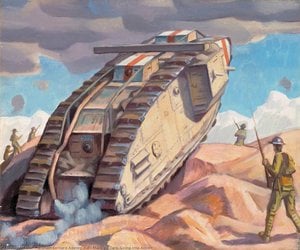
While much of his oeuvre celebrates the tranquility of the English countryside, Adeney’s legacy is indelibly marked by his courageous documentation of the Great War. During World War I, he was commissioned by the British Tank Corps, a role that thrust him into the heart of industrial and military evolution. This period saw a fascinating metamorphosis in his style, as he fused technical precision with an expressive, almost kinetic brushwork to capture the sheer scale of modern machinery. His iconic painting, “The Experimental Depot for Tanks, Dollis Hill,” stands as a monumental achievement of this era. It is not merely a record of armored vehicles; it is a visceral depiction of progress and the daunting reality of military preparedness, capturing the movement and heavy presence of the tanks within the depot.
This intersection of the mechanical and the painterly allowed Adeney to contribute something truly unique to the genre of war art. He did not shy away from the industrial weight of the era, yet he maintained the atmospheric sensitivity that defined his earlier landscapes. His ability to render the metallic surfaces and the dust-filled air of a military depot with the same emotional depth as a sunlit meadow speaks to a rare technical dexterity. Through these works, Aden_ey became a chronicler of a world in transition, documenting the dawn of armored warfare through an artist's lens.
Adeney’s influence extended far beyond his individual canvases, reaching into the very structures of the British art community. As a founding member and later the president of the London Group from 1921 to 1923, he played a crucial role in shaping the direction of contemporary exhibiting societies. His leadership helped foster an environment where diverse styles—from the traditional to the avant-garde—could coexist and flourish. His life was also marked by a profound familial connection to the arts; his son, Richard Adeney, would go on to become one of Britain’s most celebrated flautists, carrying forward a legacy of musical and aesthetic excellence.
When we reflect on the career of William Bernard Adeney, we see an artist who refused to be confined by a single subject or style. Whether he was designing intricate textiles, capturing the quietude of a stream in “Campers by a Stream,” or documenting the formidable presence of a Mark V tank, his work remained anchored by a deep respect for light, color, and the human experience. He remains a pivotal figure whose work continues to resonate with those who seek the beauty in both the serene landscape and the turbulent march of history.


第一时间获取最新的艺术新闻、独家优惠及装饰灵感。
向我们介绍您的项目需求,我们的艺术专家将为您提供 3 个个性化的艺术品推荐。
由我们的专家为您精选 3 款心仪之作 —— 完全免费!


 效果预览
效果预览
 购买手绘画作
 分享
分享 分享
分享
 详情
详情

 下载
下载
 相似作品
相似作品 X射线
X射线 幻灯片播放
幻灯片播放 展开详情
展开详情






































 玻璃选项仅适用于110厘米以下的尺寸。