从与原作比例一致的预设尺寸中进行选择。

您可以输入自定义尺寸,以适配特定的画框或空间。如果您选择的尺寸与原图比例不符,我们将对作品进行裁剪,或通过镜像填充/纯色填充边缘的方式来扩展图像。在开始制作之前,我们会向您发送一份数字效果图供您确认。
请注意,屏幕上的预览并不能反映实际的裁剪或扩展效果。只有效果图才能准确展示最终的构图。
虽然我们提供定制尺寸,但为了保持原图比例,我们建议您从预设列表中选择尺寸。

Whose Name Was Writ in Water
复制品尺寸
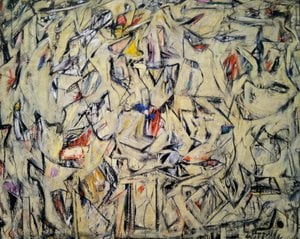
Willem de Kooning's "Whose Name Was Writ in Water," painted in 1975, is a powerfully evocative work that encapsulates the core tenets of Abstract Expressionism – a movement he helped define. This close-up view reveals not just paint on canvas, but a visceral outpouring of emotion and a deliberate disruption of traditional artistic representation. The painting’s dynamism stems from de Kooning's masterful manipulation of color and texture, creating a surface that seems to writhe with energy. Dominating the composition are bold strokes of red and blue, interwoven with strategic accents of green, yellow, and white – colors he frequently employed to convey intense psychological states. The title itself, “Whose Name Was Writ in Water,” adds another layer of complexity, hinting at themes of memory, loss, and perhaps even the elusive nature of identity.
De Kooning's technique is immediately apparent in this piece. The application of paint is anything but smooth; it’s deliberately rough, fragmented, and layered. Thick impasto – built-up areas of heavy paint – creates a tactile surface that demands attention. He employed a vigorous, almost violent brushstroke, often applying the paint with a palette knife as much as with his brushes. This technique wasn't simply about creating an image; it was about imbuing the canvas with feeling. The visible brushstrokes aren’t accidental; they are deliberate marks of energy and struggle, reflecting de Kooning’s own turbulent emotional landscape. The close-up view allows us to appreciate the sheer physicality of his process – a testament to his commitment to expressive abstraction.
"Whose Name Was Writ in Water" was created during a pivotal moment in art history, roughly halfway through de Kooning’s career. Following his early figurative work, particularly his iconic "Woman" series, he increasingly embraced abstraction, though always retaining a raw, almost confrontational quality. This painting reflects the broader trends of Abstract Expressionism – a movement born out of the anxieties and uncertainties of post-World War II America. Artists like de Kooning sought to express fundamental human emotions through non-representational forms, rejecting traditional notions of beauty and harmony. De Kooning’s work stands as a crucial bridge between his earlier explorations of figuration and his later, more purely abstract endeavors, showcasing the evolution of one of art's most influential figures.
The title itself is laden with potential symbolism. "Writ in Water" suggests something fleeting, ephemeral – perhaps a memory fading away or an attempt to capture a moment that’s inherently unstable. The dominant colors—red for passion and violence, blue for melancholy and introspection—contribute to the painting's overall mood of unease and intensity. Ultimately, “Whose Name Was Writ in Water” is not about literal representation; it’s about conveying an emotional state – a feeling of disorientation, struggle, and perhaps even a desperate search for meaning. It invites viewers to confront their own anxieties and grapple with the complexities of human experience.


1904 - 1997 , 荷兰

探索抽象表现主义的十幅经典杰作!波洛克、罗斯科等大师作品,揭秘艺术史上的重要瞬间。WahooArt.com为您呈现高品质艺术品复制和精选家居装饰方案,感受现代艺术的力量与魅力。立即浏览全系列!

Journey through Wassily Kandinsky's 25 most iconic abstract paintings. Explore his revolutionary use of color, form & spiritual expressionism. Find museum-quality Kandinsky reproductions and elevate your home decor with WahooArt.com. Discover all masterpieces on WahooArt.com!

探索戈雅大师的25幅杰作!深入了解西班牙绘画巨匠Francisco Goya的艺术世界,从洛可可到浪漫主义风格,感受黑加仑时代的情感力量。WahooArt.com提供高品质油画复制品和家居装饰灵感。立即在线发现所有名画!

Immerse yourself in the captivating world of slate blue! Explore 10 iconic paintings by Monet, Van Gogh & Renoir. Discover their stories, techniques & find museum-quality art reproductions for your home at .

Explore the evolution of Willem de Kooning's iconic Abstract Expressionist paintings. Discover his signature style, key themes & investment potential with expert insights for discerning art collectors.


 效果预览
效果预览
 购买手绘画作
 分享
分享 分享
分享
 详情
详情

 下载
下载
 相似作品
相似作品 X射线
X射线 幻灯片播放
幻灯片播放

 展开详情
展开详情









 玻璃选项仅适用于110厘米以下的尺寸。