
 Traditional Chinese Art
 95.0 x 70.0 cm
由我们的艺术家按需定制,为您提供您所选尺寸及画框的布面手工油画。 ( 切换至版画销售渠道 切换至数字图像销售渠道)
从与原作比例一致的预设尺寸中进行选择。

您可以输入自定义尺寸,以适配特定的画框或空间。如果所选尺寸与原图比例不符,我们将通过裁剪作品或添加手绘元素来扩展画面。数字样稿将在制作开始前发送给您确认。
请注意,屏幕预览无法准确反映实际的裁剪或扩展效果,只有样稿才能真实呈现最终的构图。
虽然我们提供定制尺寸服务,但为了保留原作比例,建议您从预设列表中选择尺寸。

CALLIGRAPHY IN RUNNING SCRIPT
复制品尺寸

Born in Beijing’s Daxing District in 1733, Weng Fanggang (翁方綱) emerged as a pivotal figure during the late Qing Dynasty – a time of profound intellectual ferment and artistic refinement. More than simply a calligrapher, he was a philosopher, literary critic, and collector deeply invested in shaping the aesthetic landscape of his era. His life’s work reveals a complex interplay between formal tradition and innovative thought, culminating in a unique approach to calligraphy and a significant contribution to the burgeoning “School of Musculature” (Jili Pai). His story is inextricably linked to the influence of Su Shi – a poet whose legacy he meticulously cultivated, transforming his admiration into a vibrant cultural phenomenon.
Weng’s early life was marked by diligent study and a keen awareness of literary trends. He secured the prestigious Jinshi degree in 1752, an accomplishment that opened doors to service within the Qing court. Initially employed as a junior compiler, he steadily ascended through the ranks, eventually becoming a member of the Grand Secretariat – a position reflecting his considerable intellect and administrative abilities. However, Weng’s true passion lay not in bureaucratic affairs but in the pursuit of artistic excellence, particularly in calligraphy and poetry. His translation of Tao Yuanming's “Peach Blossom Spring” (桃花源) into Manchu for the Qianlong Emperor was a watershed moment, securing his royal patronage and establishing him as a respected scholar within the imperial court.
Weng Fanggang’s most enduring legacy rests on his development of the “School of Musculature” (Jili Pai), a critical approach to poetry rooted in the concept of ‘muscles’ – referring not to physical strength, but to the rigorous intellectual discipline required to understand and appreciate classical Chinese literature. He vehemently opposed the prevailing trend of “Han Studies,” which prioritized textual analysis over the deeper philosophical underpinnings of Confucianism. Weng argued that true scholarship demanded a holistic understanding of universal principles, embodied in the teachings of Zhu Xi – emphasizing contemplation and the pursuit of ‘righteousness’ (yili) as the foundation for all knowledge. His critique of Dai Zhen's approach, which he deemed overly focused on superficial details, highlighted his commitment to a more profound engagement with literary tradition.
Perhaps the most fascinating aspect of Weng Fanggang’s career was his deliberate cultivation of the legacy of Su Shi (蘇軾). Recognizing Su Shi's profound influence on Chinese poetry, Weng initiated an annual birthday celebration in his honor – a ritual that quickly gained momentum and became deeply ingrained within Qing cultural life. This wasn’t merely a sentimental homage; it represented a strategic effort to preserve and promote Su Shi’s artistic ideals. Weng amassed a substantial collection of Su Shi's works, including the highly prized Songyang Manuscript (宋陽帖), acquired for an extraordinary sum of 60 Jin – a testament to his dedication. He even established a room in his personal library dedicated solely to Su Shi’s poetry, further solidifying his commitment to this particular literary figure. This “cult” wasn't confined to Weng himself; it involved collaborations with Chosŏn scholars from Korea, creating a vibrant transnational community united by their shared admiration for Su Shi.
Beyond his philosophical pursuits, Weng Fanggang was a highly accomplished calligrapher. He meticulously studied the techniques of ancient masters like Ouyang Xun and Yu Shinan, specializing in Lishu script – a bold, angular style that conveyed both power and elegance. His calligraphy is characterized by its precision, balance, and profound understanding of brushwork. Weng’s work continues to be admired for its technical mastery and its embodiment of the aesthetic principles he espoused in his literary criticism. Weng Fanggang died in 1818, leaving behind a complex and influential legacy – one that bridges the realms of philosophy, literature, and art, shaping the intellectual and artistic landscape of late Qing China.

1733 - 1818

Embark on a profound journey through the soul of Chinese calligraphy. Explore the historical mastery of ink, brush, and script, from ancient Zhuanshu to elegant running script, and discover how this timeless art form reflects the enduring spirit of classical East Asian aesthetics.

Embark on a sophisticated exploration of ink wash painting and Sumi-e. Uncover the profound historical lineages, Zen philosophies, and technical mastery behind this timeless medium in our authoritative guide for fine art enthusiasts.
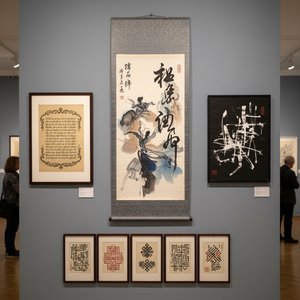
Explore the profound beauty of calligraphy art. From the fluid running script of Chinese masters to historical ink masterpieces, discover how the elegance of line transforms spaces with timeless grace and scholarly sophistication.


 效果预览
效果预览
 分享
分享 分享
分享
 详情
详情

 下载
下载
 相似作品
相似作品 X射线
X射线 幻灯片播放
幻灯片播放 统计数据
统计数据 展开详情
展开详情






































 玻璃选项仅适用于110厘米以下的尺寸。


