
博物馆级艺术微喷或帆布版画,制作高效,并提供多种饰面选择。 ( 订购此收藏品的纯手工复刻画作 切换至数字图像销售渠道)





























您可以从与原作比例一致的预设尺寸中进行选择。

请输入您所需的宽度和高度,以适配您的画框或墙面。由于印刷品只能进行裁剪,无法超出原图尺寸,因此若比例不一致,画面的一部分将会被裁切。在正式印刷之前,我们会为您发送一份数字效果图供您确认。本页面显示的图片并非最终裁剪后的效果——只有效果图才能展示真实的裁剪情况。
Ocean
复刻品尺寸说明
Vija Celmins’s “Ocean” isn’t merely a painting; it’s an immersion. It’s a deliberate stripping away of all extraneous context, leaving only the raw, insistent presence of water itself. The work, created in 1975, presents a relentlessly horizontal expanse of gray and white – a seemingly simple depiction of waves that, upon closer inspection, reveals itself to be a profound meditation on observation, memory, and the very nature of perception. There’s no horizon line to anchor the eye, no suggestion of sky or distant shore; instead, we are confronted with an infinite field of undulating lines, each meticulously rendered to capture the subtle shifts in texture and tone that define the surface of the sea.
Celmins' approach is deeply rooted in a process of painstaking replication. She began by studying photographs of oceans, not as representations of reality, but as records of light and movement. This foundational act of observation informs every line, every shade, creating an illusion of depth and volume that defies the two-dimensionality of the medium. The work’s hyperrealistic quality isn't about photographic accuracy; it’s about distilling the essence of the ocean – its ceaseless motion, its subtle variations in color, and its inherent quietude – into a visual language that transcends literal depiction.
While often associated with painting, Celmins' technique leans heavily towards printmaking. The incredibly fine lines, achieved through the application of graphite on paper, evoke the delicate tracery of etching or lithography. This choice of medium is crucial to understanding the work’s impact. Graphite allows for an unparalleled level of detail and tonal control, enabling Celmins to capture the subtle nuances of light reflection and wave movement with astonishing precision. The process itself—the countless hours spent meticulously rendering each individual crest – speaks volumes about her dedication to observation and her commitment to translating a sensory experience into a tangible form.
It’s important to note that Celmins' work is not simply a technical exercise; it’s an intensely personal one. She has described the act of drawing as a way of “remembering” – of holding onto fleeting moments and impressions. The repetitive nature of her process, combined with the subject matter—the ocean, a symbol of vastness and timelessness—creates a meditative effect, inviting the viewer to lose themselves in the work’s quiet intensity.
Celmins' early artistic development was profoundly shaped by her encounter with the Italian monochrome still life painter Giorgio Morandi. Like Morandi, she was drawn to the subtle variations in tone and texture—the way light plays across surfaces, the delicate interplay of shadow and highlight. This influence is evident in “Ocean,” where Celmins masterfully manipulates graphite to create a sense of depth and volume through carefully controlled gradations of gray. The work shares Morandi’s quiet contemplation, its focus on the beauty of simple forms and the power of observation.
At first glance, “Ocean” might seem like a purely descriptive image—a straightforward representation of water. However, beneath this surface simplicity lies a wealth of symbolic meaning. The ocean has long been associated with vastness, mystery, and the unknown – representing both the potential for adventure and the inevitability of change. Celmins’s meticulous rendering of its surface suggests an attempt to capture this elusive quality—to hold onto the fleeting moment before it dissolves into nothingness. The work's stillness, despite the implied movement of the waves, speaks to a deeper sense of contemplation, inviting us to consider our place within the larger context of existence.
"Ocean"创作于1975年,属于Vija Celmins艺术生涯中的Contemporary时期。
通过创作者的出生地,《Ocean》将Contemporary Realism运动与Latvia紧密联系在了一起。
Vija Celmins 于 1975 年创作了《Ocean》。

1938 - , Latvia

Embark on a cultural journey through Lyrical Abstraction. Explore how masters like Kandinsky used color and motion to translate emotion into visual poetry. Discover the profound beauty of abstract expressionism and learn to curate emotional resonance in your own art collection.

探索抽象表现主义的十幅经典杰作!波洛克、罗斯科等大师作品,揭秘艺术史上的重要瞬间。WahooArt.com为您呈现高品质艺术品复制和精选家居装饰方案,感受现代艺术的力量与魅力。立即浏览全系列!
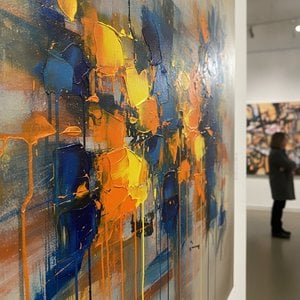
Master the high-impact world of contemporary abstraction. Discover how bold colors, textures, and modern movements like Abstract Expressionism can transform your space with premium, high-energy art curated for the design-conscious professional.

Journey through Wassily Kandinsky's 25 most iconic abstract paintings. Explore his revolutionary use of color, form & spiritual expressionism. Find museum-quality Kandinsky reproductions and elevate your home decor with WahooArt.com. Discover all masterpieces on WahooArt.com!

探索几何抽象艺术的十大杰作!康定斯基、蒙德里安等大师作品,色彩构成与非具象之美。WahooArt.com提供博物馆级艺术复制品,为您的家居带来现代艺术灵感。立即在线探索完整系列!


 实景预览
实景预览
 发送
发送 分享
分享
 详情
详情 指南
指南

 下载图片
下载图片
 相似作品
相似作品 X射线
X射线 幻灯片播放
幻灯片播放 统计数据
统计数据


 阅读全文
阅读全文









 玻璃选项仅适用于110厘米以下的尺寸。


