博物馆级艺术微喷或帆布版画,制作高效,并提供多种饰面选择。 ( 订购纯手工绘制画作 切换至数字图像销售渠道)





























您可以从与原作比例一致的预设尺寸中进行选择。

请输入您所需的宽度和高度,以适配您的画框或墙面。由于印刷品只能进行裁剪,无法超出原图尺寸,因此若比例不一致,画面的一部分将会被裁切。在正式印刷之前,我们会为您发送一份数字效果图供您确认。本页面显示的图片并非最终裁剪后的效果——只有效果图才能展示真实的裁剪情况。
Maamor va
复刻品尺寸
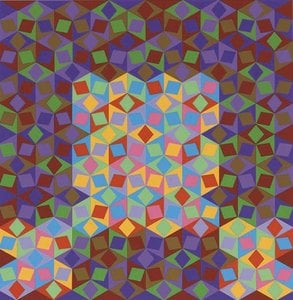
Victor Vasarely's "Maamor va" is more than just a painting; it’s an invitation to deconstruct reality, a visual meditation on perception itself. This captivating work, dominated by a vibrant interplay of blue and yellow geometric forms, embodies the core tenets of Op Art – Optical Art – a movement that emerged in the mid-20th century and profoundly impacted the course of modern art. The piece’s immediate impact lies in its dynamic surface; a mesmerizing mosaic of squares and triangles seemingly floating within a carefully orchestrated space. It's a testament to Vasarely’s meticulous approach, born from his early studies in medicine – an unexpected foundation for a revolutionary artist who sought to manipulate the viewer’s visual experience.
Vasarely's artistic journey began with a formal education in medicine, a path he ultimately abandoned to pursue his passion for visual expression. This pivotal shift occurred during his time at the Podolini-Volkmann Academy and, crucially, within Sándor Bortnyik’s “Műhely” workshop – a space deeply influenced by the Bauhaus movement. The Bauhaus, with its emphasis on functional design, geometric abstraction, and the exploration of industrial materials, provided Vasarely with the theoretical framework for his groundbreaking work. He absorbed the principles of reducing form to its essential elements – lines, planes, and colors – believing that these could be used to create optical illusions and manipulate perception in a controlled manner. This influence is clearly visible in “Maamor va,” where the precise arrangement of shapes generates a dynamic visual effect.
The beauty of "Maamor va" lies not just in its aesthetic appeal but also in its technical sophistication. Vasarely was fascinated by the way our eyes and brains interpret visual information, particularly how they perceive movement and depth. The seemingly random arrangement of squares and triangles is, in fact, a carefully calculated system designed to trick the eye. By manipulating color, size, and spacing, he created an optical illusion that generates a sense of dynamism and movement – a key characteristic of Op Art. The subtle variations in hue and tone within each shape contribute to this effect, further enhancing the painting’s visual complexity.
While abstract in its execution, “Maamor va” resonates with deeper symbolic meanings. The geometric forms can be interpreted as representing fundamental building blocks of reality – the elements that constitute our perception of the world. The vibrant colors evoke a sense of energy and excitement, reflecting Vasarely’s belief in the power of art to transform our experience of space and time. Ultimately, this artwork invites contemplation on the nature of visual perception and the relationship between the artist's intention and the viewer's interpretation. It is a powerful reminder that reality itself can be a construct, shaped by our own sensory experiences.

1906 - 1997 , 克罗地亚

Explore the profound spiritual depth of geometric abstraction. From Malevich's Suprematism to modern masters, our expert guide reveals how pure form and color command presence in fine art collections.

 实景预览
实景预览
 分享
分享 分享
分享
 详情
详情 指南
指南

 下载作品
下载作品
 相似作品
相似作品 X射线
X射线 幻灯片播放
幻灯片播放 Q&A
Q&A 统计数据
统计数据

 展开全文
展开全文









 玻璃选项仅适用于110厘米以下的尺寸。