
由我们的艺术家按需定制,为您提供您所选尺寸及画框的布面手工油画。 ( 切换至版画销售渠道 切换至数字图像销售渠道)
从与原作比例一致的预设尺寸中进行选择。

您可以输入自定义尺寸,以适配特定的画框或空间。如果所选尺寸与原图比例不符,我们将通过裁剪作品或添加手绘元素来扩展画面。数字样稿将在制作开始前发送给您确认。
请注意,屏幕预览无法准确反映实际的裁剪或扩展效果,只有样稿才能真实呈现最终的构图。
虽然我们提供定制尺寸服务,但为了保留原作比例,建议您从预设列表中选择尺寸。

The Great Recession
复制品尺寸
Leon Reid IV, a name synonymous with the dynamic evolution of 21st-century street art, emerged from the urban landscape of Richmond, Virginia in 1979. However, it was the city of Cincinnati, Ohio, that truly ignited his artistic spark. Reid’s formative years were steeped in the burgeoning graffiti culture of the mid-1990s, a period characterized by raw energy and a rebellious spirit. He wasn't merely observing this world; he became an integral part of it, adopting the tag “VERBS” – a moniker chosen with a playful awareness of its inherent action and potential for disruption. This early phase was about mastering technique—the intricacies of spray paint control, the rhythm of lettering, and the clandestine thrill of claiming space in the urban environment. It wasn’t simply about aesthetics; it was a dialogue with the city itself, a visual language spoken through walls and hidden corners.
The late 1990s proved pivotal for Reid. A move to Brooklyn, New York, exposed him to a wider network of artists and a more sophisticated art scene. The annual Scribble Jam hip-hop festival became a crucial influence, bringing together diverse voices and pushing the boundaries of street expression. This period marked a transition from traditional graffiti towards what would become his signature style: site-specific installations that seamlessly blended sculpture with public space. Reid began to see the city not just as a canvas but as a repository of materials—discarded objects, repurposed signage, everyday detritus—all holding potential for transformation. This shift wasn’t merely aesthetic; it was conceptual. He started questioning the very nature of art and its relationship to the surrounding community.
Reid's artistic exploration took a more structured turn with his formal education. He earned a Bachelor of Fine Arts degree from Pratt Institute in 2002, followed by a Master’s degree from Central Saint Martin’s in 2004. These institutions provided him with the theoretical framework to complement his intuitive understanding of art and urban space. He began experimenting with disguises—often adopting the persona of a construction worker—to execute daylight installations that challenged perceptions and sparked conversations. This period saw the emergence of “Darius Jones” as an alter ego, representing a more conceptual approach to interventionist art. His work increasingly focused on themes of social inequality, consumerism, and urban decay, communicated through humor, irony, and a deliberate engagement with public interaction.
Reid’s career has been marked by a prolific output of both commissioned and uncommissioned projects across the globe. He's not an artist confined to galleries; his work *is* the gallery—the streets, parks, and public spaces he transforms. Notable achievements include “The Great Recession” (2009) in Stavanger, Norway, a striking commentary on economic instability that blended street art with architectural photography, and “Slavery by Design” (2021), a powerful installation addressing systemic oppression through repurposed signage. He has been commissioned by prestigious institutions such as the New Museum, NuArt Festival, and SESC São Paulo, solidifying his position as a leading figure in contemporary urban art. In 2016, Thames & Hudson recognized him as one of the “60 Innovators Shaping Our Creative Future,” a testament to his lasting impact on the field.
Leon Reid IV, through his various artistic identities—VERBS and Darius Jones—has fundamentally altered the landscape of street art. He’s not simply creating visually arresting works; he's fostering dialogue, challenging norms, and prompting critical reflection on the world around us. His emphasis on community engagement is particularly significant. His installations aren’t imposed upon a space; they *respond* to it, incorporating elements of local culture and inviting public participation. This approach has inspired a new generation of artists to move beyond mere aesthetics and embrace art as a tool for social change. Reid's legacy lies in his ability to blur the boundaries between art and life, transforming the urban environment into a dynamic space for creativity, conversation, and ultimately, progress.

1979 - , United States of America
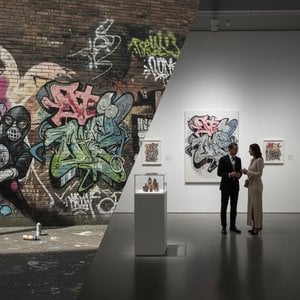
Explore the captivating journey of street art from urban walls to prestigious galleries. Discover how contemporary graffiti has evolved into a high-end collectible movement, redefining modern interior design and global art culture.


 效果预览
效果预览
 分享
分享 分享
分享
 详情
详情 指南
指南

 下载
下载
 相似作品
相似作品 X射线
X射线 幻灯片播放
幻灯片播放 统计数据
统计数据


 展开详情
展开详情






































 玻璃选项仅适用于110厘米以下的尺寸。


