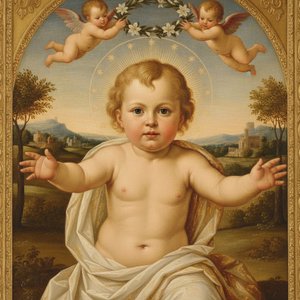
The Resurrection: A Venetian Masterpiece of Light and Faith
Tiziano Vecellio’s “The Resurrection,” painted in 1542 during his pivotal period of artistic evolution, is more than just a religious depiction; it's a vibrant testament to the transformative power of color and light. Housed within the opulent Palazzo Ducale in Urbino, Italy, this monumental canvas pulsates with an almost palpable energy, drawing viewers into a scene brimming with divine intervention and profound emotional resonance. It’s a work that speaks not only to the heart of Christian belief but also to Titian's groundbreaking approach to painting – one characterized by loose brushwork, luminous hues, and a masterful manipulation of atmospheric perspective.
The composition itself is dynamic and arresting. At its core lies Jesus Christ, dramatically lifted from the tomb by a multitude of angels, their wings outstretched in a flurry of motion. His arms are extended in a gesture of surrender and triumph, mirroring the act of resurrection itself. Surrounding him are figures – mourners, disciples, and witnesses – each rendered with varying degrees of detail and imbued with distinct emotional responses: grief, astonishment, and burgeoning hope. Noticeably, two birds—one perched near the top left corner and another towards the bottom right—add a subtle layer of symbolism, perhaps representing the soul’s ascent or the promise of eternal life. The inclusion of these small details elevates the painting beyond a simple narrative, inviting contemplation on themes of redemption and renewal.
A Synthesis of Mannerism and Venetian Innovation
Painted during a period of significant artistic transition—the waning years of the High Renaissance and the rise of Mannerism—“The Resurrection” embodies both styles. Titian, already a celebrated master, was experimenting with looser brushstrokes and more expressive color palettes than his predecessors. This work showcases his departure from the rigid formality of earlier Venetian painting, embracing instead a sense of movement and drama. The figures are not sharply defined; rather, they flow into one another, creating an illusion of depth and volume. The use of chiaroscuro—the dramatic contrast between light and shadow—is particularly striking, intensifying the emotional impact of the scene and highlighting the central figure of Christ.
Technically, Titian’s mastery is evident in his handling of color. He employs a rich, layered technique, building up hues through multiple glazes to achieve an astonishing luminosity. The reds—particularly those used for Jesus' garments—are intensely vibrant, while the blues and golds create a sense of heavenly radiance. The background, rendered with atmospheric perspective, recedes into a hazy distance, further emphasizing the drama of the foreground events. This masterful control over color is what truly sets this painting apart – it’s not merely a depiction of an event; it's an experience of light and emotion.
Historical Context and Patronage
Originally commissioned as a processional banner for the Corpus Domini brotherhood in Urbino, “The Resurrection” reflects its intended purpose. The banner was later divided, with this section becoming a standalone painting. This history reveals that Titian was working within a specific religious context, catering to the needs of a local confraternity dedicated to commemorating the body of Christ. Documents from 1542 and 1544 detail the payments made for the work, offering valuable insights into the artistic practices of the time.
The painting’s eventual placement in the Palazzo Ducale—a symbol of power and prestige—underscores its importance. The Duke Federico da Montefeltro, a renowned patron of the arts, likely acquired it as a testament to his own piety and a reflection of Urbino's cultural standing. It is believed that this piece was part of a larger Polyptych of the Resurrection, further demonstrating Titian’s ambition and artistic range.
Symbolism and Emotional Resonance
Beyond its religious narrative, “The Resurrection” is rich in symbolic meaning. The act of lifting Christ from the tomb represents not only his physical resurrection but also his triumph over death and sin. The angels, depicted with their wings spread wide, symbolize divine grace and intervention. The figures surrounding Jesus—mourners, disciples, and witnesses—represent humanity’s response to this miraculous event – a mixture of grief, hope, and awe.
Ultimately, “The Resurrection” is a profoundly moving work of art. It evokes a sense of wonder, faith, and the enduring power of redemption. Its luminous colors, dynamic composition, and masterful technique combine to create an experience that transcends mere representation, inviting viewers to contemplate the mysteries of life, death, and eternal salvation. Reproductions capture only a fraction of this original impact, but offer a beautiful way to bring this masterpiece into your home.



 效果预览
效果预览
 购买印刷品
购买印刷品 分享
分享 分享
分享
 详情
详情

 下载
下载
 相似作品
相似作品 X射线
X射线 幻灯片播放
幻灯片播放


 展开详情
展开详情






































 玻璃选项仅适用于110厘米以下的尺寸。