


x

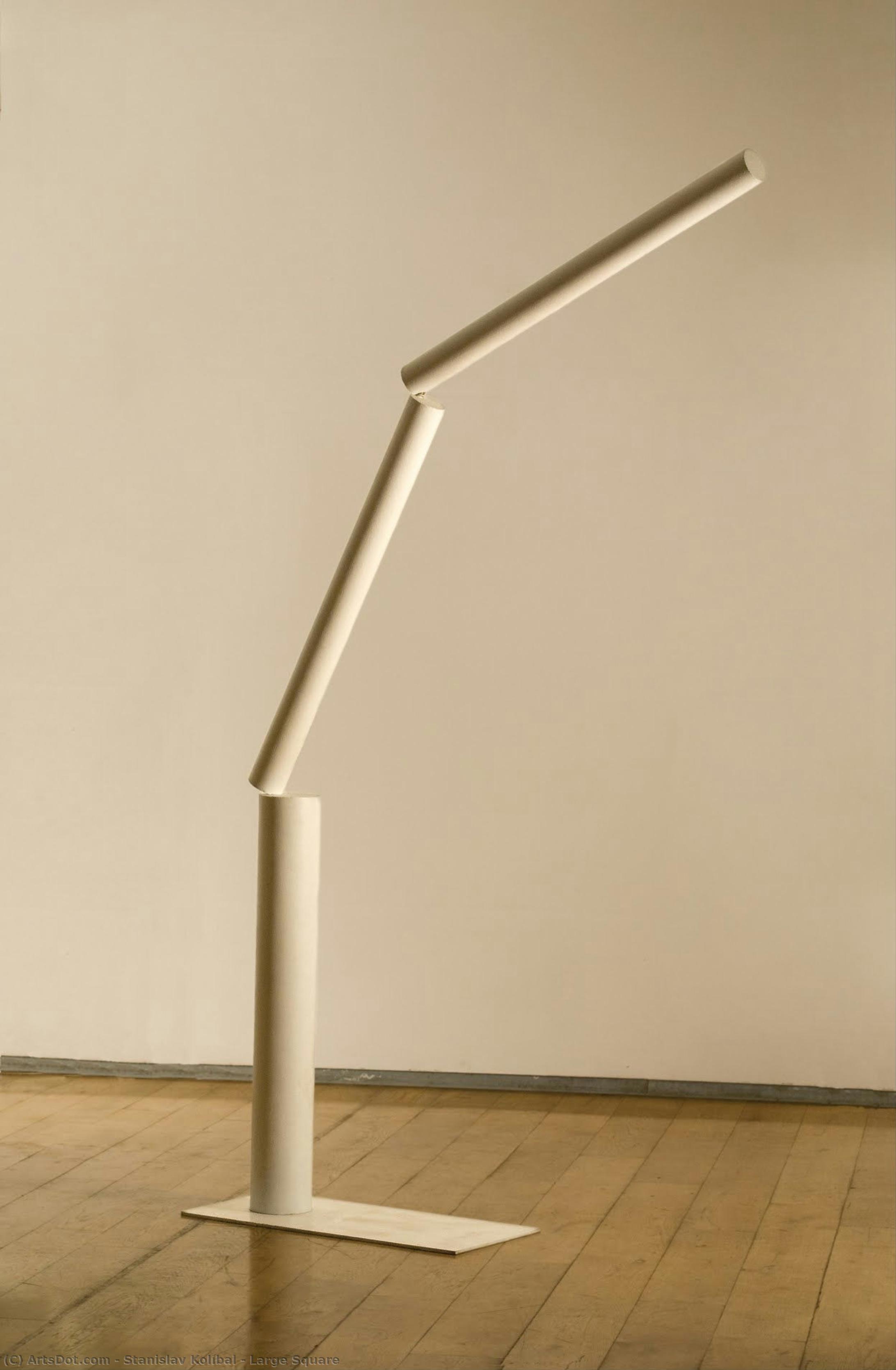
 1972
1972 72.0 x 105.0 cm
 Museum Kampa
从与原作比例一致的预设尺寸中进行选择。

您可以输入自定义尺寸,以适配特定的画框或空间。如果您选择的尺寸与原图比例不符,我们将对作品进行裁剪,或通过镜像填充/纯色填充边缘的方式来扩展图像。在开始制作之前,我们会向您发送一份数字效果图供您确认。
请注意,屏幕上的预览并不能反映实际的裁剪或扩展效果。只有效果图才能准确展示最终的构图。
虽然我们提供定制尺寸,但为了保持原图比例,我们建议您从预设列表中选择尺寸。

Large Square
复制品尺寸
Born in Orlová, Czech Republic, on December 11th, 1925, Stanislav Kolíbal’s artistic journey is a testament to the enduring power of geometry, illusion, and a profound meditation on humanity's place within the world. From his early studies at the High School of Arts and Crafts in Prague through his pivotal role in the influential “UB 12” group during the 1960s, Kolíbal has consistently pushed the boundaries of sculpture and drawing, establishing himself as a foundational figure in modern Czech art – an artist whose work continues to resonate with its intellectual depth and visual sophistication.
Kolíbal’s artistic language is immediately recognizable: a rigorous embrace of geometric forms interwoven with explorations of illusion and reality. Early influences can be traced back to the Constructivist movement, yet he quickly developed a distinctly personal style, prioritizing clarity of structure and a deliberate reduction of means. This wasn't merely about aesthetic beauty; it was a conscious effort to distill complex ideas into their most essential components – a philosophy reflected in his persistent search for rules and order within an often chaotic world. As he himself described, his art is fundamentally a “meditation on the problems engendered by and linked to man’s presence on Earth,” a statement that speaks volumes about the artist's deeply considered approach.
Kolíbal’s artistic education began at the Prague School of Arts and Crafts, followed by studies at the Academy of Fine Arts. It was during this period that he became involved with “UB 12,” a group of artists known for their experimental approach to art and architecture in the 1960s. This collective provided a crucial platform for Kolíbal’s development, exposing him to new ideas and challenging conventional artistic practices. The UB 12 group's focus on spatial relationships and conceptual exploration significantly shaped his later work, laying the groundwork for his distinctive style.
The restrictive political climate of Czechoslovakia during this era undoubtedly influenced Kolíbal’s creative output. His subsequent ban from exhibitions and sales between 1973 and 1980 highlights the challenges faced by artists operating within a controlled artistic environment. Despite these limitations, Kolíbal continued to work diligently, developing his unique visual vocabulary and solidifying his reputation as a significant voice in Czech art.
While drawing and sculpture have always been integral to Kolíbal’s practice, the latter half of the 1980s marked a pivotal shift. He began utilizing drawings not merely as preparatory sketches but as foundational blueprints for complex three-dimensional structures – “stavby” (buildings) in his own terminology. These wooden and metal constructions emerged from a deep engagement with architectural principles, yet they transcended mere imitation, becoming self-referential explorations of form, space, and the relationship between the two.
This evolution demonstrates Kolíbal’s ongoing commitment to pushing the boundaries of his art. He seamlessly integrated drawing and sculpture, creating a dynamic dialogue between these distinct mediums. His cycles of drawings became increasingly sophisticated, serving as keys to understanding the intricate logic behind his sculptural works – a testament to his meticulous process and profound artistic vision.
Kolíbal’s work has been exhibited extensively throughout Europe and North America, including prestigious venues such as the Guggenheim in New York, the Centre Pompidou in Paris, and the Indianapolis Museum of Art. Notable works like “Loosing Shape” and “Large Square” exemplify his signature style – a masterful combination of geometric precision and conceptual depth. His sculptures are not simply objects to be viewed; they invite contemplation on themes of order, illusion, and the human condition.
Today, Stanislav Kolíbal remains an active artist, continuing to create new works that build upon his decades-long artistic journey. His legacy extends far beyond the Czech art scene, influencing contemporary artists worldwide with his innovative approach to sculpture and drawing. He is recognized as a key figure in shaping the evolution of modern art, a testament to the enduring power of geometric abstraction and a profound engagement with fundamental human questions.

1925 - , Czech Republic


第一时间获取最新的艺术新闻、独家优惠及装饰灵感。
向我们介绍您的项目需求,我们的艺术专家将为您提供 3 个个性化的艺术品推荐。
由我们的专家为您精选 3 款心仪之作 —— 完全免费!
 定制手绘复刻品
 分享
分享 分享
分享
 详情
详情

 下载
下载
 相似作品
相似作品 X射线
X射线 幻灯片播放
幻灯片播放 展开详情
展开详情






































 玻璃选项仅适用于110厘米以下的尺寸。


