


从与原作比例一致的预设尺寸中进行选择。

您可以输入自定义尺寸,以适配特定的画框或空间。如果您选择的尺寸与原图比例不符,我们将对作品进行裁剪,或通过镜像填充/纯色填充边缘的方式来扩展图像。在开始制作之前,我们会向您发送一份数字效果图供您确认。
请注意,屏幕上的预览并不能反映实际的裁剪或扩展效果。只有效果图才能准确展示最终的构图。
虽然我们提供定制尺寸,但为了保持原图比例,我们建议您从预设列表中选择尺寸。

Hawks
复制品尺寸

In the golden era of the Edo period, few artists captured the intersection of wild majesty and aristocratic grace as profoundly as Soga Nichokuan. Born in the vibrant port city of Sakai, Japan, around 1630, Nichokuan was not merely a painter but a custodian of a prestigious artistic lineage. As the son of the renowned Soga Chokuan, the founder of the Sakai Soga school, his life and brushwork were inextricably linked to a family tradition dedicated to the meticulous study of nature. This heritage provided him with a unique vantage point, allowing him to inherit a specialized mastery of avian imagery that would eventually define his place in the annals of Japanese art history.
The essence of Nichokuan’s work lies in his ability to breathe life into the subjects of falconry, particularly the formidable hawk-eagles known as kumataka. To look upon his screens is to witness a world where the ferocity of a predator meets the delicate elegance of a floral arrangement. His training, believed to have been conducted under the rigorous guidance of his father, instilled in him a profound command over sumi-e, the monochrome ink wash technique. Through this method, he learned to translate the weight of a bird's gaze and the subtle texture of downy feathers into simple, yet powerful, strokes of black ink. This foundation allowed him to move beyond mere imitation, reaching toward a spiritual representation of his subjects that resonated with the Zen Buddhist ideals of harmony and contemplative stillness.
While many of his contemporaries adhered to the restrained elegance of monochrome palettes, Nichokuan dared to embrace a more luminous and vibrant aesthetic. He became celebrated for a style that utilized bold, striking hues to depict birds amidst lush, blooming landscapes, creating a visual tension between the predatory focus of the hawk and the soft beauty of the flora. A hallmark of his technical prowess was his use of gosho-e, a sophisticated method of applying pigment directly onto silk. This technique granted his masterpieces an unparalleled depth and a shimmering, textural richness that made the plumage of a hawk appear almost tactile to the viewer.
His compositions often achieved a breathtaking balance between complexity and clarity. In works such as Hawks on Plum Trees, one can observe how he utilized gold paint in the background to evoke a sense of boundless atmosphere and divine light, framing his subjects within a celestial glow. Whether depicting a solitary owl perched upon an ancient pine or a hawk poised upon an oak branch, Nichokuan’s brushwork was characterized by:
The historical importance of Soga Nichokuan extends far beyond the borders of the Sakai school. He served as a vital bridge in the evolution of Japanese bird-and-flower painting, carrying forward the traditions of his father while injecting a new, vibrant energy that appealed to the tastes of the era's elite. His depictions of falconry were not merely decorative; they were symbols of status and power, often commissioned by prominent samurai who saw their own strength reflected in the disciplined ferocity of the hawk. Through his art, the ritualistic beauty of takagari (falconry) was immortalized for posterity.
Even as the centuries have passed, Nichokuan’s ability to evoke emotion through a single, well-placed stroke remains undiminished. His work continues to captivate modern audiences, offering a window into a lost world of aristocratic refinement and natural wonder. By blending the disciplined precision of ink wash with the opulent beauty of colored pigments, Soga Nichokuan ensured that the spirit of the hawk would forever soar within the landscape of Japanese classical art.

Japan
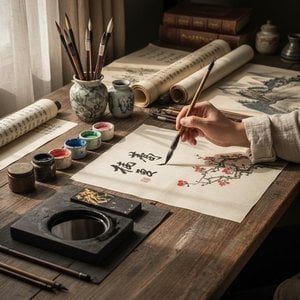
Embark on a sophisticated exploration of ink wash painting and Sumi-e. Uncover the profound historical lineages, Zen philosophies, and technical mastery behind this timeless medium in our authoritative guide for fine art enthusiasts.

Explore the profound beauty of Japanese Ukiyo-e art. Discover the legacy of Hokusai and the Utagawa school through an expert exploration of Edo-period aesthetics, seasonal motifs, and the enduring global influence of Japan's 'Floating World' on fine art history.

Explore the ephemeral beauty of Japanese Ukiyo-e art. From the dynamic warriors of Kuniyoshi to serene landscapes, discover the profound history, masterful techniques, and global influence of these iconic woodblock prints in our deep cultural retrospective.

Explore the profound beauty of Japanese landscape painting. From Hokusai's iconic vistas to Zen-inspired compositions, discover the spiritual depth and historical mastery of Ukiyo-e art in this expert cultural retrospective.


 效果预览
效果预览
 购买手绘画作
 分享
分享 分享
分享
 详情
详情

 下载
下载
 相似作品
相似作品 X射线
X射线 幻灯片播放
幻灯片播放


 展开详情
展开详情






































 玻璃选项仅适用于110厘米以下的尺寸。


